

LIFE IN ISRAEL
Textile Industry
Thriving
Haifa, Israel — Israel's
fashion and textile industry
is alive and thriving, with
1985 exports reaching $350
million, and total sales in ex-
cess of $1 billion.
Employing 55,000 workers
(17 percent of the country's
work force), the industry's
over 100 local enterprises
produce everything from
swimwear to upholstery fab-
rics. The sector encompasses
large, vertically integrated
conglomerates such as Polgat
(whose exports in 1985 were
just under $100 million),
medium-sized concerns, and
smaller, family-owned and
operated firms. All aspects of
the trade are represented,
from the growing and har-
vesting of cotton and the
processing of raw fibers to
the spinning of threads and
yarns, dying and weaving,
and the final stages of pro-
ducing finished textiles and
apparel.
Among the first industries
to be established in Israel,
the textile enterprises were
conceived to absorb the flood
of new immigrants into the
work force. The principles of
cutting, sewing and assembl-
ing were easily communi-
cated via demonstration, thus
allowing thousands of immig-
rants from diverse back-
grounds to be- smoothly inte-
grated into existing factories
with little need for in-depth
language and technical train-
i ng.
In the 1950's and 1960's,
textiles remained a small in-
dustry totally dependent on
local cotton for spinning and
weaving. Its primary func-
tions were to provide jobs and
secondarily, supply the mod-
est demands of a not very
fashion-conscious market.
By the end of the 1960's,
however, the reality of
competition and the potential
for developing a genuine_ local
industry became clear. Eco-
nomically, Israel could not
compete with the textile in-
dustries of the Far East, with
their large pool of cheap
labor and mass-production
techniques. Instead, Israel's
textile sector underwent a
dramatic change, concentrat-
ing on the design and im-
plementation of technologi-
cally advanced equipment,
and emphasizing quality
rather than quantity.
Jewish Chair
Created At
Washington Univ.
St. Louis (JTA) — Prof.
Marc Saperstein, a Reform
rabbi and scholar of Jewish
preaching in the Middle Ages,
is the first occupant of newly
endowed Gloria M. Goldstein
Professor of Jewish History
Chair at Washington Univer-
sity here.
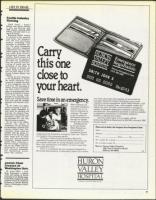
Save time in an emergency.
When someone you
love needs emergency
medical care, it's no
time for indecision or
confusion. You need
to get the patient to
the hospital quickly and
through the registra-
tion process smoothly.
Families served
by the new Huron
Valley Hospital can
now prepare for
emergencies by pre-
registering at the hospital for emergency room care. There is
no charge for this community service.
The Huron Valley Hospital Emergency Room Pre-
registration Program puts important patient information into
the hospital's data bank for use by emergency room staff.
Morn, dad, grandparents and children can each receive their
own registration card.
There is no substitute for your community hospital in a
life-threatening emergency. Freestanding Urgent Care centers,
even those associated with hospitals; do not provide the
overnight, Advanced Cardiac Life Support care so often
required in serious emergencies. Huron Valley Hospital, a 153
bed, full-service hospital, does—with complete cardiac and
critical care units; full radio communications to emergency
vehicles; a helicopter landing port; emergency-trained nurses
and physicians. And additional specialists on staff are available
to respond to emergencies in orthopedics, pediatrics,
obstetrics, radiology and surgery.
Clip the coupon below or if you prefer, call the
Community Relations Department at 360-3300, extension 3450
for your packet.
Please send my family a free Emergency Room Preregistration Packet. 7
Name
Address
City
State
Zip
No. of adults 18- in family
No. of children (under 18)
Mail to: Huron Valley Hospital
1601 East Commerce Road
Milford, MI 48042
JNJ
HURON
VALLEY
HOSPITAL
A Member of The Detroit Medico! Center
57