
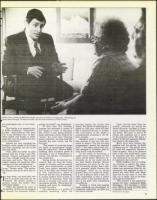

Rabbi Levine of Hebrew Memorial Chapel consults on funeral arrangements: "The feeling of
purity comes through. We treat the body with the same holiness as a Sefer Torah."
the psychologists say, is very impor-
tant."
This finality is an essential part
of Rabbi Goldberg's "integration"
process. "Non-tradition has gone
over to the Christian way," he says.
"That (death and burial) is some-
thing that can't be accepted and has
to be `cosmeticized.' "
Prayers are said, including the
Kaddish, which speaks of the living
and God's greatness, but not of the
dead and death.
"Now, after the burial we start
dealing with the living," says Hoc-
hheiser. Funeral participants form
two lines, through which the mour-
ners pass, and recite: "May the Al-
mighty comfort you among the other
mourners for Zion and Jerusalem."
We put all our emphasis on the
living," Techner notes. The service,
the prayers, they're all about the liv-
ing."
getting the bends?" says Hochheiser.
To deal with this problem,
Judaism has developed a system of
four stages, or levels, of mourning.
The aninut is the period between
death and burial; shivah, Hebrew for
"seven," the seven days following
burial; sheloshim, the time until the
thirtieth day after burial; and the
first year.
"The process of mourning shows
the depth of psychological insight
that the rabbis had," observes Rabbi
Goldberg. Each successive period of
mourning is one of diminishing in-
tensity and further reintegration
into normal life.
During shivah, the mourner cus-
tomarily does not leave the house,
engage in business, perform manual
labor, greet acquaintances or study
Torah, save certain sorrowful por-
tions of the Bible and Talmud such
as Job, Lamentations, parts of
Jeremiah and the laws of mourning.
n deep water, one must take care
A minyan gathers daily to pray in
not to go down and come up too
the house of mourning. Even the
quickly. The drastic change in
shivah is divided into more- and
pressure causes "the bends," often
less-Intense periods; ."Three .days for
'-, 7 ': ' .'•' , -' ._-.: _
with lethal--results:
weeping and seven for lamenting,'
- ""Aftelil the fkInerale'Ve come to.., declared the rabbis.
the, aiiiegtiOn of -how-, are we -going: to
The, sheloshim, s a _period of
?get through the mourning without
modified mourning, when the
I
.
mourner begins his return into
society. The period of mourning for a
parent is a full year, while the Kad-
dish is said daily for only 11 months.
The anniversary of the death is
commemorated according to the He-
brew calendar.
Excessive grief is discouraged.
God declares to the one who con-
tinues to mourn: "You are not more
compassionate toward the departed
than I." The rabbis stated that who-
ever indulged in excessive grief fi-
nally had to weep for another.
In the house of mourning, a
candle burns continuously for the
entire shivah period. Mourners tra-
ditionally sit on low stools and do
not wear leather footwear. Several
explanations are given for the cus-
tom of covering mirrors: that a mir-
ror's presence might distract the
worshipper while he is saying
prayers; that, as a symbol of vanity,
it is out of place at such a time. An-
other explanation is that a mirror
could reveal to the mourner the ex-
tent of his grief, thus intensifying
his suffering.. ,
Dressing in black and wearing,
black armbands are discouraged by
traditional .authorities, as „these are
not Jewish customs.
Upon arriving home from the
funeral, mourners are served the
Seudat Havra'ah, the Meal of Conso-
lation, consisting of hard boiled eggs
and bread. The meal is served by
friends and neighbors and is eaten
by the mourners alone. The egg is a
symbol of life and messianic redemp-
tion; bread is the staple food.
Many Jews have become dis-
satisfied with the shivah. As Rabbi
Goldberg puts it: "The shivah house
for some has • essentially become a
house of party." This is an aberrant
form of the roles traditionally taken
by mourners and their comforters,
who customarily do not speak except
in response to the mourners.
Rabbi Goldberg cites an analog-
ous situation to explain this appar-
ently awkward custom: "When Ab-
raham was recovering (from his cir-
cumcision), God appeared to him. It
doesn't say what (God) said. Rashi
says that he just came to visit the
sick, not to speak. Just to be there,
not to get his mind off it."
"The mourner is not supposed to
become, the host," „emphasizes Raktii
Schrllip- ii:er. tbeCoinel,a0OCtiii
hour, Think" in liand..: ,Ort; yieK-9.0p
`od"
to partake or the fo.-
-
r•-
- -
acilmk
Continued on next page
17