
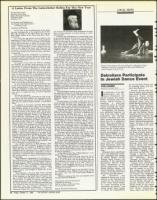

A Letter From The Lubavitcher Rebbe For The New Year
LOCAL NEWS
By the Grace of G-d
2nd Day of the Week
Sedra: Nitzavim-Vayelech
Chai Elul, 5746
Brooklyn, N.Y.
To the Sons and Daughters of
Our People Israel, Everywhere-
G-d bless you all!
Greeting and Blessing:
At this time, in the concluding days of the outgo-
ing year, and especially on the auspicious day of Chai
Elul, the birthday of the Baal Shem Tov and the
Alter Rebbe, author of the Tanya and (Ray's) Shul-
chan Aruch.
It is surely the appropriate time to reflect on the
significance of Rosh Hashono, may it bring goodness
and blessing to all of us in the midst of our Jewish
people; and, particularly, to reflect on the main point
of Rosh Hashono as the day of the "Coronation of the
King" — the "Coronation" of the Creator of the uni-
verse as the "King of the Jews" and "King over all
the earth," the King and absolute Master of Jews and
of the whole world, and of each and every individual
in particular —
The meaning of this "Coronation" is, of course, to
accept upon oneself willingly HaShem's Kingship, and
to submit oneself wholeheartedly to the "yoke" of His
Kingship concomitantly with the "yoke" of the King's
commandments.
All aspects of the Torah and Mitzvos, including
the Festivals, are infinite, being connected with the
true Infinite (En. Sof), blessed be He; moreover, each
Festival has a boundless abundance of aspects, both
such that are common to all Festivals, as, for exam-
ple, the prohibition of work, the aspects of Kedusha
(holiness), Simcha (rejoicing), etc., as well as such as-
pects in which each Yom Tov is distinguished from all
others, as, for example, the particular Mitzvo of the
day of the Festival of Matzos, is the Mitzvo of eating
Matzah, and so forth; and also in other details, such
as the occurrence of the Festival in the days of the
week, or on the day of Shabbos, and so forth.
In view of the above, one has to concentrate only
on one or two aspects and their teachings in regard to
actual implementation, since "The essential thing is
the deed." Therefore, we shall dwell on one aspect in
which Rosh Hashono is distinct from all other Festi-
vals, and in a conspicuous way, as will be explained
later on.
By way of a foreword:
As is- well known, the Festivals (as well as sol-
emn days), and also Shabbos, are designated in the
Torah as "Holy Convocations" and under this category
they all have certain common aspects, as mentioned
above.
In addition to the above, all these festive days
have another common feature: They are all connected
with cardinal events in the history of our Jewish
people; events that took place in a supernatural way,
as well as events in the natural order. Yet this fea-
ture in itself provides each of the three Pilgrim Festi-
vals its specific character: Pesach is the Festival of
Yetzias-Metzraim (Deliverance from Egyptian Bon-
dage), and at the same time is also the "Spring Festi-
val"; Shovuos is the Festival of Mattan Torah (Giving
the Torah at Mt. Sinai), and at the same time the
"Harvest Festival"; Succos — reminding us of the
Clouds of Glory that protected the Children of Israel
in the Wilderness and of the special benevolent Di-
vine Providence that HaShem shows our Jewish
people — is also the "Festival of Ingathering"; Yom
Kippur is connected with the Giving of the Second
Tablets — and is a day of Teshuvo — in regard to the
every day life and conduct throughout the year, which
HaShem designated as a day of "forgiveness" (and)
"according to your words." And even Shabbos, the ori-
gin of which is Shabbos-Bereishis (the Shabbos of
Creation), is both a "Memorial to the Creation" and
also a "Memorial to Yetzias-Mitzraim."
One notable exception is Rosh Hashono. Rosh
Hashono is not only a festival of Jews, but also a
Jewish festival (in response to HaShem's request),
"Make Me King over you"), but at the same time, it
seemingly has no connection with a special event in
the life of our Jewish people in particular, nor has it
apparently a connection with a supernatural miracle,
but, on the contrary, is related to the Creation of the
natural order.
Rosh Hashono is designated as Yom Hazikoron —
Day of Remembrance. The meaning of this Remembr-
ance Day is, as we express it in the Mussaf Prayer of
the Rosh Hashono: "This is the day which is the be-
ginning of Your work, a remembrance of the first day;
indeed, it is a decree for Israel ... (and on which
judgment) is pronounced concerning countries . . . and
on it creatures are brought to Mind (for Divine
judgement)."
Rosh Hashono is the day when Adam, the first
man, was created. And although Man was created last
of all creatures, on the Sixth Day of Creation, this
day is termed "The beginning of Your work," because
"Final action is rooted in original thought"; the
human being was the end purpose and "intention" of
the entire Creation, and all creatures preceding him
were created in order to serve this "chosen one of all
creatures," since only through humankind is the
entire Creation brought to perfectness — all previous
creatures, namely the worlas of minerals, vegetaoles
18
Friday, October 17, 1986
and animals are elevated to their perfectness (through
their serving mankind and thus sharing in man's
achievements).
However, the perfectness of a created being, even
if this created being is the first man, the "creature of
HaShem's own Hands," cannot be completely perfect.
Hence, on the same day of his creation, the first man
called upon "all the creatures," the entire created or-
der: "Come let us worship, bow down and bend our
knee before HaShem, our Maker." And this actually
took place, so that the same day saw the realization of
"HaShem reigns ... the world is established and it
shall not fall." — That was when the perfectness of
the first man and of the whole creation was achieved.
To return to the beginning of this letter.
It has already been mentioned before, and dis-
cussed at greater length on various occasions, that the
meaning of the "Coronation" of the "King" is to renew
and strengthen each year at the beginning (Rosh –
"head") of the year, our commitment to HaShem, to
carry out His commandment and wish: "Make Me
King over you." This provides - the connection, as well
as the source from which Jews, collectively and indi-
vidually, draw renewed strength and inspiration to
declare every day, immediately upon rising in the
morning:. "I give thanks to You, 0 King," and
acknowledging scores of times each day, in the
blessings which we recite in the everyday life, in
blessings recited before the fulfillment of other
Mitzvos — "Our G-d, King of the world."
"All that HaShem created in this world, He
created only for His own Glory," (to proclaim His
glory in the world). "To make this world an abode for
HaShem" is the duty of every Jew, and as we say at
the beginning of the prayers: "Offer praise to the L-rd,
proclaim His Name; make His deeds known among the
nations."
So Rosh Hashono teaches us that we must, first of
all, make Him King over us, King of the Jews, but it
must be followed up by prayer and effort to make His
Kingship known in all the world, and pray to
HaShem: "Reign over the entire world in Your
Glory." .
To end purpose of Creation is that (not only we
Jews, but also) the whole world, all mankind, all chil-
dren of Adam, the first man, indeed, the whole of
Creation, nature itself, should acknowledge that the
Creator of the world is the "King of all the earth."
Although the fullest perfection will be realized
only at the "End of Days," when there will be the ful-
fillment of the Prophecy, "The Glory of HaShem will
be revealed and all flesh shall see" — in "a manner
that not only the eyes of the intellect, but also the
physical eyes will perceive the presence of HaShem;
nevertheless, this must be preceded by the realization
of the purpose of human existence, namely, "I was
created for the purpose of serving my Creator,"
through our actions and service including also in
terms of the surrounding world, to the fullest extent
or one's ability. And "Our actions and service during
the period of the Golus" is also a prelude to the End
of Days, to the complete and perfect Geulo.
Everyone, man and woman, is duty bound to help
promote the world (especially the society and
environment in which one lives) to the Kingdom of
HaShem — by showing a shining example, and also
by words and actions in a direct manner.
To put it more simply: Everyone is duty bound to
disseminate the acknowledgment and awareness of
that which is "The foundations of foundations and the
pillar of wisdoms," that there is a Creator and Master
of this world, and that each year, on the day that we
Jews celebrate Rosh Hashono, is the Day of Judgment
for us, for all nations and countries, and for each in-
dividual in particular —
In the spirit of the "Day of Remembrance," in its
fullest scope, as mentioned above.
May HaShem grant that each and every one of
us, in the midst of all our Jewish people, should be
active in all the above, and we should very soon see
the fulfillment of the prayer in the Tehilim (book of
Psalms) of David, King of the Jews: "Show us,
HaShem, Your kindness and give us Your deliv-
erance" (with the fulfillment of) "making us dwell re-
spectfully in our land."
And we should all merit to see the fullest Corona-
tion of HaShem, when "HaShem will be King over all
the Earth" and "All will acknowledge HaShem's
Kingship."
With the coming of the true and complete Geulo
through Moshiach Tzidkeinu.
With esteem and with blessing for
Hatzlocho in all above,
And for a Kesivo vaChasimo Tovo,
For a Good and sweet year,
Signed: Menachem Schneerson.
THE DETROIT JEWISH NEWS
Ze'eva Cohen dances the role of Sarah in Margalit Oved's
"Mothers of Israel," performed at the recent Festival of
Jewish Dance in New York.
Detroiters Participate
In Jewish Dance Event
PAULA KRAMER
Special to The Jewish News
n observance of its 25th
anniversary, the Na-
tional Foundation for
Jewish Culture has estab-
lished "Creativity and Con-
tinuity: Jewish Culture in
America," a year-long
nationwide array of cultural
events involving the visual,
literary and performing arts.
In September, the Founda-
tion gathered together in
New York more than 1,000
performers and choreog-
raphers, teachers and stu-
dents, writers, historians and
dance fans for a conference
titled "Jews and Judaism in
Dance: Celebrations and Re-
flections." Luminaries from
Israel and the United States
joined to do informl and
formal presentations at the
92nd Street YMHA and the
Joyce Theater in New York,
recently renovated especially
for dance.
The conference included
more than 25 workshops,
panel discussions, films and
lecture demonstrations, all
this in addition to two con-
certs.
Detroiters had a significant
role at the September confer-
ence. Attending were George
M. (Mike) Zeltzer, Jewish
Welfare board director and
president of the sponsoring
foundation; Harriet Berg,
dance coordinator at the
Jewish Community Center;
Wendy Shifrin, dancer; and
Susan Kirschner, director of
finance at the Eliot Feld Bal-
let and an avid folk dancer.
Ms. Kirschner was
applauded during one of the
sessions as she expressed her
concern for the preservation
of the "early" Israeli dances.
In a paper circulated at the
convention, she stated, "I am
asking Israeli dance leaders
to accept the responsibility
I
for reviving these dances, and
for teaching them with the
spirit they deserve."
Several artists had per-
formed, taught and presented
their works in Detroit. Anna
Sokolow's "Seven Deadly
Sins" was produced at the
Music Hall and Pearl Lang
appeared there with the
famed Martha Graham Dance
Company. Sophie Maslow's
works have been performed
by the Festival Dancers of
the Jewish Community Cen-
ter and the Detroit Dance
Collective; Ze'eva Cohen has
choreographed works for the
Wayne State University
Dance Company and the col-
lective. Dancer/choreographer
Ohad Nararin lived and
studied in Detroit for three
years.
Many films of historic im-
portance were shown includ-
ing those of ethnic groups in
Israel, Chasidic dances, the
early days of the Inbal Com-
pany of Israel and early
European commercial ven-
tures that featured Jewish
dancing. Also shown were
films of dances with Jewish
themes choreographed by
contemporary artists includ-
ing Feld's "Tzaddik," Mas-
low's piece on shetl life, "The
Village I Knew," Lang's
Chasidic parable, "Shira" and
two Holocaust pieces,
"Dreams" by Solokow and
Meredith Monk's "Quarry."
Classes were overflowing
with dancers who were able
to sample movement styles
seen in concert or on film.
The classes were taught by
Maslow, Michael Posnick and
Liz Lerman who integrated
text and movement; Margalit
Oved who, together with her
dance company from Califor-
nia led dancers through re-
pertory phrases from her
dances based on the women
prophets of the Bible; Bar-
bara Sparti, Renaissance
dance expert and Sara Levi-