

0 0:
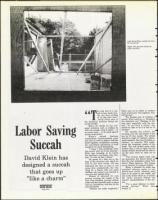
Left: David Klein installs the door
for his succah.
Right: The plywood walls just
slide into place.
•
•
Labor Savin
Succah
David Klein has
designed a succah
that goes up
"like a charm"
DAVID HOLZEL
Staff Writer
he real test of a suc-
cah is how much trou-
ble you have putting
it up the next year,"
David Klein says of
the perennial problem facing the
succah builder.
Klein, 32, thinks he has rele-
gated problems such as ending up
with not enough wood to build — or
too much wood — to the dark ages of
succah construction.
features
succah
Klein's
standardized interchangeable parts
and uses no nails or pegs to hold the
booth together, incidentally avoiding
the unavoidable splintering of wood
caused by too much hammering.
"I knew I had something when
this succah went up in ten minutes,"
Klein says beaming, as he lowers
the dwelling's roof beams onto brac-
kets. It went up like a charm."
He points to a hole cut in the
base of the structure into which he
will fit the door frame. He has
fashioned the door so that it will
swing shut automatically, the very
thing for a family with two small
children who haven't yet learned to
close the door behind them.
Sheets of plywood fit into
grooves running the length of the
base. Free standing, grooved vertical
posts hold the plywood walls in place
and are, themselves, held fast by the
plywood sheets.
"Neither one holds completely,"
Klein says as he slides in another
sheet of plywood, but together, they
hold strong."
The hardest part of building a
succah, Klein believes, is "shlepping
the materials out." Building is the
easy part, especially with his sys-
tem. "If you have a helper, you
should be able to do it in ten or 11
minutes."
He spreads the schach, the
covering, over the roof beams of the
ten by 20 foot succah. The schach
should be made of "natural, unproc-
essed material, like tree branches or
bamboo," he explains. This under-
scores the temporary nature of the
booth. The roof should cause more
shadow than it lets in light, but the
succah dweller should still be able to
see the stars when he looks out at
night.
"Our houses might seem like
our protection, but Succot shows us
that the real protection comes from
above," Klein observes. Our houses
are an illusion of a support system."
Klein, a plumber by trade, has
installed running water in two
Detroit-area succot, allowing more
time to be spent in the booth, and
less in the house which is, of course,
the whole purpose behind the
mitzvah (commandment) of the suc-
cah.
"I'm a great believer in labor-
saving devices," Klein says
simply.
❑