
ACTION BLIND
DISTRIBUTORS
"window treatment
at wholesale prices"
Fresh Fish
Specials
BY APPT. ONLY!
SUPERIOR FISH CO. HAS MOVED! I
422-1587
WHOLE WHITEFISH,
LAKE TROUT AND
PICKEREL
Free measure, no Freight,
installation available
You can prevent
mental retardation
Call For Prices
Contact the Association
for Retarded Citizens for
free information.
SUPERIOR FISH CO.
House of Quality
Mon.-Wed. 8-5,
Thurs. & Fri. 8-6
Saturday 8-1
Serving Metropolitan Detroit for Over 40 Years
309 E. 11 Mile Rd., Royal Oak, MI • 541-4632
Parking in rear
Jewish Association for Retarded Citizens
11288 W. 12 Mile Rd., Southfield, MI 48016
(313) 551-7650
rL
Advertising in The Jewish News Gets Results
Place Your Ad Today. Call 354-6060
HeIpbuild tbearc
Association for Retarded Citizens
4 ,4
Sinai Hot Kosher
CORNED BEEF .......•..•.$399
Fresh Green
LEAF LETTUCE
•
Ill
•
•
■
•
II
•
. 39 c
•
lb.
lb.
Extra Large
....5/99c
PEPPERS ...
FRESH
ZUCCHINI
39c lb.
HAVARTI
CHEESE
WE CARRY
BARTON'S
CHOCOLATES
$269 lb.
Fresh
GREEN CABBAGE
•
1
•
10 oz. pkg.
9 c lb.
35c each
GREENFIELD'S NOODLES
3/$ 11
Borden's
LOWFAT or 1/2% MILK ...
All Specials Good Through September 24, 1986
76
Friday, September 19, 1986 THE DETROIT JEWISH NEWS
$
29 gal.
NEWS
Nostalgia At Heart
Of Yiddish Revival
BEN GALLOB
Special to The Jewish News
N
ew York — A profes-
sor of Yiddish studies
warns that the grow-
ing American interest in
Yiddish language and culture
should not be "misinterpreted
as language recovery."
David Gold, co-editor of
Jewish Language Review,
makes his observations in a
recent issue of Sh'ma, citing
two lengthy articles about
Yiddish in the New York
Times. He contends that pro-
gressively fewer Jews use
Yiddish as their everyday
language, except for Hasidim
and other ultra-Orthodox
Jews; that less and less cul-
ture "is being created in Yid-
dish; and ever more of the old
(Yiddish) culture is finding a
haven only in archive and
libraries and on researchers'
desks.
"Yiddish was once the na-
tive, primary and habitual
language of all of Ashkenazic
Jewry," he writes. But, in the
late 18th Century, Yiddish
began to be used less by
Ashkenazim in central
Europe, and, starting in the
19th Century, also less fre-
quently in eastern Europe.
The Holocaust dealt a- sav-
age blow to Yiddish, he ex-
plains. Repression in the
Soviet Union, "Hebraization"
and discouragement in Israel,
and a shift to other lan-
guages almost everywhere in
the 20th century, also "have
taken their toll."
Gold asserts that the so-
called revival of Yiddish —
"limited mostly to North
America" — is simply "the
kindling of a small flame of
curiosity about the language
and its culture, rather than a
significant increase in its
use."
He suggested that lovers of
Yiddish not permit them-
selves to be deluded "into
thinking that a language can
maintain itself in this artifi-
cial fashion."
If Yiddish were healthy, he
contends, it would not be
necessary to collect hundreds
of thousands of Yiddish books
in order to save them from
extinction by indifference or
ignorance.
Gold cites the National
Yiddish Book Center at
Amherst, Mass., for rescuing
about 350,000 Yiddish books
"but it has succeeded in sell-
ing only about 5,000 and
most of these have gone to
libraries at colleges and uni-
versities rather than into
people's homes."
He agrees that the Yiddish
theater "continues to make
itself felt" but the season
"grows shorter over the
years." Moreover, he declares
that this theater "is shunned
by ultra-Orthodox
Ashkenazim — among whom
the language has the only
chance of survival — and
producers must now resort to
more and more translations
or to Yiddish interspersed
with English because they
are playing" to audiences
"who understand little or
nothing of the language."
Gold reports that since the
early 1950s, nearly every Is-
raeli college has introduced
Yiddish studies. He directs
that program at the Univer-
sity of Haifa. But relatively
few students take these
courses and virtually "no
Israeli-born students have
become researchers of Yid-
dish language, literature or
culture, let alone Yiddish
speakers."
In North America, he de-
clares, Yiddish has become a
steadily more popular subject
of study at colleges, "so much
To survive,
Yiddish must be
withdrawn from
the modern world
or become the
language of a
political entity.
so that we Israeli teachers, to
tell the truth, look enviously
on what is happening on
American and Canadian
campuses today."
Why? Gold explains that
"most Ashkenazi students in
North American are the
grandchildren, if not the
great-grandchildren of
Yiddish-speaking immigrants
— hence their interest in
Yiddish is largely nostalgic
or antiquarian; whereas most
Ashkenazi students in Israel
today are the children of im-
migrants — hence it is too
early" in Israel "for nostalgia
or antiquarianism."
Gold contends that to be
sustained now, Yiddish must
either be withdrawn from the
modern world or "become the
official language of a political
entity," which Gold called a
"chimeric expectation."
Copyright 1986, Jewish Tele-
graphic Agency
Leaflets Pledge
Retaliation
Paris (JTA) — Leaflets have
appeared here following the
massacre of 21 Jews in the Is-
tanbul synagogue, purporting
to be from a Jewish terrorist
underground. According to a
report in the French daily Le
Quotidien de Paris, the fliers,
inscribed Terror Neged Terror
(Hebrew for "Terror Against
Terror"), appeared Sept. 8 fol-
lowing the carnage in the Tur-
kish capital.
The fliers, depicted in the
newspaper, read, "Following
the attack in Istanbul, one re-
sponsible person of the PLO
will be executed within the
week. Long live the armed
fight for the Jews of France!"
(
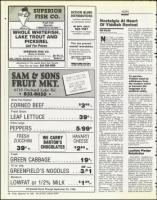
Scanned image of the page. Keyboard directions: use + to zoom in, - to zoom out, arrow keys to pan inside the viewer.
September 19, 1986 - Image 100
- Resource type:
- Text
- Publication:
- The Detroit Jewish News, 1986-09-19
Disclaimer: Computer generated plain text may have errors. Read more about this.