
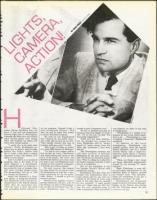

ollywood film-
maker Steven Spielberg may not
know it, but he's got competition
brewing right here in Birmingham.
Although the films have not reached
major market status, their creator
hopes that someday his efforts will
attain mass market appeal.
"I would like to be more com-
mercial," Philip Handleman ex-
plains, but he doesn't want to make
schlock like Porky's. Rather, he'd
like to make a film about a subject
important to him, like politics, civil
rights or social issues.
And it is politics, in a manner of
speaking, that is the focus of his
latest endeavor — a documentary
film entitled Brothers in Congress, a
day-in-the-life look at brothers Sen.
Carl Levin and Rep. Sander Levin.
The documentary will air at 1:30
p.m. Sunday on Channel 9.
Asked why Channel 9, a Cana-
dian station, is airing the documen-
tary, Handleman said it was the un-
receptiveness of the Detroit stations
rather than the equal-time rule.
"Over the years I never had much
luck persuading Detroit stations to
air my programs. Channel 9 had a
more pronounced interest." This
time, he said, he didn't even bother
to contact the Detroit stations.
He said he was disappointed
that Channel 56, the public televi-
sion outlet, did not pick up the film.
They should welcome this type of
program with open arms," he said.
After it airs, he hopes to market
it to other PBS stations in Michigan.
"I've had to have subject matter
that touches my heart," Handleman
said about picking the Levins as the
focus of his project. The Levin and
Handleman families have been close
for many years and Handleman had
worked on their political campaigns.
"I feel like one of them, almost."
He said, however, that despite
the close family ties, he did not want
the documentary to look like a cam-
paign commercial for the two politi-
cians. Rather, "I wanted to give an
accurate portrait."
Because of the logistics of trans-
porting equipment and crew, none of
the filming was done in Washington;
all was done in the Detroit area. Be-
sides, Handleman says, "I just
wanted to give a hometown view."
He has no partners and gets no
financial help from family or inves-
tors. "I'm on my own," he said. "I'm
financially independent."
Profit isn't his main objective,
but the thought has crossed his
mind. Handleman said he "always
hoped to" make money from his
films, and "sometimes I have been
able to."
The Birmingham bachelor has
only been involved in full-time
filmmaking for the past year-and-a-
half. Previously he worked at it part
time. While in college he worked for
the family business and had a brief
stint as a stockbroker.
But, he felt unfulfilled. It Was
his brother David's illness that
sparked the change.
Handleman said that when his
brother was hospitalized after a
heart attack and he saw him at-
tached to all kinds of wires and
tubes it was then that he realized
his own mortality. "I asked myself
what am I doing with my life? Are
they (his work, activities) going to
make a statement? When his answer
was negative, he knew it was time
to change gears.
"Filmmaking is a means of ex-
pression for me, to say what's impor-
tant to me ... Filmmaking is a way
of making a statement," Handleman
exclaimed.
In addition to the Levin
documentary, Handleman has
created another about the Detroit
Public. Libraries, one on a Soviet
Jewish family and a made-for-
television movie about a Vietnam
veteran, which aired nationally over
PBS.
"These are things I don't think
are • being addressed substantially
enough by the existing' TV estab-
lishment."
Roger Winkelman, a trust offi-
cer and estate administrator for the
National Bank of Detroit, praised
his friend's work. "The documen-
taries are worthwhile if you get a
chance to view them," he said.
Handleman's yet unreleased
project is Detroit Christmas Montage,
footage of the Detroit area during
the last Christmas season. He said
Continued on next page
23