

22 Friday, June 13, 1986
THE DETROIT JEWISH NEWS
*LIBERTY
ost people who know
Emma Lazarus' name
think of her as the
woman who wrote
the lines enscribed
on the base of the
Statue of Liberty.
Those who know she was a -jew
seldom realize she was a Zionist in
the 1880s and an outspoken defender
of her people everywhere. Her story
— and its subsequent suppression —
affords a fascinating glimpse of the
interest that Ralph Waldo Emerson's
generation of Protestant intellectuals
had in Emma's Judaism — and the
speed with which their interest in
Judaism became the next generation's
anti-Semitism.
Emma, born in 1849, grew up in
the aristocratic world of the Sephard-
ic elite. It was a time when it was
possible to be a committed Jew and a
member of New York's high society.
For example, her cousin, Benjamin
Nathan, a sabbath observer whose
home was kosher, was also vice-
president of the New York Stock Ex-
change and belonged to the exclusive
Union Club. Her uncle J.J. Lyons was
rabbi of New York's Shearith Israel, a
Spanish Portuguese synagogue. Her
father, Moses Lazarus, a wealthy sugar
manufacturer and a member of the
synagogue board, owned a summer
home in Newport, Rhode Island.
There, he was as apt to entertain
Ralph Waldo Emerson or William
James as he was to invite over his
brother-in-law, the rabbi.
Moses Lazarus lavished more atten-
tion on Emma, his most gifted child,
than on his other five daughters or
his son. Taught by private tutors, she
learned Italian, French, German and
Spanish by the time she was 15. She
translated Alexander Dumas, Victor
Hugo and Heinrich Heine into
English. She composed her own
verse.
When Emma was 18, her father
paid for her work to be published in
book form. Copies were sent to
William Cullen Bryant and Ralph
Waldo Emerson. At the home of a
mutual friend, Emma met Emerson,
whom she captivated with her in-
telligence and personality. Soon,
Emerson volunteered to be her "pro-
fessor." Emerson took his job serious-
ly. By the mid-1870s, he was criticiz-
ing as much of her poetry as he was
praising. She was particularly dis-
turbed when he said her epic poems
— fashioned after Greek and Italian
models — were derivative and flat.
In his book, Genius and Other
Essays, the banker, writer and editor
Edmund Stedman, who lived next
Paul Cowan is a contributing editor of
The Village Voice and the author of
An Orphan In History."
-
PROMISE*
The Poet
of the Huddled
Masses
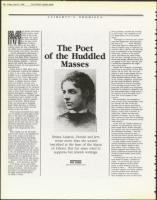
Emma Lazarus, Zionist and Jew,
wrote more than the sonnet
inscribed at the base of the Statue
of Liberty. But her sister tried to
suppress her Jewish writings.
PAUL COWAN
Special to The Jewish News
door to Emma, recalled the evening
in 1879 when "she confided in me
her despondency as to her poetic
work."
"Although no American poet of her
years had displayed a more_genuine
gift than hers . . . ," wrote Stedman,
"[she] had added no distinctive ele-
ment to English song. It suddenly oc-
curred to me to ask her why she had
been so indifferent to the advantage
which she, a Jewess of the purest
stock, held above any other writer.
She said that, although proud of her
blood and lineage, Hebrew ideals did
not appeal to her. But I told her that
I envied the inspiration she might
derive from them."
Despite her complaint to Stedman,
Emma was at the center of New York
literary life by 1879. She was com-
pletely at ease in the elegant old car-
riage house just off Union Square
where Richard Watson Gilder, editor
of the Century Magazine, invited peo-
ple like Sarah Bernhardt, William
Dean Howells or Grover Cleveland
for an evening of good music and
good talk. Her poetry was frequently
published in Lippincott Magazine and
her increasingly spare, biting essays —
far superior to her brocaded verse —
were one of the staples of The
Century.
Her personality and intelligence
seem to have been extraordinary since
her friends, the elite of the age,
describe her in almost awed tones.
Mrs. Constance Burton Harrison, for
instance, a descendent of Thomas Jef-
ferson, a writer and a socialite, re-
called that "Emma was the most
feminine of women, but her inner
spirit seemed to burn like an unfailing
lamp. She could not treat [even trivia]
with banality."
In her late 20s, Emma's interest in
Judaism was intensifying. When she
read George Eliot's Daniel Deronda,
for instance, she was so captivated by
this Christian's Zionism — and her
loving attitude toward the Jews —
that she put Eliot's picture above her
writing desk and dedicated her most
passionate Jewish writings to her.
In 1881, Rabbi Gustav Gottheil of
Temple Emmanuel took Emma on her
first visit to Ward's Island in New
York harbor. There, refugees from
Russian pogroms were living in the
hastily constructed barracks that the
German Jewish banker Jacob Schiff
had financed.
"Leaning upon my arm, she went
from house to house," Gottheil re-
called. "It was Purim day and the
wretched fugitives tried to make
merry as their religious duty pre-
scribed to them . . . Men and women
crouched together with little children
crowded around them. Beautiful
women chatted or sat in corners,
their thoughts far away of dear ones