
25
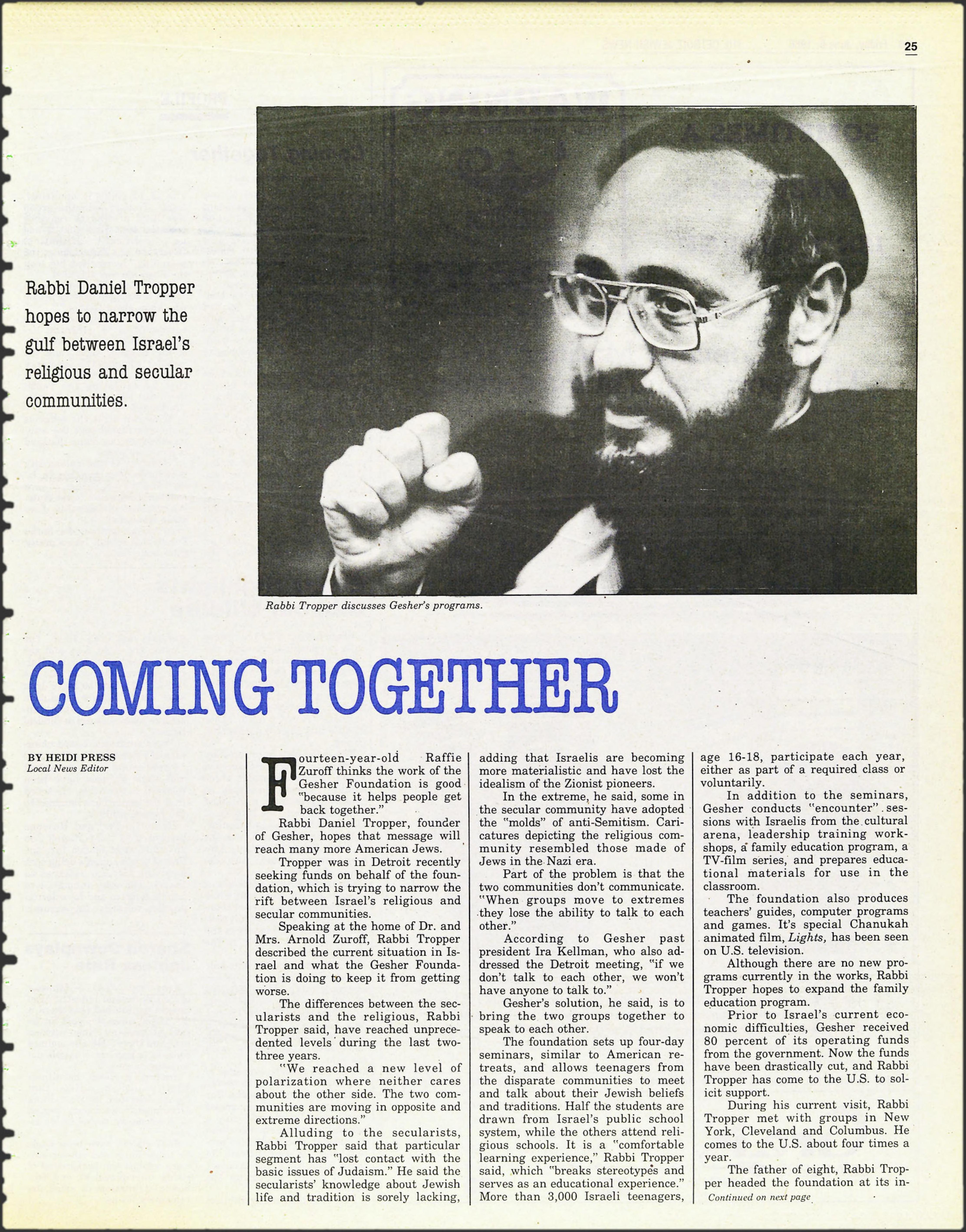
Rabbi Daniel Tropper
hopes to narrow the
gulf between Israel's
religious and secular
communities.
■
Rabbi Tropper discusses Gesher's programs.
COMING TOGETHER
F
BY HEIDI PRESS
Local News Editor
>-
Raffie
ourteen-year-old
Zuroff thinks the work of the
Gesher Foundation is good
"because it helps people get
back together."
Rabbi Daniel Tropper, founder
of Gesher, hopes that message will
reach many more American Jews.
Tropper was in Detroit recently
seeking funds on behalf of the foun-
dation, which is trying to narrow the
rift between Israel's religious and
secular communities.
Speaking at the home of Dr. and
Mrs. Arnold Zuroff, Rabbi Tropper
described the current situation in Is-
rael and what the Gesher Founda-
tion is doing to keep it from getting
worse.
The differences between the sec-
ularists and the religious, Rabbi
Tropper said, have reached unprece-
dented levels ' during the last two-
three years.
"We reached a new level of
polarization where neither cares
about the other side. The two corn-
munities are moving in opposite and
extreme directions."
Alluding to the secularists,
Rabbi Tropper said that particular
segment has "lost contact with the
basic issues of Judaism." He said the
secularists' knowledge about Jewish
life and tradition is sorely lacking,
adding that Israelis are becoming
more materialistic and have lost the
idealism of the Zionist pioneers.
In the extreme, he said, some in
the secular community have adopted
the "molds" of anti-Semitism. Cari-
catures depicting the religious com-
munity resembled those made of
Jews in the. Nazi era.
Part of the problem is that the
two communities don't communicate.
When groups move to extremes
they lose the ability to talk to each
other."
According to Gesher past
president Ira Keilman, who also ad-
dressed the Detroit meeting, if we
don't talk to each other, we won't
have anyone to talk to."
Gesher's solution, he said, is to
bring the two groups together to
speak to each other.
The foundation sets up four-day
seminars, similar to American re-
treats, and allows teenagers from
the disparate communities to meet
and talk about their Jewish beliefs
and traditions. Half the students are
drawn from Israel's public school
system, while the others attend reli-
gious schools. It is a "comfortable
learning experience," Rabbi Tropper
said, which "breaks stereotypes and
serves as an educational experience."
More than 3,000 Israeli teenagers,
age 16-18, participate each year,
either as part of a required class or
voluntarily.
In addition to the seminars,
Gesher conducts "encounter" . ses-
sions with Israelis from the cultural
arena, leadership training work-
shops, a family education program, a
TV-film series, and prepares educa-
tional materials for use in the
classroom.
The foundation also produces
teachers' guides, computer programs
and games. It's special Chanukah
animated film, Lights, has been seen
on U.S. television.
Although there are no new pro-
grams currently in the works, Rabbi
Tropper hopes to expand the family
education program.
Prior to Israel's current eco-
nomic difficulties, Gesher received
80 percent of its operating funds
from the government. Now the funds
have been drastically cut, and Rabbi
Tropper has come to the U.S. to sol-
icit support.
During his current visit, Rabbi
Tropper met with groups in New
York, Cleveland and Columbus. He
comes to the U.S. about four times a
year.
The father of eight, Rabbi Trop-
per headed the foundation at its in-
Continued on next page