

26 Friday, April 18, 1986
THE DETROIT JEWISH NEWS
-PASSOVER'%)
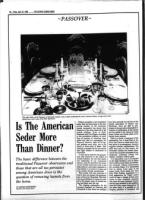
The seder- table, set for Passover, is laid with matzoh, wine, a plate containing the moror, haroset, karpas, an egg and a lamb
shank bone, and a copy of the Four Questions.
Is The American
Seder More
Than Dinner?
The basic difference between the
traditional Passover observance and
those that are all too pervasive
among American Jews is the
question of removing hametz from
the home.
BY ARTHUR HERTZBERG
Special to The Jewish NewS
' Without exception, every statistical
study that has been done in the last
several decades of the American
Jewish community has shown that
Passover is the most observed of all
Jewish holidays. Even on Rosh
Hashanah and Yom Kippur, according
to the cumulative evidence, no more
than 60 percent. of American Jews
spend any time in a synagogue. On
Passover, however, eight out of ten,
and perhaps even more, are to b e
found at some kind of Seder. This
statistic is equaled only by the number
who light candles in celebration of
Chanukah.
A case can be made for the proposi-
tion that Passover is the oldest of
Jewish holidays, the one that marks
the beginning of our communal
history, and that therefore the choice
of not terribly observant Jews in the
20th century to put major emphasis on
this holiday is a re-echo of a deep and
very ancient Jewish commitment.
The trouble with this argument is
that it does not explain the equal pas-
sion of Jews for Chanukah. This holi-
day is post-biblical; it cannot be rank-
ed in the 'classic order of Jewish car-
ing anywhere near the top.
The reigning explanation for the
unusual emphasis on Passover and
Chanukah is that these two holidays
have been pressed into service as the
Jewish equivalent of Easter and
Christmas. Jews are able to par-
ticipate in the pervasive atmosphere in
America of celebration of the spring
and the middle of the winter by using
those of their own rituals which occur
during those seasons.
This is, no doubt, a large part of the
explanation, but a close look at the
forms that Passover observances have
been given in contemporary America
suggests another consideration. The
seder feast and, for that matter, the
Chanukah candles are Jewish obser-
vances that are prime examples of con-
temporary American Jewish folk
religion: Judaism without guilt.
It is impossible to go to synagogue
on the High .Holidays, even in places
where rabbis preach bland and inoffen-
sive sermons, without encountering
the accusing finger of a demanding
God on almost every' page of • the
prayer book. Even those who limit
their High .Holiday attendance to 'a
brief appearance for Yizkor cannot
avoid at least a twinge of bad cons-
cience as they remember ancestors
who were far more intensely Jewish,
and far more obedient to the tradition,
than the Yizkor sayers themselves. On.
the other hand, it is possible to eat
heaping platefuls of kneidlach and