

30 Friday, April 4, 1986
THE DETROIT JEWISH NEWS
PURELY COMMENTARY
Diaspora Plus Israel
Continued from Page 2
sacrifice. But then what is at
stake?. Is it our conviction that,
without a powerful Diaspora,
conscious of its duties, Israel '
would undergo more dangerous
ordeals because of her isolation
among nations?
Logical reasoning and not
without merit: just as the Dias-
pora of our days could not live
without Israel, Israel would not
be Israel without the Diaspora. Is
that the only motivation? I know
nothing about it. I know only
that I belong, equally, to both of
them. Both communities have
claims on me. Both have the right
to exist and expand.
The propagandists and
ideologues who preach "negation
— or the liquidation — of the
Diaspora" have a pessimistic
conception of history. The term
"liquidation" horrifies me. In my
opinion, there is a place, in
Jewish destiny, for both large
. communities; there has always
been one. It is their mutual duty
to enrich each other, to assist
each other by the interrogation
that each symbolizes for the
• other.
There is also the general question
involving the chassidim and the Baal
Shem as well, and that relates to current
experiences. A series of articles in the
American Jewish World of Minneapolis,
Minn., by Rabbi Marc Liebhaber com-
mences with one entitled "The Rebbe is
Misguided." It was written from
Jerusalem and is a comment on "the Re-
bbe" Menachem M. Schneerson" who
"sits in Crown Heights in Brooklyn"and
fails to come to Israel.
While these accusatory reports from
Jerusalem have significance, it is the
vaster subject to which it serves as an
introduction. What about the Chassidim
as an important element in relation to
Israel? There are many of them in the
Holy Land. But what about the initiator
of the Chassidic movement, the Baal
Shem Tov? Hillel Halkin, one of the
most prominent Hebrew writers, in the
essay "The Baal Shem Tov and th Flam-
ing Sword" writes in Diaspora:
For it, Jews yearned for cen-
turies, endlessly recounting its
virtues, lauding its holiness,
praying for their triumphant re-
turn .to it on the day of their re-
demption, which would be the fi-
nal, irrefutable proof that they
were indeed God's Chosen
People and that 'their long,
humiliating absence from the
land had not been in vain. In-
deed, the longer their exile
lasted, the further they wandered
from Israel, and the more remote
their memories of it grew, the
more paradisiacal a place it
seemed to them — a land in
which no miracle was impossible
and • every wonder was to be
found. Little by little it ceased to
be a real, tangible country, a
land of ordinary hills and valleys,'
stones and earth, and it trans-
formed itself into a fabulous
dream in which the grief of loss
and the promise of restoration
mingled indiscriminately., For
hundreds of years this dream_
sustained the Jew, bestowing
solace on his suffering and hope
on his travail. . •
And to this dreamed-of land
the Ba'al Shem Tov is warned not
to go. But why? What is the
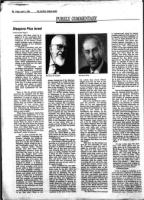
Abraham Karp
Mordeccii M. Kaplan
danger facing him if he disobeys
the warning? Is it really because .
the divine will has decreed that
no Jews shall enter it until the
time of the Messiah? Yet nowhere
in Jewish tradition is such a
thing ever suggested; on the con-
trary, for all the notable failure
to implement it, the command-
ment of 'yishuv Bretz Yisrael — of
resettling the Land of Israel — is
repeatedly stressed. Is it because
Yehuda he-Hasid and his follow-
ers have tainted this command-
ment with the sin of the false
Messiah, which threatens to in-
fect the Ba'al Shem too? Al-
though he may have conceivably
been inspired by the heretics'
example, the Ba'al Shem cer-
tainly never harbored Sabbatian
tendencies himself, nor was his
plan to settle in the Holy Land
part of any Messianic scheme. It
was, as our story tells us, a
y private decision, made in
purel
isolation and far from the public
eye.
One must make, then, a
different assumption. What
causes the Ba'al Shem to turn
back cannot be his fear of divine
displeasure. It must be his fear of
something else.
Of what, though? The answer
is: of the Land of Israel itself, for
paradise is a human myth, one of
the most haunting; it is an ex-
pression of human longing and
lack, one of the most powerful
ever devised. But it is not a real
place on earth, certainly not such
a place as 18th Century Pales-
tine. Or rather, it can be such a
place only when seen from afar.
One can never return to it, not
because the way is-tarred, but
because as soon as one enters it,
it ceases to exist.
Now, I helleve;ive can inter-
pret our story correctly. At some
point early in his life,
was not yet a public figure and
still. had no disciples, the Ba'al
Shem Tov made up his mind to
settle in the Land of Israel. Per- '
haps the idea was suggested to
him by the aliyah of Yehuda he-
Hasid, or perhaps it sprang di-
rectly from his own great inner
need for an immediate, spon-
taneous relationship with the
elements of Jewish experience,
for piercing the shells of religious
symbols to the core of the reality
,
for which they stood. Others
might pray for an end to the
Exile; he would shake its dust
from his feet; others might dream
of the Promised Land; he would
inhabit it. Such a plan might be
deemed mad by any Jews who
heard of it, but in those days the
Ba'al Shem Tov was not consid-
ered normal by those who knew
him anyway, nor was it his habit
to consult with them.
And so he resolved to under-
take the journey. Yet having
done so, he was immediately
thrown into deep conflict. On the
one hand, his excitement as soon
being in the land of his
forefathers was intense. On the
other hand, the more imminent
the prospect, the greater grew his
fear of what awaited him there.
Suppose that the lost paradise of
the Promised Land should turn
out to be an ordinary land like
any other? Suppose that its hills
and valleys, stones and earth,
were only hills and valleys,
stones and earth? Suppose that
he was unable to experience
them as anything else? Beautiful
sights and natural splendors
there would be there, of course,
but the Carpathians had these
too. Suppose that• there was noth-
ing more?
This then was the danger: not
that he was unworthy to enter
the Promised Land, but that it
might be unworthy of its prom-
ise. And if it was, what would
happen to the entire structure of
Jewish belief that rested on that
promise? If the Holy Land itself
Was merely a symbol dreamed in
exile that could not withstand the
encounter with the reality, what
in Jewish life was safe from chal-
lenge? Once begun, where would
the disillusionment • end? (It is
surely no accident that, in tte
linked story of the transmogrified
talmudic scholar, we are told that
the latter was originally a pious
Jew who carelessly committed
one sin which inexorably led to
'another and another until he had
violated practiclly the whole To-
rah. He stands, in other words,
for the fear of such a concatena-
tion in the Ba'al Shem's own
mind, from which he can exorcise
himself only once' he has aban-
doned his plan.)
The Ba'al Shem Tov's turmoil
is underground, since he cannot
possibly admit the full extent of it
to himself. And then suddenly, as
the bog of doubt deepens, he re-
verses himself. The Jews who
counsel against returning to the
Land of Israel are right; it is too
dangerous. The conventional
wisdom of the ages against which
he has rebelled is now realized to
be, in an unconscious flash of in-
sight, far wiser than he has
thought. The Jews who for cen-
turies dreamed of the Holy Land,
yearned for the Holy Land,
grieved for the Holy Land, yet
made no attempt to live in the
Holy Land, knew exactly what
they were about. In order to pro-
tect its holiness, in order to pro-
tect oneself as a Jew, one must
y a thief
never set foot in it. Onl
may do so with impunity, per-
haps because he is so spiritually
gross that he has no expectations
to be shattered; perhaps because
he is not even a Jew. But the
Ba'al Shem Tov is not a thief.
And a flaming sword that turns
every which way bars his path. It
is a divine sign to him not to go
on.
And so he remains in exile. In
time he emerges from his conce-
alment; he gathers disciples
around him; his fame as a seer
and' worker of wonders spreads
far and wide; he becomes the
founder of one of the great
spiritual movements in Jewish
history. And long afterwards he
tells his followers how once,
when he was young and un-
encumbered, he nearly set out for
the Holy Land but turned back at
the very last minute. They pon-
der the meaning of this tale. Was •
our story invented by one of
them out of some deep intuitive
understanding of the crisis that
his master had passed through?
Or did the Ba'al Shem himself tell
it in some form to his students? .
'And if he did, could it have been
in the form of a revelatory dream
that he dreamed and later related
to them, until in the telling and
retelling it became the legend
that appears in the pages of the
Shivhei ha-Besht? The phantasmal
logic of its imagery suggests as
much.
In any event, once the deci-
•sion was made there was no
going back on it. Years later the
Ba'al Shem Tov's brother-in-law,
Rabbi Abraham Gershom of
Kitov, who was then living in
Hebron, wrote to him: "The
learned Jews here beseech me to
write you and urge you to come
live here, but what can I do? I
know your nature ... and I have
despaired of your ever coming to
the Holy Land before the time of
the Messiah, may it be soon."
V'hamevin yavin.
If this is judged as confusing, it cer-
tainly becomes a deterrent to the Halut-
ziut which may not be an estrangement
even for the Ba'al Shem's followers.
Nevertheless, it is part of the drama
called Diaspora versus Israel. In its to-
tality, Diaspora is as challenging as the
issue involved. The more than 20
authors in this volume who. include Is-
rael's architects, Golda Meir, Yitzhak
Rabin and other notables, including
Mordecai Kaplan, add great interest to a
dramatized topic. Perhaps the most
,