

15
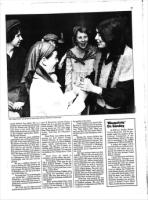
The "Shtetl Tales" cast greets the playwright during rehearsal in Ann Arbor.
of Blueprints actress Nancy
attend Hebrew day school. She re- case
Heusel who is a non-Jew and active
members tales learned in grade school church member. "She told me, 'These
from the Tanach and Chumash and are my stories too. You can't claimn
uses them in her work. She uses them. They speak for me too,' " Urist
themes that struck her as a child, such recalls. "And they are everyone's
as the childless matriarchs, Sarah,
stories."
Rachel and Hannah.
Shtetl Tales was written on com-
Urist spent two years compiling mission for Ann Arbor's Young
information and writing Blueprints. People's Theater. It was originally
She calls it her most ambitious work.
meant to be a part of a series of ethnic
The theme of the play is sacrifice, the
plays, which unfortunately fell
sacrifices parents make for their chil-
through. The play has 12 actors, in-
dren and the way parents sacrifice
cluding eight children, and has six
their children. She says it is a theme
tales and assorted jokes. It is not just
that goes across religious and cultural
for children, but a "family show," Urist
lines. But there are other themes, too
— about the Holocaust and problems said. Shtetl Tales are meant to
in contemporary Israel. Each theme
entertain, and also inform, she said.
intermingles with the past and the
But the play stops short of lectur-
present.
ing or preaching. Urist says she de-
We see a childless. Hannah. In- spises didactic theater. "I hope the
stead of finding the high priest to aid play gives Jews something to talk ab-
her in having a baby, she approaches a
out. I hope it gives non-Jews some-
gynecologist. We also see a blue tattoo thing to talk about."
on Hannah's arm. But she is the Han-
Its stories are from Yiddish tales,
nah of the Bible too.
including the legendary town of
Or young Isaac. Tired of being the
Chelm. She also uses, stories by I.L.
only Jewish kid — actually the first Peretz, Sholem Aleichem and Hershel
Jewish kid — he complains about hav- Ostropolier.
ing to keep kosher and faces being re-
While writing Shtetl Tales Urist
jected from a summer camp because of
tested possible material on her sons,
Joshua, 10 and Gabrial, 7. She says
his religion.
But Urist says her plays are not her children were a "barometer" for
just for Jewish audiences. She cites the
the quality of the tales.
"I had wanted to use Agnon's The
Kerchief so I told the story to my kids.
When I was done I had goosebumps all.
over. Then Joshua said, 'Mom, you
can't use that. No one's gonna like it.'
So that was it," she remembers with a
smile.
Having two young children has
not hindered her career. "In. fact my
family has allowed me to flourish," she
says. She also cites support from her
husband, a University of Michigan
psychology professor and private
psychiatrist, as an important part of
her work.
Her best writing is done very late
at night. "When I am in the grips of an
idea, it just burns its way out of me,"
she explains. She began writing about
seven years ago, when a friend asked
Althou
her to collaborate on a play.Although
she had been an active freelance
writer and theater critic, she had
never written drama. The play was a
self-described "fiasco" and a personal
trauma, but out of the experience she
discovered her own "ear for dialogue,"
and has been writing ever since.
Urist has won awards for her
work, and has recieved several grants
to continue projects. She says that
recognition is important and that the
Continued on next page
'Blueprints'
On Sunday
At 6:30 p.m. Sunday, Rachel
Urist's Blueprints will be pre-
sented under the auspices of the
Cultural Commission • of the
United Hebrew Schools. The play
will be performed in the LaMed
Auditorium of UHS in Southfield.
A kosher deli supper will be
served at 5:30 p.m. AdVance reser-
vations for the supper were re-
quired, but tickets are still avail-
able for the play through United
Hebrew Schools.
A panel discussion will follow
the performance, focusing on is-
sues raised by the play. The panel
will include Ms. Urist, Dr. Joseph
Lewis, and Dr. Martin Walsh.
Plans are being made for
Urist to address the United He-
brew Schools faculty and students
at a later date and to lead a work-
shop for them. Last Sunday, stu-
dents from the various UHS
branches attended two perform-
• ances of Rachel Urist's Shtetl
Tales at Adat Shalom Synagogue.