

18 Friday, March 7, 1986
THE DETROIT JEWISH NEWS
PURELY COMMENTARY
Activism Of Youth
Continued from Page 2
which is here acknowledged as an in-
teresting introduction:
Dear Mr. Slomovitz,
It was indeed a joy to read
your editorial on February 14
and find a reprint of our son
Eric's letter from the Michigan
Daily.
You may be interested in
knowing that Eric, who is 18, is a
graduate of Hillel Day School
and a former member of the Adat
Shalom youth group. He has al-
'Ways been keenly interested with
the survival of Judaism 'through-
out the world.
Sincerely,
Blume
(Mrs. Leonard) Siegal
My reply:
Your very welcome and most
interesting message, introducing
me to your son whose letter I was
privileged to utilize in my recent
column, provided me with satis-
faction in recognizing the exis-
tence and urgently needed ac-
tivism for our people by our
youth.
Eric's background, the fact
that he had acquired his Jewish
concerns as a Hillel Day School
graduate and in Adat Shalom
youth ranks provide an apprecia-
tion for the very roots of an ac-
tivism to be welcomed and
encouraged.
There is a specific reason for
the interest you aroused in me in
your son's response to anti-Israel
propaganda motivation which
emerge also as an anti-Semitic
act. My interest is much more in
the concern shown by a proud
young Jew than in what he has
achieved in outlining and expos-
ing the anti-Israel-anti-Semitic
motivations. It is the urgency of
training our youth for action and
to assure the education so vital in
the training of knowledgeable
Jews.
Many of us had become dis-
couraged. We see many young
people who are only philanthrop-
ically motivated. The need for
them and their leadershipis vital.
Much more is needed. The de-
mand is for a youth that will not
be silent in time of crisis, for
young men and women who will
not be indifferent when their
people are under attack.
Your son Eric demonstrates
that such youth are available
when needed,• that the command
from Isaiah: "Lmaan Tzion lo
ekhshe" — "For the sake of Zion
I will not be silenced" — is a call
to action that will not be
squelched.
Our faith is restored and con-
fidence renewed by young men
like Eric Siegal. May their ranks
grow;
With cheers to you for being
so blessed with a Jewish respon-
sive son.
The idea entertained is defined in
the enthusiasm aroused by the actions of
a single young person who commits him-
self to Jewish identification. There is
this to be said additionally:
To assure commitments, the com-
munal responsibilities are self-evident. If
there is to be activism, there must be
knowledge and understanding. If there is
to be an assured identifying link with
Jewry, proper training of youth must
start very early and must never be in-
terrupted.
Knowledgeability should, as it must,
educate the youth for inalienability with
the peoplehood to which they owe a de-
votion that helps assure spiritual-
cultural strength and libertarian power.
When such links are created in and for
Jewry they also link to commitments
toward the highest ranks in humanism
toward all peoples everywhere. The duty
is apparent. Living up to it must become
a major aim for Jews everywhere.
Genocide Convention:
Lemkin Its Generator,
Challenge to Meaning
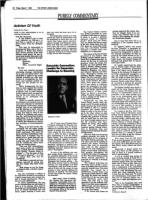
Raphael Lemkin
For 37 years, since President Harry
S Truman acclaimed the Genocide Con-
vention as a major step in human
endeavors to eliminate the crime of mass
murder of peoples, and with the Soviet
Union among the first nations to ap-
prove it, there had been a struggle to
gain endorsement of it by the United
States Senate. The ultra-conservative
factions staunchly opposed it and pre-
vented its adoption. Now that a majority
of the Senators gave it•endorsement, the
opposition viewpoint is gaining some
recognition. The Wall Street Journal in a
"Ratifying Genocide" editorial (Feb 24),
calls it "meaningless."
In view of the jubilation now ram-
pant among Jewish organizations — in
the consistent habituality of the Jewish
spokesmen of all factions to keep issuing
statements on all issues with a repe-
titiousness that becomes galling — the
Wall Street Journal must be considered
seriously. If a long struggle is in itself
"meaningless," then there must be alter-
natives to deal with the menace of mass
national or other murders affecting the
decencies of mankind. The Wall Street
Journal thus treats the subject "Ratify-
ing Genocide":
After many years of debate,
the Senate has approved the
Genocide Convention first sub-
mitted by President Truman in
1949. The reason it took so long is
that the convention has plenty in
it to oppose. More to the point, it
doesn't stop genocide.
The United Nations conven-
tion defines genocide as "acts
committed with intent to destroy,
in whole or in part, a national,
ethnical, racial or religious
group." Such acts, the treaty
says. are illegal. But like so many
of the fine words issue from the
U.N., these are worse than tooth-
less. The convention actually
manages to exempt every con-
temporary act of genocide.
The reason is that the Soviets
prevailed in the treaty's 1948
drafting sessions. Stalin's men in-
sisted that "political genocide" be
struck off the list of outlawed
practices. Under the treaty, the
Kremlin can send political dissi-
dents to Siberia without having
committed genocide. Likewise,
Ethiopia's Mengistu can starve
and relocate Tigreans and Erit-
reans, Nicaragua's Ortega can
decimate Miskito Indians, Cam-
bodia's Pol Pot could kill a third
of his countrymen, and Uganda's
Amin could butcher his oppo-
nents. Even where the victims
are of one ethnic or religious
group, the tormentors can claim
this is merely political genocide.
When the Senate approved the
treaty 83-to-11, it also voted
93-to-1 to direct a more-than-
willing President Reagan to try
to get a change in the treaty to
cover political genocide.
Proponents say that the
United States should ratify the
treaty even if it's purely symbolic
simply because the Soviet Union
has ratified it. This is a strange
argument. One country signs a
treaty in order to be free to viol-
ate it, the other refuses to sign
but has never been accused of
anything like genocide. It should
also be noted that no case has
ever been brought against any of
the 96 countries that have
ratified the treaty. This despite
Soviet use of biochemical
weapons against Hmong tribes.
men in Southeast Asia and
against freedom-fighting Moslems
in Afghanistan.
But even aside from forgiving
political genocide, the treaty is
fatally flawed by the problem of
the United Nations generally. The
U.N. does, and can do, nothing to
enforce the treaty. Everyone
knows this. And yet genocide
may well be this century's
greatest evil, with totalitarian re-
gimes persecuting individuals
and peoples throughout the
world for the crime of wanting to
be free. The United States hardly
shows serious opposition to
genocide by ratifying a meaning-
less treaty.
The original motivation for
the treaty was to avoid a recurr-
ence of anything like the German
genocide against Jews. (The term
genocide was coined by a
Polish-born Jewish jurist who
fled to the United States in 1939.)
But while the intent was entirely
honorable, it is by now clear that
good intentions alone don't
count. The only way to stop
genocide is for the civilized coun-
tries to use their power against it.
Allied troops, not the lawyers at
the Nuremberg trials, brought
down the Nazi regime.
If the Senate feels better for
having approved the treaty, fine.
But we simply hope it is not
under any illusion that it has
struck a blow against the slaugh-
ter of innocent peoples.
Does it mean that there will be an
indifference to the repeated crimes in
mankind?
Dr. Raphael Lemkin, who created
the term "Genocide," is regrettably for-
gotten or his name overlooked when the
movement he inaugurated is spoken of.
The Genocide Convention was fully ap-
proved by the United Nations on Dec. 8,
1948. Dr. Lemkin was a practicing
Polish lawyer who himself escaped the
Holocaust and gained fame in interna-
tional legal circles.
Dr. Lemkin experienced the suffer-
ings in Poland under Colonel Beck's
pro-German, anti-Semitic government.
Most of his family were murdered in
Warsaw by the Germans. He fought with
the Polish underground, managed to es-
cape and reached the United States in
1941. He taught at Duke and Yale uni-
versities and served on the Board of
Economic Warfare under Henry Wallace.
He succeeded in placing his genocide
proposals on the U.N. agenda in 1946.
The Raphael Lemkin story should Le
retold and his name honored wherever
there is concern over human lives. His
advocacy of international concern for
prevention of the mass murders prac-
ticed on an international scale finds
echoes everywhere. Now there is addi-
tional evidence of such a necessity in a
depressing report from Lebanon of a hor-
ror incomparable even in the 20th Cen-
tury era of Nazi murders. In the past
couple of weeks, three of four Jews ab-
ducted by terrorists were murdered.
In a report to the New York Times
from Paris, Richard Bernstein quotes
leading French analysts warning that
the remaining Lebanese Jews are in
imminent danger, calling upon them to
seek refuge elsewhere. At the outset,
French relatives of Jewish hostages in
Lebanon, had asked, according to Berns-
tein, that "the abductions not be pub-
licized in hopes that by remaining silent
they would increase the chances that
their relatives would be released." Ap-
parently there is a change in attitude
with the new effort to get the Lebanese
Jews to seek homes elsewhere.
How many Jews are left there?
Of the several thousands who lived there
in the early 1960s there are now, Berns-
tein reports, 22 in West Beirut and 73 in
East Beirut, mostly widows and elderly
people.
Apparently it doesn't matter how
many Jews there are left anywhere: as
long as there is a Jewish semblance
there is anti-Semitism!
It will be recalled that during the
most horrifying periods of World War II,
when there was some fear of Japanese
prejudices against Jews, the less fearful
asked what is there to fear when there
were then only 1,000 Jews in Japan.
And in explanation of the anti-Semitic
trends, the Japanese, borrowing from the
Germans, were threatening the anti-
Jewish bias. Those explaining the bor-
rowing from the Nazis. said: "To inspire
any anti-Semitism, if the haters need it,
they will of necessity import even a
single Jew to make anti-Semitism opera-
tive." •
Such is the humanism that could
deny what is termed "meaningless" of
the Genocide Convention. The Raphael
Lemkin demand for humanism remains
alive.
Continued on Page 20