

THE DETROIT JEWISH NEWS
the International Ladies Garment
Workers Union.
So Haber came in. Two years la-
ter, he was elected president of the
American ORT Federation.
Although Haber never men-
tioned it, a close look at his Who's
Who in America biographical sketch
shows that in 62 years, Haber has
only made one brief foray away from
the halls of academia. In 1923, the
year he was graduated from the
University of Wisconsin, he briefly
served as labor manager for Hart,
Schaffner and Marx, the men's clo-
thing manufacturers. -- -
Does Haber regret his decision
to continue teaching while so many
other economists have made the
move into either labor union or cor-
porate executive suites?
Not on his, yours or anybody
else's life. "I'm 86 years old and I
love what I do," he retorts. "The
other day a young man, a student of
mine now, came into my office at the
university. 'Hey, I made a great dis-
covery this weekend,' he told me,
'my mother was student of yours.' I
asked what was her maiden name
and he told me. After he left, I
looked her up in my files. She had
an excellent record, a brilliant young
woman.
"A couple of weeks later, the
young man came back. 'I've got some
bad hews for you,' he said. Natur-
ally, having talked about his
mother, my first question was 'how
is your mother?'
"'Oh, she's fine.'
" 'O.K., then I can take the bad
news.'
"My grandmother was in your
class.'
"'Well, that's good. But why call
that bad news?"
"'I thought the reference to age
might offend you,' replied the stu-
dent.
Haber laughs, then once again
turns his attention to the photo-
graphs on his wall. "There's Soapy
Williams, and Frank Murphy. Harry
Hopkins, and Rabbi Stephen S.
Wise. Abraham Sachar an Robert
Nathan, the economist."
When Haber's eye falls upon the
portrait of former Michigan Gov.
Frank D. Fitzgerald, it's time for
another story.
"In 1936," recalls Haber, "after
his election, Fitzgerald sent me a
wire. It read: 'As governor, I am
going to appoint a commission to
draft an unemployment insurance
bill. It's going to be headed by Prof.
William Haber of Ann Arbor. I
would like you to announce the
commission, but don't wait two or
three months until the inaugura-
tion.'
"It was my first year at the
University of Michigan," continues
Haber, "and the nation and state
were making progress toward com-
ing out of the effects of the Great
Depression. I had been active in
some of the programs set up by the
government to combat the effects of
the Depression. I was the Michigan
state emergency welfare relief ad-
ministrator from 1933 to 1936; the
state director of the National Youth
Administration for Michigan from
1935 to 1936; and I was deputy di-
rector of the Works Projects Ad-
ministration in 'Michigan which had
built 22 state police stations during
the years I was affiliated with the
agency — from 1934 to 1936.
"The class I, was teaching at
U-M was called Social Security
Economics. I met my class and said,
'We've got a project. We've got to
write an unemployment insurance
law. Meanwhile, I'll be chairing an
outside committee comprised of rep-
resentatives from Chrysler, General
Motors, Ford, and a whole lot of
other people. Whomever you elect
will be chairing a committee of stu-
dents that will be working on this
law.'
"And I'll never forget that day,
Dec. 21, 1936. It was 3 a.m., and the
students from my class were sitting
in the gallery of the Michigan legis-
lature in Lansing. I'm on the floor,
with the legislators, explaining the
bill, and suddenly the speaker drop-
ped the gavel. Ninety-nine ayes and
one .nay. The nay was only cast on
one issue — they wanted an
employee tax and bill we intro-
duced — the same law that is in ef-
fect today — had an employer tax.
"It was an exciting thing to look
in the galleries and see the students
who had worked on this."
Eventually, Dr. Haber joined the
faculty of the departments of
economics at the University of Wis-
consin, teaching there from 1926 to
1927. The department had been
founded by Prof. Richard T. Ely, one
of the pioneers of American
economic theory, and one of Haber's
teachers.
"I was very close to the men of
Madison," recalls Haber. "They were
part of my family. One day in 1927
Prof. John R. Commons called me
into his office and said, 'William,
you're going to have to know the
facts of life.' I was then still working
on my doctorate, which - I got later
that year.
"Dr. Commons handed me a let-
ter. It read: 'Dear Prof. Commons: I
have your letter of recommendation
for William Haber as a professor at
Michigan State Colle– je Agricul-
Continued on next page
Friday, January 24, 1986
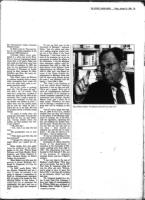
Dean William Haber: "I'm 86 years old and I love what I do."
•
15