

THE DETROIT JEWISH NEWS Friday, November 22, 1985
add a whole lot more to your life and
not get in the way."
If for no other reason, that's why
his goal as a rabbi is to work
Judaism into the lifestyle of young
people — to have them participate in
it and grow from it in a contempor-
ary fashion. "That's what I would
like to communicate to people," he
says.
Of some of the bigger congrega-
tions, he reasons, "It's kind of a con-
sumer Judaism," with an impersonal
nature often the result, causing a
loss of meaningfulness for many
people. "I don't see the 500-family
synagogues as being `Bad,' but I
think there are ways we can re-
structure it. We do need the big
numbers to maintain the Institution
itself; to have the facility there so
that smaller groups can take advan-
tage of it.
"I , think the future is with
groups like the chavera movement
where small groups get together in
the home or wherever convenient,
while remaining affiliated with a
synagogue. There's a fulfillment and
a personalness there. What I've
found in some metropolitan areas is
they have these old, old congrega-
tions with a number of different
minyanim that meet in different
rooms on Shabbat morning. In one
room you'll find a traditional group
with a mechitza (separation of men
and women) and maybe downstairs
an egalitarian one with women as
full participants."
The women's role in Judaism is
an issue that has faced Pasternak
frequently. And in his mind, he
foresees what he calls a "limited
egalitarianism" entering into
Judaism where women will partici-
pate in every way men do, with
some notable exceptions — like a
-bris.
He attended the Jewish Theolog-
ical Seminary in New York this past
year with the first ordained Conser-
vative female rabbi, and his indoc-
trination into Naval chaplain school
included as fellow recruits the first
husband-wife rabbinical team. "I'm
all for women rabbis," says Paster-
nak. "The traditional meaning of a
rabbi is just someone who is a
teacher — someone who has
achieved a particular level of learn-
ing and understanding. And (that
level of learning) isn't something
Continued on Page 68
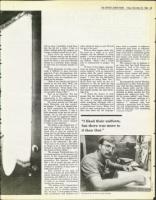
"I liked their uniform,
but there was more to
it than that."
Bob McKeown
tied so soon, I probably would have
had the job for a while. I like to
think I helped settle the contracts, so
I guess I worked myself out of a job."
From there he moved on to
T.G.I. Fridays until he left for Israel
in the summer of 1983. He stayed in
Israel for about a year and attended
classes at a seminary there, though
he still had not formally decided to
enroll.
Being thousands of miles away
made it difficult to keep everyone
apprised of his developments, but
Pasternak admits that his friends
and family were not completely sur-
prised by his decision.
"Most of my friends just kind of
looked at me and said, Well, it's
about time you got around to it,' "
says Pasternak. "Even those who
hadn't expected it kind of looked at
me and said, 'Yeah, it fits.' "
And, as he observes, "It's not
like I switched from chemical
engineering to the rabbinate — I
have a social sciences background."
His proud parents are Abe and
Gerry Pasternak, and they couldn't
be happier. "I was very pleased that
he found something he wanted to
do," his mother recounts. "I was a
little surprised at the way he told us
though. As he left the house one
night, he said `I've applied to rabbin-
ical school, goodbye!' But the more I
thought about it the more I realized
it wasn't a snap decision."
His father is also behind him. "I
was a bit skeptical at first, but he
had talked about it before and I
think this is what he wanted all
along, but he just didn't make up his
mind. It's a little bit disturbing that
in a city the size of Detroit with
70,000 or 80,000 Jews, there's so few
going to the rabbinate." He adds,
You have to be quite an individual
to choose to be a rabbi. I'm looking
forward to the day that Marty takes
the bimah at B'nai Moshe."
The younger Pasternak has a lot
of strong opinions on the present and
future of the Conservative Jewish
movement, especially as it affects his
generation. For starters: "I sense
that a lot of people my age and of
my generation would be more in-
terested in Judaism if they knew a
little more about it."
He's critical of the lack of
follow-up at home for many Hebrew
school students, pointing out how
frustrating and difficult it is for stu-
dents, parents and teachers if there
is little or no Judaic involvement
outside the classroom.
The failure of the Conservative
movement the last couple genera-
tions has been to educate responsi-
bly," he says. "I want people to know
that involvement with Judaism can
57
Pasternak has to hit two sets of books.