

14
Friday, November 8, 1985
THE DETROIT JEWISH NEWS
StIFFE11111
THE l'11111
Michigan's Jewish Vietnam
veterans still repress the
bitterness for their
experiences in 'Nam . . . and
at home.
BY ELLYCE FIELD
Special to The Jewish News
I
he Vietnam War brings
back unsettling memories
for most men who came of
age during the late 1960s
and early '70s. Most vividly
recall their draft board registration,
their first ritualistic brush with the
war machine.
Stories of draft board visits be-
came folk tales passed from friend to
friend, told with intimacy and
bravado amid the noise of Tiger
Stadium or in the privacy of college
dorm rooms. Stories of youthful au-
dacity and creative evasion were
rampant.
There were 27 million draft age
men during the Vietnam War years;
25 million managed to stay out of
the war. Two million men were not
as lucky. Buffeted by fate, con-
fronted with the draft induction let-
ter, they submitted and tried to
make the best of it. Their goal was
to do their job, survive and come
home.
There were many Jewish men
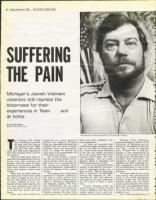
Bob Mitchell and Steve Hirschberg: The bitterness remains.
among the two million American
soldiers who fought in Vietnam.
They, too, experienced first-hand the
tangible heat, the smell of decay,
senseless death and destruction.
They, too, fought for survival and
came home to an unsympathetic and
often hostile community.
The Jewish Vietnam veteran,
like his non-Jewish brother, has re-
mained largely silent the past 19-
plus years, as he reconstructed his
life, nursing his loneliness, bitter-
ness and desperation, confronting in
private the demons of his wartime
memory.
The complete story of the Jewish
experience in Vietnam is difficult to
tell. Amar J. Singh, director of the
National Veterans Administration,
Office of Information, Management
and Statistics, explains, The Vete-
rans Administration does not keep
statistics on veterans by religious af-
filiation." For the most part, Jewish
Vietnam veterans, like other Viet-
nam veterans, have until recently
shied away from established vete-
ran's organizations.
Yet there are reminders that
Jewish men fought and died in Viet-
nam. In the lobby of Temple Beth
El, a large bronze plaque dedicated
to the men and women who
their lives during World War II has
inscribed at the bottom, The Viet-
nam Campaign," with two names:
Sergeant Jeffrey A. Schonfield and
First Lieutenant Larry S. Weil.
In front of the Southfield Public
Library, in the midst of a circular is-
land of landscaped shrubs, lies a
grave marker: "Dennis Greenwald,
PFC Co. A 503 INF, 173 ABN BDE,
Vietnam PH, November 23, 1948 -
November 20, 1967." The abbrevia-
tions might not be easily understood,
but the nature of death is quite
clear.
Careful checking yields the
names of at least 12 Jewish veterans
living in Michigan. Does this small
number indicate only a small per-
centage of Jews served in Vietnam?
Professor Victor Lieberman,
associate professor of history at the
University of Michigan and in-
structor of "The History of the Viet-
nam War," makes an educated
guess. If there were a small per-
centage of Jews participating in
Vietnam, it was probably due to the
fact that many took advantage of all
available draft deferments and
exemptions. If people were knowl-
edgeable, had draft counseling con-
tacts, professional contacts like doc-
tors or psychiatrists, or were in pro-
fessional training, they would have
gotten out.
The same would be true of any
other group with characteristics
similar to the Jewish demographic
structure at that time. We were an
educated middle class with profes-
sional contacts. Basically, the armed
forces had a class disproportionately.
Men from the lower classes, lower
income and lower education brackets
fought the war."
This underrepresentation of