

88
Friday, September 20, 1985 THE DETROIT JEWISH NEWS
KEEPING SCORE
After 37 years
in professional
baseball,
the Tigers'
Lew Matlin
has seen
(and heard)
it all.
BY LARRY PALADINO
Special to The Jewish News
Lew Matlin smiled warmly as
he remembered a humorous bit of
Americana from some 35 years ago
when he was business manager of
baseball's Bakersfield team in the
California League. It seems that a
young recruit right off a California
farm reported to the ballclub and as
he dressed for his first day of prac-
tice he realized he had two left
baseball shoes.
"He wanted to know if anyone
wanted to swap a left-footed size
101/2 for a right-footed 101/2," Matlin
recalled.
That player eventually made it
to the majors for a brief stay, "a cup
of coffee in the big leagues" is the
way Matlin put it, "so I won't tell
you his name."
Matlin has collected countless
other stories during his 46 years in
baseball, 37 of them as a profes-
sional. After a Detroit Tigers home
game it's not uncommon to see Mat-
lin in the press lounge relating some
of the tales — between puffs of his
omnipresent cigar — to reporters,
broadcasters, scouts, coaches or any-
one else whose ear is attuned to the
game, its history and foibles.
He has a wealth of stories be-
cause he has a wealth of experience
in the game, from that of a business
manager to stadium manager to
promotions director to group sales
representative to general manager to
executive vice president and every-
thing in between. Currently, the
64-year-old Matlin is assistant direc-
tor of public relations for the Tigers,
in charge of special events and the
computerized scoreboard. He has
been with the Tigers in various
capacities since 1971.
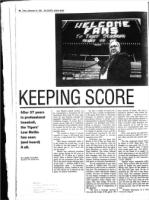
Detroiters may not know who
Matlin is, but if they are Tiger fans
they have to be familiar with his
work. All they have to do is look at
the huge scoreboard above the upper
deck bleachers in center field at
Tiger Stadium. The screen informs
the fans on everything — from bat-
ters' averages, runs, hits, errors, in-
stant replays, out-of-town scores,
quizzes, welcome messages to groups
and movie or television reproduction.
"It's as complicated as you want
to make it," Matlin said. "I'm very
fortunate in that I have an outstand-
ing crew. The scoreboard we have is
actually a video information display
system. We have 16 shades of gray
we can display messages in and the
capacity to show motion picture film,
video cassettes, slides, display mes-
sages. The only things we're hin-
dered by are the time factor and
agination, or lack of imagination of
the operator.
"We have a message operator
who sets the tempo of the game. We
have several of them. We have a
statistical operator who keeps the
stats up to date ... we have a turret
operator who puts the balls and
strikes up on the auxiliary boards as
well as the main matrix. We have a
video switcher that handles the
video aspects of it, and he also
serves as a maintenance man. And
we have a camera if we want a cam-
era man."
Since most games are televised,
either on network or cable TV, there
isn't often need for the camera oper-
ator.
The big, electronic board made
its debut in 1979. Back then, "We
thought we were good, but we we-
ren't very," Matlin said. "I think
we're pretty good now. Our philos-
ophy on the board is to supply as
much information as we can and not
to insult the intelligence of the fans.
It's pretty bush to tell someone,
`CLAP. CHEER."
Quizzes began appearing right
away. Photo quizzes used for several
years no longer are used because,
Matlin said, about all the photos in
the files had been used. As far as
questions go, "We run a very demo-
cratic ship. The message operator
has the right to submit the question,
subject to my veto. If I don't like the
question or they can't come up with
one, I'll come up with one. I think in
the seven years we've only had two
wrong answers. One of 'em was this
year.
"Freddie Heumann is a very
Continued on Page 38