

Neal Duchin
THE DETROIT JEWISH NEWS Friday, September 13, 1985 31
A Bloomfield Hills teenager
visits Poland and comes
face-to-face with the horrors of
the Holocaust.
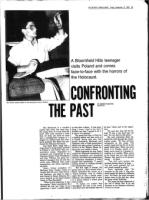
Eric Rosin studies slides he took during his trip to Poland.
CONFRONTING
THE PAST
BY SHERI PICKOVER
Staff Writer
The Holocaust is a terrible
reality that every Jew must face.
For young Jews, it is even more dif-
ficult. They must reconcile a truth
that, for most, can never be more
than a grandparent's memory or a
chapter in a history book. But Cran-
brook graduate Eric Rosin has con-
fronted the Holocaust first hand.
Last .April, Rosin, along with a
large group of young people, traveled
to Poland to visit former Nazi con-
centration camps. Organized in
Jerusalem and co-sponsored by the
American Zionist Youth Foundation
and Noar V'Halutz, the group con-
sisted of teenagers from all over the
world, some affiliated with youth
organizations and others represent-
ing cities.
Rosin, former president of
Michigan State Temple Youth at
Temple Beth El and a Yale Univer-
sity freshman, was asked to repre,
sent Detroit by Benny Schwarz, De-
troit's shaliach at the Israel Aliyah
Center in West Bloomfield.
"When he first asked me, it was
big surprise," Rosin remembered. He
realized the trip was "more of an
opportunity I knew I couldn't afford
to miss than a desire . It was some-
thing I knew I had to do, but I
wouldn't say that I wanted to do it.
It wasn't very pleasant."
The group first flew to Paris for
a briefing session and then went on
to Poland. During their stay, they
toured Auschwitz, Maidanek and
Treblinka with a Polish government
official and other guides, including a
survivor of the Warsaw Ghetto up-
rising who now resides in Israel.
Before beginning the trip, Rosin
studied the Holocaust extensively by
reading pamphlets and attending
lectures. And while they helped form
an intellectual standpoint, it didn't
prepare him emotionally. "I wasn't
looking forward to walking through
the concentration camps."
The first night in Europe, the
group went to a Paris Jewish center.
Rosin described the center as a
"blank building" with no visible
signs that it was a Jewish estab-
lishment. The students had to wave
to a person behind a locked glass
door to enter.
"It makes you realize that
throughout the rest of the world,
Jews don't have the freedom that we
do here," Rosin said of the experi-
ence.
The next day, they left for Pa
land. "It was a very hard trip," he
said. "It's very hard to talk about."
His voice restrained, Rosin de-
scribed his walk through the concen-
tration camps. "We had services,
ceremonies at the camp. You
couldn't (help but) feel the tie to the
people killed there. When you learn
about it in Sunday school or in
books, you're numb to it because ev-
erything is so terrible. When you're
at the camps and you walk around
Warsaw, that used to be 40 percent
Jewish ... it's hard.
"You still can't picture the
numbers because they're so huge ...
You still numb yourself, but you
can't numb yourself as much."
Rosin explained that "for
everyone on the trip, it (the emo-
tional impact) hit them at a different
time." For Rosin, the trip's strongest
impact came on the last day, when
the group visited Treblinka.
The camp had been destroyed at
the end of World War II by the
Germans as the Russians advanced.
Continued on next page