

14
Friday, July 12, 1985
THE DETROIT JEWISH NEWS
Beacons To The Past
Tracing Detroit Jewry's
"northwest passage".
through the synagogues
left behind.
BY PHILLIP APPLEBAUM
Special to The Jewish News
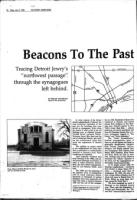
Cong. Shaarey Zedek's Winder St. home
now is a burned-out hulk.
Bob McKeown
In what remains of the former
Jewish neighborhoods of Detroit, the
most prominent reminders of the
past are the buildings that once
served as synagogues. Drive down
the streets of what is left of the old
Hastings area, or Oakland Avenue,
Twelfth Street, Linwood, Dexter,
Wyoming, Seven Mile Road and the
rest of northwest Detroit, and you'll
see the architectural relics that
mark the migrations of Detroit
Jewry.
The inability to remain rooted
in one neighborhood for much more
than a generation is a characteristic
peculiar to Detroit's Jews. Their
wanderings are ceaseless.
Jews originally wandered here
from Germany in the 1840s, and set-
tled around Hastings and Gratiot, in
what is today downtown Detroit.
Here, the city's oldest congregations,
Beth El and Shaarey Zedek, were
born.
The 1880s saw the beginning of
the greatest wave of immigration
ever to reach American shores.
Hundreds of thousands of eastern
European Jews were among the mil-
lions that came to America between
1880 and the end of free immigra-
Phillip Applebaum is a past president
of the Jewish Historical Society of
Michigan.
1 :7 :! • -.7"--
,I;;; ,;" ■ 74170,+ ■ .:4..t
tion in 1925. Hundreds of those Jews
wandered to Detroit, and settled
among their brethren in the Hast-
ings area, Detroit's answer to New
York's Lower East Side — without
pushcarts. So heavily populated with
Jews did Hastings become that a De-
troit newspaper tagged, it "The
Ghetto" and "Little Jerusalem."
The "Little Jerusalemites"
founded congregations, many of
them in private homes and based on
geographic identification. Landsleit
from Poland, Romania, Galicia,
Hungary and Russia started their
own synagogues: Beth Yehuda, Beth
Moses, Beth Abraham, B'nai Moshe
and B'nai David are still in exist-
ence. Perhaps some of the oldtimers
remember the "ethnic" character of
the shuls, but the congregations .are
thoroughly Americanized today.
At its height around 1920, the
Hastings neighborhood — stretching
from Gratiot to about where 1-94 is
today — contained more than 20
synagogues. By 1940, the area had
seen a large influx of blacks, most of
whom had come to Detroit from the
South, filling an acute labor shor-
tage created by World War I.
The Jews wandered on, north of
Hastings to the Oakland Avenue
area. There, near the intersection of
Delmar and Westminster, the "Del-
mar Shul" (Ahavas Achim) reigned as