

n• •
16
Friday, June 21, 1985
THE DETROIT JEWISH NEWS
CLOSE-UP
Angel Of Death
Continued from preceding page
actions, and despite the fact that our
efforts yielded more and more damn-
ing evidence, the legal precedents
presented insurmountable obstacles.
A small loophole in the U.S. Law
that allowed American citizens to file
suits against foreign governments
was growing smaller every week.
Other lawyers familiar with our
pending lawsuit — among them Mar-
tin Mendelsohn, former head of the
Justice Department's Office of
Special Investigations, and now
Washington counsel for the Simon
Wiesenthal Center, and Monroe
Freedman, Elie Wiesel's personal
attorney and professor of law
at Hofstra University — doubted
that it could be successful.
When we dropped the suit, how-
ever, we were left with a growing file
of information — particularly about
Josef Mengele — and no specific use
for it. A friend suggested that
McGraw-Hill, which was interested
in publishing a well-documented
Iccount of Mengele's life, might also
interested in a history of his post-
x existence. I contacted the pub-
lisher with the thought that if such
a book became a commercial success,
I could donate substantial amounts
of the resulting revenues to survivor
groups, and thus accomplish in some
measure what the original lawsuit
could not. He agreed and gave me a
$25,000 advance on prospective sales
of a book I am now writing about
Mengele's life as a fugitive.
And so the second phase of my
research began. It has been a unique
and exhausting experience. I have
traveled to 20 countries on four con-
tinents, tracking - people and docu-
ments connected with the Mengele
case. I have filled two passports with
entry and exit visa stamps, met
dozens of shady characters in parks,
bars and hotel rooms, pored for hours
over dusty files in libraries and sterile
government buildings, driven long
distances into the jungles of South
America in search of people who say
they have known or seen Mengele.
My first experience with a Nazi
broker — a man who makes his liv-
ing buying and selling information
about fugitive party members —
should have warned me that I was
delving into a very unusual area of
historical research.
I was in Germany, on my way to
Gunzburg, Mengele's birthplace, and
reviewing documents in German gov-
ernment archives. It was 1982 and I
was staying at the Bayerischerhof
Hotel in Munich for a few days before
driving northeast to Gunzburg. On
the third night of my stay, I was
awakened about 2 a.m. by a tele-
phone call from a man who spoke
English with a heavy German accent.
He told me that a friend of his, a
former SS officer, had recent photo-
graphs of Mengele, taken after plas-
tic surgery. He told me I could meet
the man the next day, but not in
Europe, where he was wanted by the
police. I would have to fly to Casa-
blanca.
Furthermore, my caller said, be-
cause of the "police misunderstand-
ing," his friend could not sell the pic-
tures to a legitimate news organiza-
tion. Neither would he allow them out
of his possession. The man on the
telephone told me what flight to take
and what hotel to check •into.
"You will be contacted," he said
cryptically.
The temptation was too much for
me. The flight wouldn't take more
than an hour, I had enough for plane
fare, and I figured I wouldn't have to
spend more than a day in Casablanca
if the whole thing turned out to be a
fake, so I made the trip. Moreover,
the possibility of recent Mengele
photos was too important to pass up,
even in the face of a confrontation
with a fugitive Nazi in Morocco.
Besides, I had never been in Cas-
ablanca.
Eight hours later I checked into
the Hotel El Mansour in downtown
Casablanca and started waiting.
Nothing happened that day. No calls,
no messages, not even a glance from
any of the suspicious-looking people
I thought I saw in the lobby. I was
beginning to think I was the butt of
a bad joke. Maybe some neo --Nazi in
Germany had decided to get a laugh
by sending me on a fruitless journey
to North Africa. I went to bed that
night fuming. I'd take a sight seeing
tour the next day and hop a plane
back to Munich in the evening.
About 7 a.m. there was a knock on
my hotel door. I put the chain latch
on and opened the door a crack. Out-
side stood a tall man with a barrel
chest, a bloated, puffy-looking face,
short, white hair and wraparound
sunglasses. he looked to be in his
mid-60s.
"My name is Herman," he said. "I
have something you want to see. Get
dressed and meet me in the lobby cof-
fee shop. I'll wait for you."
Twenty minutes later, I was sitting
across a small tiled table from Her-
man, sipping mint tea andlooking at
two photographs of a man between
50 and 65 years old. The pictures
were of poor quality and taken from
a distance. it was clear that no one
could positively identify the subject.
In fact, they were so indistinct that
they could have been snapshots of al-
most any man in that age bracket.
I looked at them for almost a
minute. Then Herman snatched them
out of my hands and told me that I
could buy them for $5,000. Cash on
the table. Now.
Fortunately, I didn't have any-
thing like $5,000 with me. Perhaps if
I had, I would have fallen for the
ploy. Maybe the pictures were worth
the gamble. But I was working out
of my own pocket, and the answer
had to be no.
I tried to reason with Herman. I
told him that I could not pay that
kind of money unless I at least tried
to verify with forensic scientists that
the pictures he was offering were
truly photographs of Mengele.
It did not take me long to realize
that I had undertaken a most dif-
ficult task. How does a young Jewish
lawyer in a strange land reason with
a wanted former SS officer who is
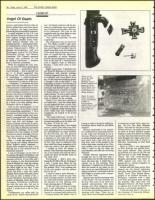
Above: In his
search for data
about Josef
Mengele, lawyer
Posner bought these
souvenirs of the
Third Reich from
shopkeepers and
street vendors in
South America.
Right: In many
South American
cities, anti-Semitic
graffiti is "
commonplace.
Author Posner took
this snapshot of a
wall in Buenos
Aires.
trying to make a living by selling in-
formation about Nazis on the black
market?
Herman responded to my request
for verification by slamming his fist
on the table and shouting at me in
German. When he cooled off enough
to speak English again, he asked me
how much cash I had with me. By
this time, most of the people in the
coffee shop were staring at us. Her-
man hulked over me and glowered
while I tried to sip my mint tea
nonchalantly and calm my revolving
stomach.
Finally Herman simmered down
enough for me to tell him that I
would think over his offer and let him
know the next day. I asked him to
contact me in the morning. That
afternoon, I checked out of the hotel
with the sound of my heart in my
ears, drove my rented Renault to the
airport as fast as I could and took the
next flight to London with a connec-
tion to New York.
Herman was my first encounter with
a Nazi broker. He was certainly not
the last. But some of my most out-
landish confrontations with these
strange and often desperate sales-
men have taken place in South Amer-
ica. In fact, the continent seems to be
teeming with them. There are so
many that I once thought it possible
to stand on a corner with a sign say-
ing, "$5 For The Best Mengele
Story" and wait for the line to form.
Within an hour, one might have had
his pick of several hundred people
hoping to make five dollars by telling
you that they had either played cards
with Mengele last night, gone bowl-
ing with him last week or where to
find him vacationing at Club Med
every summer.
Early in 1983, I was approached
in New York by two retired Peru-
vian police officers. They showed
me pictures of a man in his 70s and
told me that it was Josef Mengele.
"Since the last authenticated
Mengele photograph was taken in
1966, almost any man can be
passed off in a current snapshot as
the fugitive doctor.
Armed with the fuzzy prints they
showed me, the former policemen
said they knew where the "Angel of
Death" lived. They flashed photo-
graphs of an isolated hacienda in
Paraguay, complete with a high
wire fence and guard dogs roaming
the grounds. This, they said, was
Mengele's hideout. All they needed
to capture him would be $15,000 to
finance a commando expedition.
I told the pair that I was not in
the business of financing kidnap-
Continued on Page 18