

THE DETROIT JEWISH NEWS
Friday, April 12, 1985 .25
uthor . . . teacher . . . lecturer
. . . political scientist . . . world
traveler . . . These are just some of the
credits Dr. Daniel Elazar has collected
over a career that started when he
enrolled at United Hebrew Schools of
Detroit nearly 40 years ago.
• Elazar was in Detroit in March to
be guest lecturer at a convocation hon-
oring Rabbi Max Weine on his retire-
went from the Midrasha. Dr. Elazar,
who received his M.A. and Ph.D. de-
grees in political science from the Uni-
versity of Chicago, spoke to an ap-
preciative Beth Achim audience on
"Kinship and Consent — The Bonds of
the Jewish Community."
He told his listeners that Jews are
"a commonwealth that transcends
space in the same way that we es a
people have transcended time." In
other words, Jews have not only had to
overcome the distance between their
communities caused by the Diaspora,
but that Jews have also survived the
significant events they have faced.
Elazar's message is both optimis-
tic — "People are having a revival,
religiously and ethnically . . . of com-
munities," and pointedly realistic —
"For some people, being Jewish is like
being born in South Dakota. Once they
move away, it's just a datum of their
birth rather than a sign of their com-
mitment." He suggests that to bridge
that gap, "we must teach our children
to be Jewish citizens in the full range
of the meaning of that term . . . prod-
ucts not only of their kinship, but able
to consent to the continuation of
Jewish life."
In a separate interview, the warm
and articulate Elazar offered some
concrete responses to this issue as well
as insight into his own personal back-
ground.
Originally from Minnesota,
Elazar began his association with
UHS as a student when his family .
moved here in 1948 and his father Al-
bert became the school's superinten-
dent: Elazar was a member of the Mid-
rasha's second class. He still has
strong feelings for these schools and
the instructors. "They have contrib-
uted so much to the enrichment of
Jewish life in the U.S. and throughout
the world. We have not yet seen their
Bo b McKeo wn
A native son
points to his
Detroit
experiences
for solutions
to Jewish
problems.
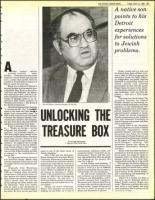
Daniel Elazar: Jewish education is the key.
UNLOCKING THE
EASURE BO
BY NOAM GELFOND
• Special to The Jewish News
equal in any of the other forms of
Jewish education."
After UHS and the Midrasha,
Elazar entered what was then Wayne
University. Elazar says he knew early
on he wanted to be a political scientist
and that he would also be involved in
Jewish affairs. The polio he contracted
as a youth hasn't interfered with his
career. While it is difficult for him to
get around, he dismisses it. "Fortu-
nately, I did not intend to be a football
player so I didn't have to change my
career direction." He adds that, "I
think any obstacle one has to overcome
strengthens one and makes him a lit-
tle tougher."
Among his major influences,
Elazar first mentions his parents,
singling out his father as "a man of
extraordinary influence inside and
outside the family." And that's an un-
derstatement. Nearly half the audi-
ence approached him after his speech
with greetings for his parents, who
now live in Israel.
In fact, Elazar notes modestly, "I
have a built-in audience wherever I go
because I lived in a lot of different
places and everybody likes to come up
and say hello. It's very gratifying."
He still travels extensively. His
visit to Detroit was preceded by stops
in Houston and Philadelphia, and he
recently returned from Yugoslavia.
He usually gets to Detroit about five or
six times a year and he travels so much
he likes to joke, "I spend 100 percent of
my time in Israel, 50 percent in the
States and 25 percent in planes."
Elazar moved with his wife and
the first of their three children to Is-
rael in 1968. In 1976, he organized the
Jerusalem Center for Public Affairs,
an independent, non-profit institute
dedicated to researching Israeli and
Jewish policies and assisting
policymakers to deal with the issues.
Elazar likens his center to the Ameri-
can Enterprise Institute or the Brook-
ings Institution "with one little dif-
ference — they have a little larger
budget."
The center has two divisions: The
Jerusalem Institute for Federal
Studies focuses on conducting re-
search on Israel-Arab peace, including
questions of the administered ter-
ritories, powersharing in multi-ethnic
polities (organized societies) and in-
tergovernmental relations in Israel.
The Center for Jewish Community
Studies concentrates on the "political,
civic and communal dimensions of
Jewish life past and present and their
policy implications."
Among some of the Jerusalem
Center's programs is a study of Jewish
community organization which
spawned Elazar's well-known book
Community and Polity, the United
Jewish Appeal's Project Renewal, and
an ongoing series of evaluative studies
on the impact of Project Renewal on
Israeli-Diaspora relations. The
Jerusalem Center has offices in
Jerusalem, Philadelphia, Montreal
and Paris.
Elazar notes that there has been a
proliferation of think-tanks similar to
his on paper, but except for those in-
stitutions active in foreign affairs or
defense, there's only one other func-
tioning think-tank like it in the world
— The Institute for Jewish Affairs in
London. Dr. Elazar has just published
a book called The Jewish Polity, which
he calls "the first volume of a constitu-
tional history of the Jewish people,"
and "a broadening and deepening" of
Community and Polity.
Asked if it is harder now than a
few years ago for American Jews to
defend Israel's actions, Elazar con-
tends, "There was a period a few years
back when it was harder, but even
then something like 75 percent of the
Continued on next page