

18
Friday, April 5, 1985
THE DETROIT JEWISH NEWS
PASSOVER
And Now,
The Grunberg
Haggadah
BY JANNE HEIFETZ
Special to The Jewish News
H
aggadah, literally,
"the telling;" the book
of stories, songs and
blessings read at the
Passover Seder as we
celebrate freedom from slavery and
the survival of our ancient and ex-
quisite culture.
But the Haggadah is something
more: It is one of Judaism's best ve-
hicles for artistic expression. Its il-
lustrations can help us explain the
Exodus story to our children as well
as enliven the entire Passover exper-
ience.
There have been Haggadot of
many kinds: the book has appeared
in over 3500 different editions, in
numerous languages. The earliest ex-
tant complete text is part of a tenth-
century prayer-book from Babylonia.
The first Haggadot that were inde-
pendent manuscripts did not appear
until the late thirteenth century,
however. Magnificent examples in-
clude the Golden Haggadah from
fourteenth-century Spain, the Prague
Haggadah of 1526, and the Amster-
dam Haggadah of 1695, which exert-
ed the strongest single influence on
subsequent Haggadah design.
But the most important factor in
making the Haggadah available to a
wide audience was the invention of
moveable type in 1450, by Johannes
Gutenberg. Gutenberg's invention —
which was financed by the Jews of
Strasbourg — allowed all Jews, rich
and poor alike, to acquire books. And
the Haggadah was, and is, one of the
most valued.
Haggadahs have been adorned
with illustrations in various de-
corative styles. Pictures have also re-
flected the dress and customs of Jew-
ish society in each period, and the
text has often been enriched with
timely references.
A potent example is the Haggadah
written during the last days of the
Warsaw Ghetto. It was read at the
Seder celebrated just before the final
uprising, and contains an urgent poem
intended to inspire resistance against
the Nazi persecutors. This Haggadah
expresses the spirit of a people in cri-
sis, while affirming the continuity of
their tradition.
Other well-known Haggadahs from
our century include those illustrated
by the artists Ben Shahn and Leo-
nard Baskin.:
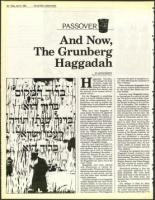
And now a new Haggadah emerg-
es, having been five years in the mak-
ing. The artist's name is Maty Grun-
berg, and he was commissioned by
the Bezalel Academy of Art and De-
sign in Jerusalem. The Academy is
the only professional art college in
Israel, and Grunberg himself gradu-
ated from there in 1966. It is named
after Bezalel ben Uri ben Chur, the
Jewish artist whom Moses asked to
build the Tabernacle and the Ark.
Maty Grunberg was born in Yugo-
slavia in 1943. After surviving the
Holocaust by hiding in a flour mill in
rural Italy, he and his family emi-
grated to Israel in 1948. There he
studied art, and completing his
courses at the Bezalel Academy, he
went to England for further study.
He soon established a reputation
there, winning numerous awards and
being invited to exhibit his work in
the major European cities. He cur-
rently resides in London with his
wife, who is a psychologist, and their
three children.
Grunberg has designed the entire
Haggadah himself, creating it with
the time-honored technique of wood-
block printing. The oldest of the print
processes, woodcut was used for the
Prague, Mantau, and Venice Hagga-
dot, and reached its artistic zenith
with the work of Albrecht Durer.
Wood-block printing is also the
most inherently expressive of all
print processes. The wood block
lends itself easily to the formation of
bold black and white areas, and
therefore has a tremendous potential
for drama.
The medium is ideal for Maty
Grunberg. His seventy-five illustra-
tions are symbolic and expressionis-
tic, rather than purely descriptive.
He says that his aim, -aboire an, is "to