

THE DETROIT JEWISH NEWS
13
"I knew he'd never understand why I wanted to
be a rabbi, but I respected him."
- A crucial test came late in 1979, when the
Seminary's faculty scheduled a debate and a vote
on the issue. Fearing a split in the Conservative
movement if they approved women's ordination,
the faculty members instead voted to table the
matter. That decision quashed the hopes of many
women, among them Amy Eilberg, now a class-
mate of Cantor's who stands to become the first
female Conservative rabbi when she is ordained
May 12. Eilberg said recently that after the 1979
vote, she became convinced 20 years would pass
before the Conservative movement would again
take up the issue of women's ordination.
The postponement devastated Cantor. One after-
noon a short time thereafter, she sat in the women's
portion of the Seminary chapel and found herself
thinking: "I can't pray with these people anymore.
They have no idea what I'm struggling with."
She soon left the school, because "I couldn't be
here indefinitely and not know what was going
be here in the end." Cantor entertained the idea of
going to a Reform or Reconstructionist seminary,
institutions of branches that had accepted female
ordination since the early '70s. But she rejected the
idea, because her allegiance was to Conservative
Judaism.
By the time of the 1983 vote to allow women into
the JTS rabbinical school, Cantor had embarked
on a new life. She had married and had carved out
a career for herself in the movement for Soviet
Jewry and in educating college students about their
Jewish heritage. Her first reaction on hearing of
the vote was joy. "I thought: Is that all there is?
No confetti? No ticker tape parade?" But then she
began to reflect on the practical details of what it
would mean for her — a married woman pushing
30 and four years out of the Seminary — to return
to the school. She and her husband would have to
delay starting a family. They would have to live
on one income in expensive New York for several
years.
But her husband encouraged Cantor to rekindle
X "1.
t
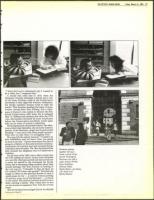
Students, getting
together during a
break in front of the
Jewish Theological
Seminary are, left to
right, Joshua Finkel,
Rana Goldberg,
Rhonda Nebel,
Shelly Melzer, Jay Sales,
J.B. Sacks and
Michal Shekel.
Continued on Page 20
'
'-
)!';LJ:?-,E,V1)
Friday, March 15, 1985
17