

THE DETROIT JEWISH NEWS
malice was only a technicality."
The potential importance of Be-
gin's warm statements for Sharon
cannot be underestimated, be-
cause it has long been rumored
that Begin blamed Sharon for Is-
rael's failure to achieve the goals
it set for itself in Lebanon and for
the heavy loss of Israeli lives
there. While the former Prime
Minister may have spoken out
about the case more because of his
own well-known dislike for Time
than out of any affection for
Sharon, his statements may well
give Sharon the imprimatur of Be-
gin's chosen successor for many of
the former Prime Minister's still
fervent followers.
Sharon's impressive showing in
his highly personalized battle with
Time magazine is likely to
strengthen his hand politically in
Israel, even with many Israelis
who are uncomfortable with his
reputation as a hard liner and mili-
tarist.
"Many Israelis are going to say
that only Sharon had the strength
and courage to fight and over-
come this powerful media empire,
while ignoring the petty criticism
back home about his long absence
and his hotel bill," said one Israeli
journalist who covered the trial.
"Even Israelis who oppose him
feel the western media falsely
reported what happened in Leba-
non, so they feel happy and pro-
ud that Sharon proved the story
false."
The sense that Sharon had been
"vindicated" in the trial, as his
chief attorney Milton Gould said
to reporters after the verdict, was
somewhat jarred the next day
when one of the jurors, Patricia
De Loatch said on NBC's "To-
day" show that the jury had be-
lieved that Sharon had in fact
been aware that a massacre would
take place if the Phalangists were
allowed into Sabra and Shatilla.
In remarks to this reporter, De
Loatch, a 27-year-old marketing
specialist from Mt. Vernon,
stated, "All of us believed that
Sharon knew [a massacre] would
happen. We didn't believe him for
one minute when he said that nev-
er in his wildest dreams did he fear
there would be a massacre."
However another jury member,
a 36-year-old management consul-
tant named Lydia Burdick, said
"There was disagreement within
the jury on the question of wheth-
er or not Sharon knew there would
be a massacre. I personally felt
that he did not know in advance."
Burdick stressed, "The point
that people are forgetting is that
it was not our job to judge Ariel
Sharon. We had to decide whether
the average reader of Time
magazine, after reading the
paragraph in question, would feel
that Sharon was more guilty than
the Kahan Commission said he
was. We felt the paragraph did
say that."
Burdick said that the jury final-
ly decided that Time had not been
malicious because, "We decided
David Halevy really believed that
the discussion of revenge was in
Appendix B. We reasoned that
while Halevy might have been
careless in his work, he would not
have reported that the discussion
was in Appendix B unless he
believed it, since he knew than
many people would see the Appen-
dix and he could be easily
disproved."
According to Burdick, "To me
the most important thing to come
out of the trial is that the press
has to be responsible that its rea-
dership understands what has
been written. In this case Time
felt it was communicating one
thing with its paragraph, but we
read the same paragraph and
came to a completely different un-
derstanding."
Sharon, who had in the main
been uncharacteristically warm
and jovial with the press corps at
the trial (in Israel he has often im-
plied that press gives aid and com-
fort to Israel's enemies), blew up
after De Loatch's comments after
they persisted in asking him
about it. Sharon's media counse-
lor Uri Dan told this reporter,
"Arik is not going to say anything
about this. We are not going to
get down into the gutter with
you."
Another subject about which
Sharon seemed reluctant to talk
concerned the group of wealthy
supporters who paid many of his
legal exenses. (Last week, the New
York Times reported that Arnold
Forster, the former legal counsel
of the Anti-Defamaion League
and a member of Shea and Gould,
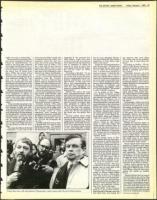
Time's Ray Cave, left, and attorney Thomas Barr, claim victory after the jury's final decision.
the law firm defending Sharon,
had raised $350,000 from Jewish
supporters to help defray legal
costs to the firm.)
Asked who his principal backers
were, Sharon said, "All of this was
done through the law office. Ask
the law office who these people
were. I myself never received so
much as a penny." Asked by this
reporter whether any of the do-
nors to his defense effort, some of
whom have business enterprises
in Israel, might conceivably hope
for or expect pr3ferential treat-
ment in future dealings with him
as Minister of Industry and
Trade, Sharon said angrily, "That
is a vicious question." He refused
to offer a further response.
In an article in the Village
Voice, Robert Friedman quoted
"reliable sources" as saying that
the principal financial backer of
Sharon was Joe Nakash, one of
the three brothers who own Jor-
dache Enterprises, and that other
multimillionaires like Mechulam
Riklis and Armand Hammer, the
85-year-old owner of Occidental
Petroleum, had also contributed
to Sharon. Nakash flatly denied
the report, saying he had "not giv-
en anything" to the Sharon de-
fense effort. Riklis and Hammer
could not be reached for comment.
Two contributors to Sharon's
defense willing to talk openly
about it were Mel Dubin and
Chaim Gerlitz of Great Neck, re-
spectively the chief executive of-
ficer and director of market devel-
opment at Slant/Fin, a Greenvale,
L.I. heating and air conditioning
firm which also has a factory in
Ashdod, Israel.
Dubin became active in Sha-
ron's defense after serving as din-
ner chairman at a dinner last May
organized by Gerlitz on behalf of
the American Committee for the
National Sick Fund of Israel, at
which time the honored speakers
were Sharon and Mayor Ed Koch.
Dubin said that he had contacted
about 36 of his friends and busi-
ness acquaintances on behalf of
Sharon, and that about half of
them ended up making contri-
butions. Dubin declined to say
how much he managed to raise.
According to Dubin, "The costs
to Sharon in this case were stag-
gering, and we were glad to do
what we could to help."
Asked if any of those who gave
money to Sharon might expect
anything in return, Dubin said,
"Our only motive was to defend
the good name of the Jewish peo-
ple. We even got contributions
from people who do not agree with
Sharon's views because they be-
lieved it was important to show
that Time lied in this case."
Dubin added, "It is a sweet mo-
ment for us to see Time swallow
this bitter pill of having a jury rule
that _their story was wrong. No
Friday, February 1, 1985
41
one deserves that more [than
Time does], and we are gratified
we were able to help bring this
about."
According to Gerlitz, "We de-
cided to help Sharon because we
felt that his victory is our victory.
Sharon is standing up for all of
Am Yisrael."
Ultimately, however, the trial
seemed to be less of a tableau of
the proud Jewish David (Sharon)
against the anti-Semitic Goliath
(Times), as Sharon and his sup-
porters presented it, but rather a
conflict between two antagonistic
Jewish mind-sets.
While it was the 'gentile' Time
magazine that served as the vehi-
cle for the alleged "blood libel"
which Sharon said stained him-
self, Israel, and the Jewish people,
it was David Halevy, an archetyp-
ically brash and patriotic Israeli,
who was the source of the offend-
ing report.
Interestingly, while most of the
American press covering the trial
focused on the question of what
the verdict would mean for the fu-
ture credibility of Time magazine
and how it would affect freedom
of the press, the two opposing
principals, Sharon and Halevy,
made clear that for them the pri-
mary issues in the trial concern-
ed how it would impact on the
future of Israel.
Besides his obvious desire to
strengthen his political position in
Israel and repair his reputation
among American Jews and the
American public at large, Sharon
made clear that he believed that
if Time were punished sufficient-
ly for its false report, "Time and
other magazines and newspapers
will think twice in the future
before they publish false and libel-
ous statements about Israel."
Sharon clearly believed that the
majority of Israelis would agree
with him that his struggle against
Time magazine was for a cause
larger than his own future. He
said repeatedly, "The people of
Israel know I have always been in
the forefront of every important
struggle for Israel. This struggle
is a critical one for Israel as well
as for myself. I regard this as the
front line of the State of Israel."
Halevy clearly agreed that the
trial was important for Israel,
although he believed that it was
Ariel Sharon himself who repre-
sented the threat to Israel's
future.
Despite the fact that he was ac-
cused thoughout the trial by Sha-
ron's lawyers of allowing his poli-
tical antipathy toward Sharon to
overcome his journalistic objecti-
vity, Halevy presented himself in
discussion with this reporter less
as a journalist defending his rep-
utation for fairness and accuracy
than as an Israeli patriot trying to
Continued on Page 52