

THE DETROIT JEWISH NEWS
writers do speeches. I don't
write speeches. I do some
speaking for the candidate. I
help organize the Jewish
community for Mondale by
talking to people, getting
them to come to meetings,
giving them options as to
what kinds of things they
ought to be talking about.
"I work with scheduling,
helping to mount major
meetings at which we get
either the candidates or sur-
rogates to speak. I do press
releases on our events, posi-
tions and programs, and
work with the heads of the
Reform, Conservative and
Orthodox rabbinical
organizations to shape letters
urging people to support
Walter Mondale. I'm on the
phone a lot and I spend quite
a bit of time cleaning up my
desk.
Cohen confirmed that the
Mondale/Ferraro campaign
organization was spending
considerably less than the
GOP on its push for Jewish
voters.
"Our budget, - he said, "is
in six figures, but its so low
I'm embarrassed. Consider-
We'd like to get 50 percent.
But I don't think it will be an
anti vote. I think much of it
will be transformed into a
pro-Republican vote. And I
think this presages a sea-
change in the Jewish political
scene into a two party
system.
"Before 1928, Jews voted
Republican. Whether that
was still the heyday of the
German Jewish community,
and the immigrants' socialist
based had not yet entered the
political arena, or whether
the Democratic Party was
seen as an Irish Catholic
immigrant party is unclear.
"But Jews tended to vote
Republican until Al Smith in
'28. Then the vote began to
move, because Smith was
such a popular governor. And
in '32, the Jewish vote mov-
ed with Roosevelt and stayed
very close to him."
A portly young man of 38,
Breger is a Native New
Yorker, a graduate of the
University of Pennsylvania,
magna cum laude, and
possessor of a graduate
degree from Oxford.- He is a
law professor on leave from
Jews on the part of the
Reagan administration. In
any event, he has a deman-
ding job.
"It's complicated," he said.
"In order to be sensitive to
the needs and concerns of the
Jewish community, I have to
be sensitive to the needs and
concerns of the Administra-
tion. I use the analogy of the
transmission belt in describ-
ing it. It goes both ways at
the same time. You can't do
one job well without doing
the other well.
"In a narrow sense, I meet
with various groups in the
Jewish community, arrange
briefings in the White House
— I had Secretary
Weinberger speak to a brief-
ing recently for UJA national
leaders — I speak often at
Jewish functions and I meet
regularly with Administra-
tion officials to try to make
them aware and sensitive to
Jewish concerns.
"There's also a service
function, in terms of people
who want to have the presi-
dent speak to their groups, or
who want to meet with Ad-
ministration,officials or meet
at the White House.
"It's a fast-moving job,"
said Breger. "The toughest
part is answering all the
phone calls...
At last report, the phones
were still ringing off the
hooks, not only at the Old
Executive Office Building,
"Twenty-five percent of the
Jewish community," Waldman
said, "is sitting on the fence,
not knowing what to clo‘ They're
whipsawed."
ably less than a quarter of
what the Republicans are
spending. But we have a
great advantage. We have
Democrats who are Jews.
The Republicans have to beat
the bushes to find them.
Jewish Democrats are grow-
ing on trees. We have a
natural constituency of
Jews. -
Marshall Breger believes
that situation is changing.
The only one of the political
liaison people who actually
has that title, Breger is
Special Assistant to the
President for Public Liaison.
He is, officially, in charge of
the Administration's Jewish
Desk.
"I think there is a shift, - he
said. "A not insubstantial
shift. The base line we talk
about is 40 percent of the
Jews in '80 for Reagan. Much
of that was an anti-Carter
vote. This time around, we're
going to try to get that same
40 percent and do better.
the New York Law School,
married, and has a six-week-
old daughter. His credentials
include a visiting fellowship
in legal policy at the Heritage
Foundation, the conservative
think tank; a place on the
board of directors of the
Washington, D.C. Legal Ser-
vices Corporation; member-
ship on Ronald Reagan's
Transition Team on Legal
Services: chairmanship of the
American Bar Association's
Administrative Law Section
Foreign Affairs Committee,
and a Mellon fellowship at
the Aspen Institute for
Humanistic Studies.
Breger's supporters call
him unique, highly respected,
a sophisticated bureaucratic
player of exceptional talent,
and a man with strong ties to
the New Right. His detrac-
tors charge that he does not
project an image of strength
on behalf of the Jewish com-
munity, and that his presence
argues a lack of respect for
Friday, November 2, 1984
but in the nine states 'being
canvassed by the National
Jewish Coalition. Richard J.
Fox, chairman of the
Republican National Com-
mittee's end of the NJC, told
the B.-11.11.110HE JElvisH TimEs
that his callers are now iden-
tifying themselves by giving
their real names. They are
also identifying themselves
as pollsters for the Republi-
can Party, but not unless peo-
ple ask.
"Nobody does that," said
Fox. "You don't tell people
what the answer is before you
ask the question. We're not
selling anything. There is no
attempt to sell. We're just
taking a poll.'
Ah, politics.
"
AAW ‘ ■ N‘
•
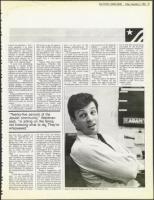
Benjamin Waldman: Reagan could lose 41 states and still win.
17