

2
Friday, October 26, 1984
THE DETROIT JEWISH NEWS
PURELY COMMENTARY
•
PHILIP SLOMOVITZ
Memorable dates: when pioneering engineers took pride in Technion
When the Detroit Chapter of Technion
marks its annual assembly of supporters,
in the coming week, a handful will surely
recall that this year marks six decades of
notable activities in behalf of the Israel
Institute of Technology whose achieve-
ments match the most creative in its field.
It was some 60 years ago that a group
calling itself the Zionist Engineering
Society really served as the opening wedge
for many years of identification with the
Technion of Haifa, Israel.
True: there were earlier beginnings,
when Shmaryahu Levin, who served as an
elected member of the short-lived Russian
Duma (a mockery for a parliament), found
refuge in the United States during World
War I and enrolled Detroiters' support for
Technion, among other. Zionist move-
ments. Dr. Leo M. Franklin, never a
Zionist enthusiast, was among those who
embraced Shmaryahu Levin in the move-
ment. Fred M. Butzel was among the early
enthusiasts who befriended the eminent
visitor and encouraged his activities in
support of Technion.
It was to the Zionist Engineering
Society, a Detroit creation, that early
Technion devotions must be accredited:
To two men with leadership goes spe-
cial credit for that organizational attach-
ment. Samuel N. Heyman, just out of MIT
as a star student who made his way
through collegeby utilizing every means of
earning a livelihood for himself and also
assisting his family, saw the need for an
interest in what was then Palestine among
technical experts. A native of Jerusalem,
Zionism was his major devotion next to his
engineering profession. He joined with a
small group of engineers in sponsoring
that society and his right-hand man in the
effort was Leo Friedlaender, a most distin-
guished member of his professional field. A
graduate of the Berlin (Germany)
Polytechnic Institute, Friedlaender was
associated upon his arrival in this country
with Charles Steinmetz in the General
Electric Co. main office in Schenectady,
N.Y. The rise of the automobile industry
brought him to Detroit and he had an im-
portant role with Chalmers and other con-
cerns with important professional assign-
ments.
Both Heyman and Friedlaender merit
serious consideration in lengthy articles
-
Technion "historian" Helen Dushkin
about the careers of noted Detroit
engineers who also were Zionist pioneers.
Such was the beginning, the Bereshit,
in Technion's history. The 60 years of its
activities are linked with many names of
distinguished technicians and engineers,
including a number in leadership in the
movement.
The ingathering of some facts regard-
ing Detroit Technion history is attributa-
ble to a lady with a sense of history, who
may-well be among the best informed per-
sonalities about the Detroit Jewish com-
munity. Helen Dushkin is as alert now, at
88, as she was in her youth when she was
associated with her parents in the Jewish
National Fund, Hadassah, the synagogues
of her parental choice — and with a special
dedication to Technion.
Helen Dushkin's mother, Fanny Sac-
hse, was affiliated with every traditional
and Zionist movement. Her father, Eli, was
especially active in Cong. Beth Tefilo
Emanuel and was treasurer of the Jewish
National Fund Council of Detroit. Helen
follows a family tradition, in the syna-
gogue, Hadassah, JNF, Zionist devotions.
She is one of the leaders in ranks selecting
speakers for the Jewish Book Fairs of the
Jewish Community Center and its af-
filiates.
Her interest in Technion makes her
sort of an historian of the movement's ac-
tivities here. She remembers the pioneers
in Technion.
Among the important names who play
a major role in her extensive corre-
spondence with notables is that of the late
Alex Taub. Taub held important positions
in the General Morors Corporation. He was
widely acclaimed as an expert in many
engineering projects. Like a number of his
contemporaries, he did not reach a very
high role at GM. The only Jew to do that
was Meyer L. Prentis, who became General
Motors treasurer. It is recalled that, as a
member of the bookkeeping staff, Prentis
had refused to sign a $2,000,000 check for
something he considered unwise for the
corporation and he was rewarded with the
treasurership.
Helen (Mrs. Max) Dushkin earns
appreciation for constantly recalling
names of pioneers, with emphasis on Alex
Taub, and there are legendary references
to that distinguished engineering pioneer
and his Technion and Zionist interests.
Helen has elicited from Taub's son,
Edward, a most interesting story about
Taub and his conferences with David
Ben-Burion. Calling BG's attention to the
abundance of artichokes that grew wild in
Israel, he suggested that they could be con-
verted to alcohol. Taub proposed it as
something that could be Used to the coun-
try's advantage.
Thereupon Ben-Gurion said to Taub:
"I have a superabundance of political par-
ties. Have you a suggestion how I could
A `Kol Bo' Cantor
The puzzled electorate . . and some issues at hand
Jacob Sonenklar was more than a
Shaarey Zedek Shaliach Tzibur, an inspi-
rational emissary for his congregants on
all occasions. He was the nationally ad-
mired synagogue singer who gave dignity
to all occasions when his services were
utilized. He was especially the revered ac-
tivist in every important community cause
and was as much a volunteer as he was a
functionary. He was a "Kol Bo," the all-
inclusive interpreter.
A special link
with the Zionist com-
munity gave him -
leadership in a circle
that held aloft the
banner of Zion. The
Sonenklar home be-
came a center of ac-
tivities for the Zionist
Organization of De-
troit along with
pioneers in the
movement in the Sonenklar
1920s and 1930s.
There were rotations with his home and
those of Rabbi A.M. Hershman, Dora and
Joseph Ehrlich, A.M. Zackheim, Robert
Marwil and others too numerous to men-
tion. The Saturday night functions they
instituted in their homes became the Sing-
ing Zionist Assemblies, music for them
having been inspired by Cantor Sonenklar.
As an activist, Cantor Sonenklar
formed an especially productive team with
Harry Cohen in the United Hebrew
Schools and in Zionist membership
enrollments and in Keren Hayesod and
Keren Kayemet volunteerism.
Both as the inspired synagogue singer
and community activist, Jacob Sonenklar
inscribed his name indelibly in Detroit
Jewish community history.
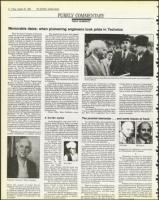
David Ben-Gurion meets Detroiter Alex Taub. The man in the center is an unidentified
Israeli official.
convert them to some sort of advantage?"
There is an untold number of stories
about pioneers in Zionist movements and
their creative efforts, with Technion serv-
ing as a path toward progress in Israel.
Sixty years of Technion activities here
have given that movement a position of
glory in Greater Detroit Jewry's devotions
to Istael. Every reminder of the pioneers —
and there were scores of them — Ben Wilk,
Leon Komisaruk Kay and many others —
merits attention. Alex Taub had a leading
place in that cast of characters. It is well to
remember these.pioneers while a new gen-
eration becomes equally dedicated to a
great movement.
In a matter of days, the puzzled ballot-
ers for the most important office in the
world will be relieved. The majority will
decide for them. At the ballot box, the voter
usually resorts to common sense. Only ten
days from the Day of Decision, it may well
be said, if polls are to be trusted, that most
voters have made up their minds, and only
a fraction is undecided. Even the fraction
could affect the results, but 1984 is an un-
usual year, with predominating prefer-
ences and determined attitudes.
There is one assumed certainty in the
pre-election disputes: that like most of the
world this country has gone conservative.
When politicians panic over the appella-
tion "liberal," it's a sad time in social ex-
perience. It was not so long ago when the
Soap Box Orator was an accepted character
on the American scene. He was the long-
haired socialist and in only a few spots did
he succeed. There was a socialist mayor in
Milwaukee and a socialist member of Con-
gress elected by the New York East Side
liberals. Now such characters might con-
front danger from infuriated conserva-
tives. True: there were reactions then as
well, in the 1920s. An attempt was made to
expel Meyer London, the socialist Con-
gressman. But the Soap Box Orator was
tolerated as a link in the American democ-
racy. Now one must hope that what is con-
servatively predominant will not become
atrociously reactionary.
There is no reason for testing patriot-
ism with prejudiced eyes, with fears lead-
ing to panic. A liberal is as patriotic as
rightists of either- party, and both major
parties possess them.
Most to be regretted, therefore, in the
pre-election aura, is the abandonment of
the liberal formula, the fear to be thus
Fulbright
McGovern
designated, the emphasis on conservatism
as if liberalism were a disease.
•
Remembe'r Franklin D. Roosevelt's
"We have nothing to fear but fear itself."
It is applicable now in many respects.
Take Jesse. Jackson as an example of
fear-mongering. In some quarters it has
been heard that one must confront Demo-
cratic candidates as disease-ridden be-
cause Jesse Jackson could be given a lead-
ing post in a government dominated by
Democrats — mainly out of the party's de-
sire to assure support by all blacks at the
polls. Even such fears must be viewed cau-
tiously. A Jackson in office would be ex-
pected to be fairminded and sensibly mod-
erate.
Political party leadership is expected
to be realistic and to go full length to reject
prejudiced judgments. There is an appli-
cable experience on record. When George
McGovern was running for President on
the Democratic ticket, in 1972, fear was
expressed in Israel that if elected he would
appoint Senator J. William Fulbright, the
Continued on Page 26