

26
Friday, October 12, 1984
THE DETROIT JEWISH NEWS
doing all that we are doing if people didn't feel our work
was important. The people support us. That's the proof."
And what does Simon Wiesenthal have to say about all
of this — the praise, the criticism, the controversy? Since
he lives and works in Vienna (though he keeps in touch
with Rabbi Hier through frequent phone calls), he is able
to stay above the fray, taking credit for what he is proud
of and shrugging off any criticism as the work of the Center
officials in Los Angeles.
During an interview with Wiesenthal, who was in the
U.S. for a speaking tour, he defended the work of the
Center as essential. "I don't just talk about the past, I
talk about the consequences and look to the future. And
that is how Rabbi Hier works, also."
He laughed when told that Rabbi Hier is criticized for
his methods. "He knows how to make publicity," said
Wiesenthal. "We needed $3 million for the film 'Genocide,'
a very important film. How can you get $3 million without
publicity, I ask you?" He said the Center is "for Holly-
wood," and it is proper to make use of entertainment
figures to further the Center's goals.
"We have done in Los Angeles what has never been done
before. The museum is only a help, but the main purpose
is to be action-oriented."
As for criticism that the Wiesenthal Center exaggerates
the degree of Anti-Semitism in America, he responded: "It
can happen in every country, believe me."
'Where Can You Go From There?'
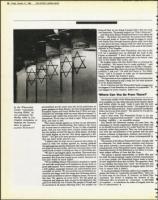
Is the Wiesenthal
Center "constantly
burying Hitler," as
one prominent On
rabbi in Los
Angeles complains, or
keeping the memory
alive to prevent
another Holocaust?
personalities are the same ones who invite politicians as
guest speakers at their dinners. Do they bring dignity and
Elizabeth Taylor and Orson Welles don't? Why not com-
municate our message with the most effective means? A
criticism is only valid if the critics don't do the same thing
themselves. We do what we think is right. When you look
back, you turn to salt.
"The worst charge against us is that we are alarmists
and over-react to anti-Semitism. But which is the worst
sin: to over-react or under-react? To me, it's like a baseball
game. Did you ever notice how a batter stands when he
has two strikes on him? He digs in a little deeper. He holds
his hands higher on the bat. His whole approach is dif-
ferent — he's got to be more protective because he knows
that one more strike and he's out.
"I believe that we Jews are at a point in time where we
stand in with two strikes against us, having suffered
through pogroms and the Holocaust this century. We Jews
are down to our last strike, and I say we must take a very
careful look at what's coming our way or we'll strike out.
"We say it can happen again, anywhere. The worst that
we can be accused of for being ever-watchful is that we're
paranoid. But if we don't keep up our watch, the price we
may pay would be much higher.
"We're fulfilling Simon Wiesenthal's mandate to speak
out and take action and we'll continue to do our work, to
grow and expand. We're undertaking a major expansion,
a $30 million campaign because our achievements have
exceeded our dream. We see ourselves as an Orthodox in-
stitution not happy with the image that Orthodox institu-
tions must be limited to narrow religious issues. We're not
like that. We operate on every front. We will speak up
whenever and wherever Jews are put on the defensive. Our
goal is to work for Am Yisrael (the people of Israel) and
be involved in all issues affecting Jews. We couldn't be
One former staffer of the Wiesenthal Center says he us-
ed to complain, in vain, about the tone of the Center's direct
mail letters which, he said, "make it seem like the next
Holocaust is right around the corner." He argued that not
only was this inaccurate but, "from a practical standpoint,
where can you go from there?" The answer he was given,
he said, is that "it works."
And it does work. The Wiesenthal Center is, by any
criterion of organizational standards — size of membership,
funding, visibility — an incredible success.
But should the Holocaust remain, 40 years later, the
centerpiece of Jewish experience? Rabbis and others tell
us we should be motivated by joy rather than fear, by com-
mitment rather than paranoia. They say such preoccupa-
tion with the anti-Semitism of the present and the past
creates a climate of depression, isolation and mistrust —
and renders virtually all other issues inconsequential by
comparison.
The success of the Simon Wiesenthal Center, though, tells
us otherwise. For while scholars, statistics and sermons
may -point towards a more positive Judaism, the pheno-
menal growth of the Wiesenthal Center suggests that the
haunting memory of the Holocaust is, for better or worse,
what makes millions of Jews feel like Jews.
This places a special responsibility on Rabbi her and
his staff. Having awakened a spark of Jewish consciousness
in so many people, the Wiesenthal Center seeks to bring
its new supporters from fear to faith. The question, then,
is not whether the Center has "used" the Holocaust, but
how. Not whether the Holocaust can happen again, but how
best to ensure that it doesn't.
If, as one prominent Orthodox rabbi in Los Angeles com-
plains, the Center is "constantly burying Hitler," there can
be little hope for the future. If, however, as Rabbi Hier
maintains, the Center is keeping the memory of the
Holocaust alive to prevent its recurrence, it will fulfill
its mandate — to transform the ashes of tragedy into the
fire of commitment. $