

Friday, September 7, 1984
15
Bill Pugliano
THE DETROIT JEWISH NEWS
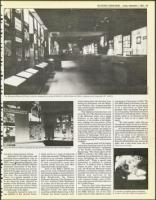
The Holocaust Memorial Center's interior, designed as a series of dimly lit, subterranean corridors, creates an eerie impression for visitors.
Life in the Warsaw Ghetto is detailed through panels displaying maps and photographs.
was such a large element of luck.
Detroiteis of the baby-boom and
post-baby-boom generations may be
I surprised to learn, through one of the
HMC's more siisturbing displays, that
between April 1943 and May 1945 the
systematic destruction of the Euro-
pean Jewish community was not con-
sidered front-page news by any of the
three major dailies serving the city at
that time. The now-defunct Detroit
, -Times, in a typical example of the
r treatment the Holocaust was accorded
by the American press, informed its
readers of the discovery of the exter-
mination of some two million Polish
Jews with a three-inch story buried on
an inside page of the paper.
Among the museum's most mov-
ing exhibits is the eternal flame,
-
which serves as a kind of memorial
within the memorial. Thetas flame is
centered on an elevated, cobblestone
patio, on which is engraved the name
of each concentration camp that
claimed Jewish lives and each labor
camp that broke Jewish spirit.
Each of the HMC's lifelike dis-
plays is the work of British architect
and museum designer James Gdrdner,
best known for his accomplishments at
Beth Hatefutsoth, the Nahum
Goldmann Museum of the Diaspora in
Tel Aviv. Gardner's Beth Hatefusoth
is, in fact, one of the two main refer-
ence points in reaching the over-all de-
sign and philosophy of the Holocaust
Memorial Center. The other model,
according to Rabbi Rosenzveig, is Yad
Vashem, the Israeli museum dedi-
cated to those Jews who lost their lives
during the Holocaust and the Right-
eous Gentiles who, at great personal
risk, acted to protect the Jewish people
whenever possible.
The Righteous Gentiles have not
been left out of the Detroit monument
to the Holocaust either. On a raised
platform, to the right of the HMC
entrance, is the Garden of the Right-
eous, perhaps the one portion of the
center which can claim the most direct
community involvement. The as-yet-
to-be-completed garden has begun to
take shape largely through the efforts
of Prof. Paul Chu Lin of the Lawrence
Institute of Technology. Prof. Lin in-
itiated a formal design competition for
the garden among LIT's architectural
students.
The museum itself will be highly
automated, boasting some of the most
technologically-advanced equipment
in the world, according to Rabbi
Rosenzveig. The visual aspect (of the
HMC) is critical," the rabbi said, ex-
plaining the proliferation of video sc_-,
reens throughout the underground
exhibit hall. "When a person sees
something, in addition to reading
about it, it tends to have a lifetime
impact on him." Also in the visual
vein, the Holocaust Memorial Center
features a multiscreen theater, where
excerpts from interviews with scores of
Detroit area survivors of the
Holocaust will be shown, intertwined
with newsreel footage, some of Ger-
man origin and never before shown in
the United States.
Then too, there is the educational
aspect of the multi-million dollar proj-
ect, something that was, according to
the HMC director, one of his main
goals when he first agreed to oversee
construction of the center in 1964. "We
(the HMC board of directors) were de-
termined that this was not just going
to be a monument to those that
perished. This, we decided, has got to
be a living thing. The Holocaust center
has got to be something where, when a
person comes in, he becomes excited
enough to want to see it again and
again.
We want people, when they go
through the center, to see it as the be-
ginning of an educational experience."
It is for this reason that a portion
of the building has been designed as a
state-of-the-art Holocaust archive. Set
off in one corner is an extensive li-
brary, including some 600 volumes
donated by Jewish News Editor
Emeritus Philip Slomovitz. Just to the
right; and a step down from the li-
Continued on next page
A number of exhibits feature television
monitors and other high-tech equipment.