

Jewish News Back-to-School Supplement
Jewish News Back-to-School Supplement
an accurate assessment of
his intellectual level can be
made.
Once you have . deter-
mined that the child is dys-
lexic, remediation should
begin at once. Because of
the child's auditory and vis-
ual processing problems, he
needs to be taught by a
method which will incorpo-
rate the tactile-kinescetic,
or movement-touch, in the
learning process. This is the
way that Helen keller was
taught to read and write,
and it will work with a dys-
lexic child as well. Feeling
the letters, by writing them
in a tray of sand, while say-
ing the sounds that the let-
ters make — and again feel-
ing the sound in the throat
and the position of the
mouth when the sound is
made — will enable the
child to see, hear, and, most
importantly, feel the letters
and their sounds simul-
taneously. This process will
reinforce the relationship of
the letters to the sounds.
It's hard to imagine, but
this really works. One of my
students did not like to
"play in the sandbox," as
she called it, until the day
came when she could not
remember what letter made
a certain sound. I had her
place her finger in the sand
and say the sound, and this
triggered her memory,
much to her surprise- and
my delight. This same stu-
dent memorizes spelling
rules by attaching physical
movements to the words - of
the rule and her "cheerlead-
ing" technique has aided
her tremendously.
It's also important to pre-
sent the elements of the
language in a simple and
organized way. To help the
child learn to organize
words sequentially, I some-
times give him comic strips,
cut into their separate
panels, and ask him to ar-
range them in order.
Adults, of course, prefer
more adult methods of
learning. One of my older
students has taken up bak-
ing as a hobby, in an effort
to improve his sequencing,
abilities. The, only problem
with this, hitells me, is that
he still has to eat his mis-
takes.
A reading tutor that I
know — . the mother of a dys-
lexic boy, and dyslexic her-
self — emphasizes that the
child has not learned the
letter, or the spelling rule,
until he can repeat it back.
She herself remembers
things by pibturing them in
her mind, as specifically as
possible. She can not always
recall the words, but she can
recall the picture, and by
loing so, she can remember
the basics of what was said.
'Content is everything,"
she says. "You can tell the
lifference between yester-
lay and tomorrow because
resterday, has content."
(
•
I
.SymptomS of. Dyslexia
At School
Reading Does your child read below his grade or intel-
lectual level? When reading aloud, does he guess at long
words? Omit or misread small words? Does he confuse simi-
lar letters, like, b and d, or p and q?
Writing Does he have poor handwriting? Is he a chronic
misspeller? Does he reverse letters, syllables or numbers?
In the Classroom Does he have a short attention span?
Can he repeat what the teacher has just said? Are his
grades poor or mediocre, despite his intense effort? Is he
disorganized?
At Home
Speech Does your child have difficulty distinguishing
between similar sounds like m and n or s and z? Does he
mispronounce or transpose words? Does he forget what he
is about to say? Is the name "on the tip of his tongue" or is it
"you know, whatzisname?"
Physical History Does he have allergies? Is he left-
handed or -footed? Ambidextrous? Can he tell left from
right? Forward from backward? Does he have difficulty
with "ball sports" like tennis or baseball despite athletic
ability?
It is important to remember that any of these char-
acteristics may appear separately in the average child, and
that we all have these problems from time to time. The
surest test of possible dyslexia in your child is his reading
ability. If he is not reading at the level he should be and
other physical and emotional problems have been ruled
out, chances are good that he is dyslexic.
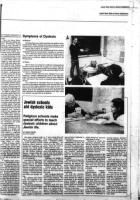
Jewish schools
aid dyslexic kids
Religious schools make
special efforts to teach
dyslexic children about
Jewish life.
BY HEIDI PRESS
Local News Editor
How does a dyslexic child
gain a "Jewish education?"
In Detroit, special efforts
to teach dyslexic Jewish
children about Hebrew,
Jewish life, traditions, and
rituals are being made
through' programs offered
by the ,United Hebrew
Schools, Temple Beth El's
-religious school and by
P'TACH (Parents for Torah
for All Children).
According to Bayla Land-
sman, special education
ccordinator at the UHS,
special reading programs
tailored to groups and indi-
viduals are offered to teach
dyslexic children about the
holidays, Jewish history
and Bible and Jewish val-
ues.
For children who cannot
read, the program is, tai-
lored according to each
child's ability.
"We don't put presaure on
them. They learn according
to their potential," Mrs.
Landsman said.
About 15 dyslexic chil-
dren, ranging in age from 7
,
to 17 and coming from all ing and heavy emphasis on
three major Jewish tradi- the physical.
tions — Orthodox, Conser-
Dyslexic children have an
vative and Reform — are opportunity to learn via
involved in the UHS pro- computer, much like their
gram, which has been in non-dyslexic counterparts.
existence for six years.
However, where there peers
Mrs. Landsman said chil- are studying math, spelling
dren of all abilities are ac- and "regular" classroom
cepted . into the program. subjects, the dyslexic chil-
Bar mitzvah training also is dren are learning left to
available.
right progression and simi-
Children are taught in lar skills.
small groups, but one-to ,- - - Although the temple fol-
one instruction,' according lows the Reform Jewish
to the child's strengths and tradition, the special reli-
abilities can be obtained.
gious school program in-•
Classes meet for two cludes childrem from Or-
hours on Sundays and at thodox, Reform and Con-
least one more hour during servative homes among its
enrollment.
the week.
Mrs. Landsman said that To help the children
synagogue skills are impor- understand some of the con-
tant to the program. "We cepts, parents are asked to
want students to feel part of participate. In the teaching
and comfortable in the con- about Shabbat, parents
helped prepare a Shabbat
gregation."
Temple Beth El's Pro- dinner which was served at
gram for Exceptional Chil- the. SaTurday morning
dren is a "doing kind of meeting of the class.
class," according to Rose , Teaching also is done on a
Werney, coordinator of the one-to-one basis. Mrs. Wer-
program. There is less read- ney said she is aware of each
s
child's limits but "we try to
help the
m do more."
Trained to teach ,the
learning disabled, Mrs.
Werney is joined in the pro-
gram by another teacher
trained in LD and by a so-
cial worker who is the music
and Hebrew teacher.
Reading materials for the
five dyslexic students in the
Beth El program are geared
to each child's grade level.
According to Mrs. Werney,
none is severely dyslexic. If
that were the case, then
tape recordings would be
provided.
P'TACH
teacher-
administrator
Rabbi
Shmuel State said' the
thinking of that particular
group is that kids should
spend some time in a "reg-
ular" class. They are taken
out of the class as necessary
for Hebrew and other
Jewish subjects.
In teaching dyslexic chil-
dren about holidays and
traditions, Rabbi State said
"there is no difference in
serving dyslexic children"
and non-dyslexic. All are
encouraged to take part in
holiday discussions. For
Pesach, Rabbi State finds
an area in which the dys-
lexic children can partici-
pate, such as singing songs.
"I like to give them a
hands-on approach, one
that they can use right,
away."
Last year there were 12
boys in the program, rang-
ing in age from 7 to 13. All of
the childien come from Or-
thodox homes, but Rabbi
State said that non-
Orthodox are welcome.
Visual aids are an impor-
tant part of the P'TACH
prograin for (I) Jlexic chil-
dren- . The blackboard, pic-
tures and outlines for chil-
dren to color are important
tools for instruction. .
The key to teaching his
dyslexic students, asserts
Rabbi State, is stimulation.
"You have to stimulate
them so you can draw them
out a little."
I ,
,