

80 Friday, July 20, 1984
THE DETROIT JEWISH NEWS
SCORE
ST ARS
FOR
ELI -ZARET
k.n
BY NORMA ZAGER
Special to The Jewish News
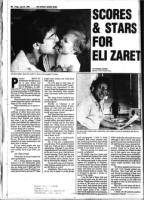
Eli Zaret plays "pass the cookie" at home with daughter Cortney.
r j
'
opular
WDIV-TV
sportscaster Eli Zaret grew
up in Ann Arbor and
grauated from the Univer-
sity of Michigan. In addi-
tion to his TV work, Zaret also hosts a
morning sports show on WRIF Radio.
He lives in West Bloomfield with his
wife, Patty, and one-year-old daugh-
ter Cortney.
Zaret recently had a candid dis-
cussion about his career with Norma
Zager of The Jewish News:
What interested you in sports re-
porting?
I was always a fan as a kid like
millions of other boys and never
really had the long-term dream that
I'd be a sportscaster down the line. I
always liked English and reading
and when I got to college, I liked
media and studied the technical as-
pects. I had a few jobs in that end as a
director at a little cable TV station
and one thing led to another.
A radio programmer in Detroit
at a rock and roll station in the early
seventies said I think we need sports
if it can be done a little differently on
the air. He knew me and asked if I
wanted to do some commentary and
that's how it started.
Do you resent people who may
think because you're young you ha-
ven't worked hard to get where you
are?
Am I that young?
Thirty-four is young compared to
other sportscasters.
It's a young person's business,
believe it or not. Nationally, there
are sportscasters even younger than I
who are doing well. I didn't get into
television until I was 30 which is ac-
tually kind of old to get into TV. Most
people start earlier, but I had done
radio before.
I'm very glad to have done as
well as I have while I'm still "young."
If there's any resentment it's the
normal thing that happens to anyone
who has something other people
want. Age doesn't seem to be a factor
here.
Has being Jewish hindeied you
in any way? Have you had to deal with
anti-Semitism?
Briefly at Channel 4 all
sportscasters were Jewish. If any-
thing, we were well over quota. I
think if it were 30 or 40 years ago it
would have been a factor. •
Anti-Semitism has never been a
problem. In fact I could even imagine
it helping in that Ackerman is
Jewish and he was there before me.
Cosell is Jewish and he was there
before me. I think Jews are kind of
looked at as capable in terms of jour-
nalism and if anything the
stereotype might have even helped,
not hurt. But really, I don't think it
was a factor at all.
Did you have a traditionally
Jewish homelife as a child?
No, it was not a traditionally
Jewish home. I'll be perfectly honest
with you, I did not have a religious
upbringing. Although it was always
emphasized and I was told to be proud
of the fact I am a Jew, I did not have
formal training. That's just the way
my parents did it and of course• if
you're Jewish you're Jewish, but as
far as knowing the religion, I don't.
Do you feel some sort of responsi-
bility because people look at you and
say Eli Zaret is a Jew?
Absolutely. That is why I go out
of my way to speak to youth groups
LYJ i)
c
1,I131U1i0
V
'Al.
TEP, ROM
r,
ItIPW11 ,
!.1 1,1
An Ann Arbor native with a distinctive voice makes a name for himself in the Detroit
sports world.
and synagogues. I. talk to Adat
Shalom's kids every summer and,
yes, I want to go out of my way to keep
this identification up. If there's any
consciousness in the community I am
Jewish, I want them to know it.
Did your parents ever guide you
toward a profession?
My family was very music and
arts oriented and I played the violin
for many years. My brother, whom
I'm visiting next week, is the concert
master of a symphony in Virginia.
Classical music'was always stressed
in our house, at the expense of other
types and think my parents were
really musical snobs in a sense. Was
it stressed to become a doctor or
lawyer? Not really.
I was the last of three kids and
my parents were over 40 when they
had me. I think most of their energies
in terms of "We want you to become
this or that" had already been spent
by the time I came along. They didn't
really expect much of me. I didn't
show much inclination toward music,
calthough'I'didit.and vas good at it: I.
t•
didn't really like school all that much
although I did it and I was pretty
good at it and they just figured I'd do
all right because I was a normal kid.
I think they hoped that my big
brother would try to direct me to
beome a violinist, but I faded on that
too. In fact sports was always poo-
poohed in my house as an unintellec-
tual waste of time. They discouraged
my older brothers from participating
in sports because they were afraid an
injury might interfere with their
music.
My father passed away two years
ago and I had already gotten into
television. Once I got into my field
and started developing it they were
very proud of what I did. My mother
still lives in Ann Arbor and listens to
me every morning on the radio and
struggles to stay up late and see me
on television.
How do you feel about all the at-
tention? Do you resent intrusions on
your privacy?
I think it's 90 percent positive
'Continued on Page 36
.
,