

H DETR IT
TWO YEARS as cabinet sec-
retary made Dan Meridor one of
Israel's famous faces. That's no sur-
prise in Israel, where the soft-spoken
attorney-politician appeared on TV
screens almost every week from 1982
until early this year, in his role as the
cabinet's official spokesman.
But the measure of his celebrity
abroad did come as something of a
shock to Meridor, who recently disc-
overed that he has become one of the
most sought-after Israeli figures on
the U.S. lecture circuit..
Now Meridor, 37, is poised to
enter the political arena in his own
right, as one of the new Herut candi-
dates for the 1 1 th Knesset.
In the young candidate, one sees a
pronounced. continuity with the
heritage of his late father, Eliahu,
one of the most likable Herut MKs in
the early years of the Knesset.
His father immigrated in 1936,
rapidly becoming one of the heads of
Betar in Jerusalem, and subsequent-
ly a commander of the Irgun. Since
his childhood Dan Meridor remem-
bers the presence of a huge portrait
of Ze'ev Jabotinsky on the wall of
the living room in their Rehavia
home.
His father was close to the prophet
of Revisionism, working with him in
Europe, and he remained a close
friend and follower of Jabotinsky's
heir, Menachem Begin, both in the
underground and in the post-
independence political wilderness.
He became a well-known Jeru-
salem attorney, and his son has fol-
lowed in his footsteps, not only into
politics but into the same law office.
Politics, in fact, was only one ele-
ment that contributed to the cul-
tured atmosphere of the Meridor
home: upstairs lived Dan's maternal
grandmother, a highly-educated
woman who translated German
poetry into Hebrew. His Vienna-
born mother has taught classical
Greek at the Hebrew University for
many years.
"IT WAS VERY difficult belonging
to Herut. There was great hatred
towards the party, which was treated
as a pariah for too long," he says,
explaining his background.
He never had doubts about his fu-
ture: he was going to become a
lawyer like his father and his grand-
father back in St. Petersburg. Thus,
on completing his army service in
1967, he entered the Hebrew Uni-
versity Law School. Soon after he
married his wife Liora, who is no
"stay-at-home" aside from raising
three children (two boys aged 10 and
eight and a daughter, four) she holds
down two posts, that of economics
lecturer at the Hebrew University
and senior economist at the Bank of
Israel's research department.
I mention Yossi Beilin's research
on the generation gap in Israeli poli-
tics. Meridor thinks the concept ap-
plies more to Labour, where the sons
were never given a chance by their
fathers.
"I disagree with Beilin. It's not a
case of a land that consumes its sons,
but a party," he says, a hint of the old
anti-Mapai antagonism in his cordial
tone. The second generation of
Herut were certainly given an oppor-
tunity to make their way in politics,
says Meridor, citing Menachem Be-
gin's firstborn, Binyamin Ze'ev, and
the late Haim Landau's son, Uzi, all
three friends since boyhood. But
Meridor is especially close to
Binyamin Ze'ev, a natural consequ-
ence of the friendship between their
fathers. In the Meridor home, the
Herut leader was always referred to
simply as Menachem.
For the young Meridor, Herut was
a movement, not a party. The Mapai
leaders' sons rebelled, he argues,
because there was an establishment
ISH N W
Up and coming
New faces are few and
far-between on the Likud
and Alignment lists.
Mark Segal interviews
two of the young
hopefuls.
to rebel against. "Since childhood
Herut was pure Zionism for me. We
followed our fathers because there
was nothing to rebel against."
He is one of the few people who
coq,tinue to see the former premier
regularly, apart form immediate
family members and Begin's faithful
aide, Yehiel Kadishai, his contact
with the Prime Minister's Office.
BEFORE BECOMING govern-
ment secretary in April 1982, Meri-
dor built up his law practice and
was active in Herut, both in the
Jerusalem branch and on a national
level; he was chosen for the party's
Central Committee as early as 1968.
He served on the national executive
for many years and was in charge -of
youth activities.
Highly regarded as government
secretary, in which capacity he did
not pick fights with the media like his
predecessor, Arye Naor, Meridor
served under two prime ministers in
a stormy period encompassing some
of the most dramatic events of our
recent history.
He began during the evacuation of
Yamit and stayed on until after the
Begin resignation and the swearing-
in of Yitzhak Shamir.
His most onerous task was coping
with the hostile world media during
the war in Lebanon.
It was a heady experience for him
to be at the very heart of the power
process, Meridor says, adding that
those two years as government
secretary offered him far more in-
sight into the working of government
than a decade of political science
studies.
It was fascinating, Meridor re-
calls, working close to Menachem
Begin. "I was witness to historic
decisions. I knew everything that
was happening. Then I would read
the papers and see how little was
known," he says.
THESE ELECTIONS are different
because they are the first without
Begin, just as Herut is a different
party minus the former premier.
Meridor shows his political skill by
dodging the issue of the future lead-
ership and the inevitability of a Shar-
on takeover. He is ready only to say
that Shamir was the party's choice
for the premiership, and so the lead-
ership issue is not under discussion.
To his mind, power during the
post-Begin era will be shared by the
leadership and the Knesset faction.
"It will be a different kind of party,
without the clear-cut guidelines and
solid ideological vision radiated by
Menachem Begin," he declares
earnestly.
Tackling the issues facing elec-
torate, the Likud candidate says
voters are offered a clear choice
regarding the shape of the country's
future. The main issue is the integri-
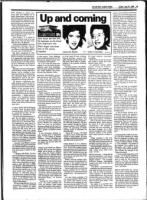
Likud's Dan Meridor
oPpAi Labour's Yossi Beilin
(Brutrnannl
the target audience, proceeded
accordingly.
Beilin points. out that for the first
time Labour is going after disen-
chanted Likud voters.
An aggressive strategy, Beilin
argues, would be counter-
productive: in this campaign, it
could actually alienate that target
audience.
Beilin strongly denies that Labour
campaigners had allowed them-
selves to become complacent. On
the contrary: nothwithstanding the
big gap in Labour's favour in the
polls, even at this late stage, they are
still haunted by the 1981 trauma,
when the huge margin in their favour
began to shrink rapidly in the final
stages of the campaign.
THE YOUNG LABOUR candidate
differs from many of his colleagues
in contending that.the war in Leba-
non and its unsettled aftermath does
play a significant role in the reduc-
tion of support for the Likud:
"Moreover the government doesn't
have a case to present as regards its
failure in Lebanon. It cannot escape
the consequences of its actions.
"Of course, the central issue in the
campaign - much as the Likud dis-
MERIDOR DWELLS on "the so-
likes it - is the failure on the econo-
cial revolution" the Likud brought
mic front. The Lebanon operation
about during its seven years in office.
should be regarded as a central ele-
"Large segments of the population
ment in the Likud's mismanagement
who were alienated have been
of the country's affairs," he declares.
brought into the mainstream. You
This is the first election without
no longer hear of a "second Israel;"
Menachem Begin, which deprives
the Likud has abolished it. We have
the Likud of its most persuasive
done wonders through the Project
communicator: "He managed to
Renewal scheme in 80 neighbour-
overcome the basic irrationality of
hoods. The percentage of people
his party's message. As in 1981,
enjoying access to education has
when he managed to paint a bright,
risen markedly.
attractive picture of his govern-
"Above all," he says, "the Likud
ment's dark record for so many vo-
accorded a sense of pride and self-
ters.
respect to many people. We have
"Begin managed to talk away
wrought a tremendous social change
soaring.inflation and the failure of
that will be felt for generations."
the peace process he had started. He
managed to present failure as a suc-
YOSSI BEILIN at 36 is definitely
cess story by his gifts of oratory.
one'of the coming men in the Labour
"But what Begin could do in 1981,
Party. He has been a highly popular
Yitzhak Shamir is unable to do in
party spokesman since he joined the
1984. Today those tricks won't
staff of party chairman Shimon Peres
wash," he says.
back in 1977, and he has seen the
party pick itself up from the depths
BEI LIN'S parents — along with the
of its debacle and climb back to the
rest of the household - were fervent
gates of power.
Hebraists and were active in "Gdud
Beilin is also the youngest candi-
Maginei Hasafa" - the Language
date on the party list, having made it
Protection Brigade, admonishing
because of the political base he
people in the street if they did not
moulded in the Mashuv ideological
speak Hebrew.
circle of younger party activists.
Yossi Beilin - a pronounced dove
Beilin should make an interesting
- remembers that the prevailing poli-
Knesset member, for he is that in-
tical mood at home was very haw-
creasingly rare creature in the Israeli
kish, with his father becoming a
political scene - the intellectual en-
strong supporter of Ben-Gurion's
gage.
activism until the end. Yet at no time
did his father seek to influence his
Isn't the Labour campaign a bit
two sons' political views, and took
too mealy-mouthed? Beilin thinks
them to all the party rallies - from
not. Quite to the contrary, he says.
The thrust of the campaign, he says,
Herut to Mapam.
His talents as a journalist were
has been cleverly crafted. The cam-
revealed fairly early - he was editor
paign planners had thought things
of the school journal and a youth
out very coolly and, after analysing
ty of the Land of Israel. Looking
beyond ideology, security and
rights, Meridor says the Likud is the
only party which offers a realistic
solution to the problems besetting
Eretz Israel.
"The main premise in the Middle
East is that strength is the only basis
on which to build peace. Peace can
be no substitute for security. There is
no way Israel can conceive making
concessions in Judea, Samaria, Gaza
and the Golan, but at the nub lies
Judea and Samaria. People with the
Zionist dream in their hearts find it
impossible to tear out the heart of
Zion. Jerusalem, Hebron, Shiloh -
it's what Zionism is all about."
He further argues: "Labour has
no real solution to offer. Territorial
compromise won't work; it has never
worked. The Arabs are not ready to
make concessions. They want all the
territory. It was Begin's genius that
produced a feasible way out at Camp
David by offering the autonomy
scheme, and leaving the sovereignty
issue open. The Likud built two
pillars for its policy - peace with
Egypt and settlements in the areas."
ay 4Ju
20, 19 4
reporter for Israel Radio school broad-
casting. He served in the signal corps
and his army service included the Six
Day War. Almost immediately after
demobilization, he marrried his
school-day sweetheart, Helena, and
they studied together at Tel Aviv
University. Helena attended law
school and worked in government
service while raising their two chil-
dren now aged 12 and six. Helena
Beilin is today one of the top three
crime fighters in the Tel Aviv Dis-
trict Attorney's office.
Yossi Beilin did his BA in political
science and Hebrew literature, and
then went on to graduate studies in
political science. His doctoral thesis,
completed earlier this year, is enti-
tled "Inter-generational Rifts in
Three Parties in Israel," due to be
published later this month in hook
form (under the Revivim Imprint) as
Sons in the Shadows of the Fathers.
WHILE AT university, Beilin work-
ed as Davar's TV and radio critic, as
well as contributing a regular politic-
al column. From there, he moved to
Peres' bureau as his spokesman after
the 1977 elections.
It has been a fascinating experi-
ence to erve as a participating
observer atqngside the Labour lead-
er: "It's the best possible school in
politics. I learned all there is about
the process of reaching political deci-
sions, about political debates and
poltical formulations.
"I was able to meet the top inter-
national statesmen in Peres' com-
pany."
He has also had an unrivalled
opportunity to work close to Peres,
which is why he is confident that the
Labour leader would make a first-
class prime minister.
He really is one of the wisest
people I have met. I'm convinced
he'll he a very good premier. I'd
even venture to say that he'll quickly
become a popular premier. For in
our country popularity goes with the
position. People forget what a popu-
lar defence minister he was, and he
has paid a heavy price as leader of
the Opposition.
"I am for Peres because he is
sufficiently sensible and pragmatic
to actively make peace. He has a
fascinating vision of a Middle East at
peace enjoying the fruits of regional
cooperation. Peres is a man of con-
siderable imagination in political
matters and he will be sufficiently
courageous to take the kind of steps
others would not. That's the prime
reason I was drawn to work with
him."
CONSIDERING SOME of the peo-
ple and likely situations he would
have to encounter in politics, why
had he decided to take the plunge?
"I want to influence things. As long
as I can remember, I've wanted to
get involved. I'm a radical in my
philosophy, and I refuse to accept
any thing or idea without question.
That includes the concepts of the
Labour movement.
"I want to help bring about social
' change - I'm for greater equality in
Israeli society, much more than my
party is ready for. My concept of
equality certainly encompasses
Arabs and our approach to them in
Israel proper and beyond the Green
Line," says Beilin.
BEILIN BELIEVES the election
issue is clear: a choice between the
closed society offered by the Likud,
and the open, social democracy of
Labour. He sees distinct elements of
Peronism and Francoism in Herut:
"The Likud's appeal to the darker
side of human nature provided fer-
tile soil for the kind of extremism
that produced the extreme zealots of
Gush Emunim," he says.