

80 Friday, June 8, 1984
THE DETROIT JEWISH NEWS
The stereotypical Jewish
mother is disappearing from -
the American scene.
BY TEDD SCHNEIDER
Staff Writer
included an investigation of mothe4..
son relationship's among many prat-
inent politicians and artists. "Sara
Roosevelt had a profound effect on
her children, especially F.D.R.," the
author said, adding that many other
Presidents, including Harry Truman
and Lyndon Johnson, relied on their
mothers for advice not only in per-
"I felt that as a Jewish mother
sonal matters, but on affairs of state
(she has two adult children) I had
following their election.
certain obligations to my children,
even though I had a career as well. It
Renowned architect Frank
was extremely important to me not to
Lloyd Wright and cellist Pablo Casa>.
have them think I was neglecting
als also were heavily influenced by
them for anything that was of my
their mothers, Ms. Klein said. "Many
own self interest."
mothers single out one child in the
On the other hand, Ms. Klein,
family with prodigious talent and
who teaches women's studies at the
dedicate themselves to developing
New School and Goddard College in
that talent, often at the expense of
New York in addition to writing,
the other children."
thinks an active career may prevent
The author also discovered that
Jewish women from turning into the
the guilt factor in mothers' relaton-
overprotective, overbearing mother
ships with their sons, an attribute
popularized in books and movies. "I
which is often thought to be the sole
feel that I ' have consciously pulled
province of the Jewish mother, is ac-
away from over-investing in my son.
tually used by both mother and son
-I have enormous confidence that he
with equal skill. "Because mothers
will define what success is for him-
have been trained to put the male
self, but I won't be defined by him and
first; it's very painful to have a son
I hope he won't be defined by me."
who is upset with you. There is often
Ms. Klein took-nearly two-
a sense that you have failed him an&
and-a-half years to complete the re-
this is one of the ways in which sons
search and manuscript for Mothers
make mothers feel guilty."
and Sons, her fourth book. The non-
Meanwhile, mothers still raise
fiction author.conducted hundreds of
sons with a heavy dose of guilt
interviews with women and men of
Ms . Klein.
thrown in, according to
men
all ages and from numerous demog-
The result is that many feel that
raphic groups. The project appealed
they never quite measure up to their
to her ,because she felt mother-son
mother's expectations.
relationships had never really been
Jewish mothers have always
examined in any kind of depth.
been involved in every facet of their
"I came out of writing the book a
children's lives, more so than
great deal more sympathetic as to
mothers in other cultures or ethnic
what it means to grow up as a male in
groups, Ms. Klein asserts, "and it's
this society and I realized that if
more difficult than we realize to
we've overprotected little girls, then
break away from the old patterns."
we've also often underprotected little
While the "Jewish mother" has
boys. We have pushed boys into that
become an endangered species, it's
male identity much earlier than
probably a little premature to dis-
necessary."
miss her from our culture entirely.
Research for the 272-page book
women are becoMing more 'sub-
merged, the roles are more inter-
changeable." But for the Jewish
woman, this can lead to conflicts be-
cause family ties are still strong, she
said, using her own family to under-
score the point.
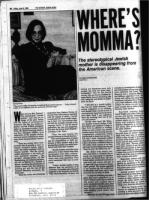
Carole Klein:
"The Jewish mother stereotype is not really all that prevalent anymore .. . Today's Jewish
mother is very different from the matriarch of 40 years ago."
W
here are. you Mrs. Portnoy?
The. stereotypical "Jewish
mother" may soon be an
image of the past, fading
into the fabric of contemporary
American life like the landsman-
shaften and the Yiddish newspaper
before it, according to author Carole
Klein. Ms. Klein's new book, Mothers
and Sons (Houghton Mifflin), is an
exploration of the complex mother-
son bond and its influence on nearly
every kind ofinterpersonal relation-
ship.
"There are certain ethnic back-
grounds that do provide a more in-
tensely emotional family experi-
ence," the author admitted while in
Detroit recently. "But the Jewish
mother stereotype is not really all
that prevalent anymore." The
gradual disappearance of the
domineering, yet endearing balabus-
tah can be blamed on a number of
factors, including the assimilation of
Jewish culture into the American
melting pot and the rise of the
women's liberation movement, Ms.
Klein said. '
While the initial wave of Jewish
emigration from Eastern Europe at
the end of the 19th Century coincided
with the ingress of others, "Jewish
immigrants had more trouble adapt-
ing to their new surroundings than
the Irish for example, because of the
language barrier. It was the second
generation, the sons and daughters,
who were the first to learn English,"
according to Ms. Klein.
"Thus, the sons became the
standard bearers in Jewish families."
This second generation of males
had the responsibility to fulfill the
dreams of their parents and in the
process they created a powerful emo-
tional bond with their mothers.
"Jewish mothers were also more
affected by certain factors than their
counterparts from other cultures,"
Ms. Klein believes. "Family and edu-
cation were more important. Your
son's emotional life was in your
hands.
"Today's Jewish mother is very
different from the matriarch of 40
years ago," the author said, citing the
progress of the feminist movement
"The characteristics of-men and
C
LIBRARY,
WAL TER Itial11,:MI, 1,11C, ■ ,11(
45!) .)(1
01 1 1C111TI, OB I
,