

46
THE DETROIT JEWISH NEWS
Friday, May 11, 1984
PEOPLE
'The
David Broza
PRIME RIB Or
NEW ZEALAND
WHITE FISH (Orange
99c HAPPY HOUR
BY CHANA HILL
Roughy)
Dinner Includes: Soup or Salad,
Garlic Sticks, Rolls and Butter
4-6 P.M.
10 To Closing
Tuesday thru Friday
TUES.-FRI. 4-11 P.M.
SAT. 4-6:30 P.M.
Orchard Lake Road at West Maple
Banquet Facilities Available
Stuart ,Ilogoff 'at the piano Thurs.- Sat.
626-1587
D IMIurt s
Of Southfield
569-0882
25080 Southfield Road at 10 Mile
SERVING COMPLETE GREEK CUISINE
• Cocktails
LUNCH and DINNER
• American Dishes
HOURS: MON.-SAT. 11 a.m. to 2 a.m., SUN. 11 a.m. to 12 mid.
Kitchen open til 12 mid. Sun.-Thurs. til 1 a.m. Fri, & Sat.
COMPLETE
BANQUET FACILITIES
FOR ALL AFFAIRS
SUNDAY
ALL-YOU-CAN-EAT BRUNCH
9 5 10 a.m. to 2:30 p.m. $450 Children
r7
1c 6
Adults
"' under 10
lac:
calf Bev.
Tea or
OUTSIDE CATERING
AVAILABLE
FOR ALL OCCASIONS
AI
FA
OUR BEST TO YOU...
MOTHERS
From the first warm hug of life,
To the last tucking in at night,
To the love and caring all life through,
There's no one dearer to us than you,
...our Mothers.
MOTHER'S DAY BRUNCH: 9:30 to 3:00
p.m.
Adults $7.75 Children 7 and Under $4.95 Toddlers Free
MOTHER'S DAY DINNER: Served from Noon
FREE 4 x 5 FAMILY PORTRAIT
10 a.m. to 2 p.m.
FREE 4 x 5 PORTRAIT
courtesy of Kingsley Inn and Lyn Jolley Photography of Pontiac -
Phone 683-2990 for appointment and clothing color advice.
10 Kingsley Jun
ri
-
WOODWARD AT LONG LAKE ROAD
BLOOMFIELD HILLS • 644-1400
ir *LIB II b.' 6.46.A.Ak
.1C-4-..C.JC A' 4 111 Ilk-19F+ 4b- 114116411M1:1141t4.611V-11tUild 1 I S. JL taiX, AA A AA 9A
Israeli superstar
'
Jerusalem — Are Israelis
hungry for love?
to
according
Yes,
Bolivian-born Louis Lahav,
who worked for Bruce
Springsteen and other top
American singers, and now
handles the artistic and
musical productions for Is-
rael's new musical sensa-
tion, David Broza. Thanks
to his advice regarding the
national mood during and
following the war in Leba-
non, David Broza moved
from the protest songs he
really felt like singing at
the time and came out with
an album of love songs, sev-
eral translated from the
Spanish by Israeli poet
Yonatan Gefen.
The album, entitled The
Woman With Me, broke
sales records within the
first month following its re-
lease and its title song
leaped to the top of the
charts. Now, seven months
and over 130,000 sales la-
ter, The Woman With Me is
on its way to earning David
his fourth platinum record.
His one-man show has
played to well over 160,000
in 121 performances during
the last six months.
The tiny vials of perfume
presented to each female
ticket holder, the romantic
atmosphere as seen by the
vase of roses on top of the
piano and the Latin style
costumes of David and his
musicians definitely help
draw the crowds, but they
are secondary to the man
himself. "His voice . . . the
words, they're special . . .
he's different from the
standard Israeli . . . he has a
look and style of his own .. .
he doesn't try to imitate
others ... Hebrew words I
can understand and the
Spanish music I love: What
a combination!" one ad-
mirer puts it.
David Broza was born in
Israel 28 years ago. His
mother Sharona, daughter
of Major Wellesley Aaron, a
British immigrant who
helped found Habonim and
the Jewish Brigade, was one
of the Yishuv's first folk
singers. His father, Arthur,
immigrated to Palestine
from London and served
first in the RAF and then in
the Israel Air Force.
Years later, Arthur
moved his family to Madrid,"
where he had started a new
business venture. Though
David and his younger sis-
ter Tali spoke Hebrew to
each other, English re-
mained the language of the
Broza household and was, in
fact, the language of in-
struction at the school
David attended.
David spent eight years
in Spain, the beginning of
his love affair with the
Spanish music predominant
in his latest album. At the
age of 16, he was sent to a
Jewish boarding school in rz
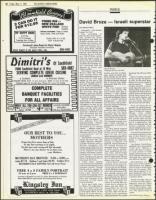
David Broza:
Singing of love, not hate.
London and then to Hast-
ings, where he lasted only
three months. It was there
he met Louis Nahas, son of
Christian refugees who had
fled to Beirut from Haifa
during the 1948 War of In-
dependence.
The two became fast
friends and among the
many things they had in
common — their Middle
East origins, mutual friends
in Israel and Egypt, fathers
with a similar business
background — was their
love of music. David attri-
butes his musical technique
to Louis' tutelage.
Despite his attempts to
maintain their friendship,
he and Louis lost touch,
especially after the latter
became a member of the ter-
rorist Popular Front for the
Liberation of Palestine.
Yet, strangely enough, even
then Louis retained a
photograph of himself and
David.
In 1974, David returned
to Israel to do his military
service, part of which was
spent in the air force
entertainment troupe. Even
before his discharge, he ap-
peared in pubs and bars,
singing in English and
Spanish, mainly because of
his avowed distaste for
sounding like an imitation
of other Israeli singers.
Upon completing his mili-
tary duty, David began
writing his own songs, the
first of which were Yihiyeh
Toy (It Will Be Good) and
Beduin Love Song.
David Broza's declared
intention not to marry be-
fore 30 was irrevocably re-
versed when he met Ruthie,
a lively Haifaite, and today,
still a few years short of 30,
he's already married and
the father of two. Ruthie is
most definitely The Woman
With Me and has for the past
two years managed his
career. It was she who con-
vinced him to abandon his
heavy rock folk album re-
leased before the war and
brought Louis Lahav to
hear him. That was the be-
ginning of the association
wkch •.4 Rropced tlf record
, „
C
4
breaking The Woman With
Me.
David, it seems, not only
breaks records, but guitars
as well. As the story goes,
before his current round of
performances, David
bought himself a hand-
made Spanish guitar in a
London shop. It was not too
long before he had to order a
second guitar, the first one
having been played with a
bit too much emotion and
musical fervor. Thus while
one was being repaired,
David could use the other.
All in all, during the six
months of performances,
the two guitars made seven
trips to London for repairs.
Things went rather
smoothly, until that one
guitar was out of commis-
sion and the other was due
to arrive from abroad on the
–eve of a performance. The
plane was delayed and the
concert cancelled, since
David refused to play on any
guitar other than his own.
Now that he's preparing a
new album and show, rumor
has it that David's con-
cluded he must buy a third
guitar — a reserve for the
reserve!
Last Succot, David Broza
attended the controversial
"Yesh Gvul" (There's a
limit) rally held in Achziv,
to raise money to help
people refusing army serv-
ice in Lebanon. However, he
refrained from expressing
any political opinion. , N
Nevertheless, he we_
fully aware of the negative
repercussions his appear-
ance at such an event could
have on his career. Why
then did he appear? To ex-
press solidarity with a cer-
tain movement rather than
a political party.
David was right: there is
a lot of love in this country,
especially when the "fellow
man" happens to be a singer
named David Broza, mes-
merizing his public with his
own very special brand of
music.
World Zionist Press Service= -,
t