

96
Friday, May 4, 1984
THE DETROIT JEWISH NEWS
few years ago, Alan
Dershowitz, a bright
young lawyer trained at
Yale and teaching at
Harvard; met in Madrid with the
head of the Russian delegation to the
Helsinki accords on human rights.
Armed with anti-Semitic diatribes
published in the Soviet Union, he
threw them on the table and asked,
"Comrad, how can you justify this
under the Soviet constitution ? How
can you justify this under the
teachings of Lenin, who said that
anti-Semitism was an abomination?"
Dershowitz's not-too-comradely
Russian was also well prepared. He
slid some Nazi propaganda printed in
the United States out of a folder. He
threw them on the table. "Professor
Dershowitz, tell me," he said. "Look
at the material from the Soviet
Union. Look at the Nazi material
from the United States. Which is
worse?"
Dershowitz — the descendant of
Eastern European Jews who came to
the United States in the late
nineteenth century, a graduate of
Talmudic elementary and high
schools, a lawyer who has turned
down only very few cases, and those
because they would have involved
defending rabid, virulent
anti-Semites — carefully scanned
the tracts before him. "Comrade," he
finally said, "you're absolutely right.
The material circulating in the
United States is worse. But take a
look at the brochures. Tell me if
something doesn't catch your eye."
The good comrade, Dershowitz
recalls, "looked. And he smirked.
And he smiled. And he growled.
Because he understood what I
meant." The Russian material all
bore the official stamp of the Soviet
censors. It had been approved —
endorsed — by the Soviet Union.
There was no corresponding insigna
on the Nazi material from the United
States because no such imprimatur
exists.
That's the difference between
the Russian and American systems,
Dershowitz says. When you
disapprove, you also approve. When
you act as censor, you also act as
approver. And in this country, we do
not need a censor. Nor do we need an
approver. We simply tolerate."
"I don't want the government to
tell me what I can think, what I can
pray, what I can read. If you allow
censorship for some, you allow
censorship for all of us. In the
marketplace of ideas, you don't shut
down the shop by government if you
don't like the ideas being proposed.
You simply don't buy the product.
For over a decade, Dershowitz
has been working to keep the shop
open. He is not a bargain basement
emporium that occasionally lets a
little shrinking of the Bill of Rights
LAVVYE
OF LAST
RESOR
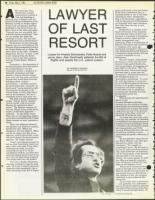
Lawyer for Anatoly Scharansky, Patty Hearst and
porno stars, Alan Dershowitz defends the Bill of
Rights and assails the U.S. judicial system.
BY ARTHUR J. MAGIDA
Special to The Jewish News
get by in the wash.. A few lost clauses
of the First Amendment here, a
bleached phrase or two of the Fifth
Amendment there. Dershowitz's
shop is for fine goods, embroidered
with the theories of civil libertarians
and brocaded with legal precedents
that belie those who say it can't
happen here.
Dershowitz is a member of the
board of directors of the American
Civil Liberties Union (ACLU) and
has been a consultant to foundation
studies on human rights and the
media, incarceration, and
sentencing. When a recodification of
federal criminal law was introduced
in Congress a few years ago,
Dershowitz criticized its "repressive"
tone. So Senator Edward M. Kennedy
invited him to help redraft a bill that
would be acceptable to civil
libertarians.
The new version, which passed
the Senate in 1978, still had some
features which galled Dershowitz,
such as permissive wiretapping and
gag orders on the press. "But," he
said at the time, "there is not a single
provision that is worse than the
existing law." The bill also contained
the Dershowitz theory of
presumptive sentencing." To avoid
the wide discrepancy in sentences
given by different judges for the same
crimes, it set specific sentencing
boundaries and allows judges to
violate them only in exceptional
circumstances. Kennedy said that
Dershowitz's . advice was
"invaluable."
While Dershowitz tags himself a
liberal in the
Kennedy-Humphrey-Mondale
tradition, he dons political blinders
when the first ten amendments of the
Constitution are at stake. His clients
range from one end of the political
spectrum to the other; some just
about fall off at the far ends.
At almost the same time a few
years ago, for instance, he defended
two Stanford University professors of
sharply contrasting ideologies: Bruce
J. Franklin, who was fired for alleged
left-wing activism, and Nobel
laureate William Shockley, who was
barred from teaching a course
postulating the genetic inferiority of
blacks.
He has defended "Deep Throat"
star Harry Rheems, who later gave
Dershowitz a photo with the
inscription, You taught me
everything I know." He has gone to
the bar for nude sunbathers on Cape
Cod, nude performers on Broadway
and for the producer of the Swedish
soft-porn film "I Am Curious
Yellow," for which, despite its boffo
box office and soporific cinematic
pace, Dershowitz climbed the long
steps up the Supreme Court.
This is one of 11. journeys he ha
made to the high court since 1967.
Then he was 29. One year earlier, he
had earned tenure at Harvard as a
full professor of law, the youngest
individual to have achieved that
distinction.
In one of his more controversial
— and, probably, less understood
moves, Dershowitz publicly defended
the rights of the members of the Nazi
Party to march through Skokie, Ill.,
"
.
Craig Ter)touritz
Continued on. Page 25