
!®_
Friday, April 13, 1.984
104
THE DETROIT JEWISH NEWS
Religious dove: choosing life over and
Avi Ravitsky, a founder of Israel's Orthodox peace movement,
bases his dovish political beliefs on the Torah
BY GARY ROSENBLATT
Editor
small but growing number
of Orthodox Jews in Israel
favor giving up Biblical
territory for peace. Avi
Ravitsky, a founder of Israel's Or-
thodox peace movement, bases his
dovish political beliefs on the Torah.
A professor of modern Jewish thought
at Hebrew University, he says that his
organization and the secular peace
movement embodied by Peace Now are
impelled by opposite motives.
"I told A.B. Yehoshua (the noted
Israeli author) that he and I attend the
same demonstrations for entirely
different reasons," Ravitsky ex-
plained. "Yehoshua wants a 'nor-
malized' state and comes to protest be-
cause he's influenced by the anti-
Vietnam and Western peace protests. I
come because I want to see a unique
society emerge in Israel based on
Jewish values."
Ravitsky is in the United States
this year as a visiting-professor at
Brown University.
During an interview with The
Jewish News, he explained that the
Orthodox peace movement is "a third
alternative" to those who believe
either in secular humanism or fulfil-
ling the Biblical prophecy of possess-
ing all of Eretz Yisrael. "Our struggle
is not just concerned with present-day
politics but really much more," he
said. "Our movement is for a Jewish
approach to Judaism."
The movement Ravitsky refers to
was founded in 1975 as Oz v'Shalom
(Strength and Peace) by he and a small
group of Orthodox intellectuals as a
response to Peace Now. But Oz
v'Shalom remained a small and mar-
ginal group perceived as professorial
and politically controversial.
Then came the Yamit episode,
where hundreds of Gush. Emunim fol-
lowers and other right-wing Orthodox
individuals fought off the govern-
ment's efforts to evacuate the Sinai
settlement as part of the peace agree-
ment with Egypt. This was a shock —
that people were determined to
undermine the peace treaty. There
was an air of false messianism, a belief
among some that God would not let it
happen, returning the land. I felt it
was a tragedy that we had to give back
the land but it was necessary for peace
and that is why I spoke out in favor of
the government's position."
It was not until the Lebanon war
and the Beirut massacre, though, that
dissenters emerged from the
mainstream of religious Zionism in Is-
rael. Ray Yehudah Amital, the head of
a Hesder yeshiva (one in which the
IA.
•
4
t
3 • /
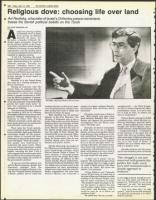
Ravitsky: choosing between life and land.
students also serve in the army), spoke
out and questioned the refusal to con-
sider giving back land in Judea and
Samaria in return for peace.
More startling was the political
change in Zevulun Hammer, the
Minister of Education who is also a
leader of the youth arm of the National
Religious Party and a founder of Gush
Emunim. Soon after the Beirut mas-
sacre, Hammer said that the unity of
the Jewish people takes precedence
over the unity of Eretz Yisrael. His
statement did not go unnoticed. When
he toured settlements in the West
Bank, his former power base, he was
heckled, denied entry from one set-
tlement and called a traitor.
Shortly afterwards, the leaders of
Oz v'Shalom met and decided to form a
more broad-based coalition called
Netivot Shalom (Paths of Peace). To
their surprise, a thousand people
turned out for the group's first major
public meeting, an address by Rav
Amital and Rav Aharon Lichtenstein,
the head of Yeshivat Gush Etzion. The
two rabbis have not been active in the
organization but their participation
helped remove the stigma for some Or-
thodox sympathizers and since then
Netivot Shalom has attracted a
number of younger religious Zionists,
particularly from the B'nai Akiva
movement.
Of course, events were a factor as
well. "Many people were upset when
Gush Emunim defended (Gen. Ariel)
Sharon and opposed the government
investigation into the Beirut mas-
sacre," Ravitsky said.
Basically, he doesn't want people
to think that if you are a religious
Zionist, you have to accept the views of
Gush Emunim that holding on to the
holy land of Eretz Yisrael is not only a
mitzvah, but paramount. "The Land of
Israel is a principal value of Judaism
but it is not the principal value," ac-
cording to Ravitsky, who believes that
when faced with contradiction of val-
ues between "life and peace on the one
hand, and holding on to every inch of
the Land of Israel on the other hand,"
we must chooselife and peace. ,
,
"I don't say it easily," he ex-
plained. We must feel the pain of loss
and recognize that it is tragic to give
up a part of Israel, just as I felt when
we gave up Yamit. But given the
choices, it is necessary."
Citing Biblical and Talmudic
sources for his views, he noted that at
the time of Ezra and Nechemia and the
building of the Second Temple, Jews
did not settle everywhere in Israel.
"The prophets urged the people to fol-
low the mitzvot, to observe the laws
and the ethics, rather than to conquer
more land," said Ravitsky, and it
would be wise for us to follow our
prophets of old."
He added that for me, to build —
metaphorically — the Third Temple,
we have to choose between the often-
contradictory values. It is never easy
but it must be done. In history you
have to compromise."
Netivot Shalom attempts to fulfill
a prophetic duty, which Ravitsky de-
fines as redressing a spiritual imbal-
ance. "If most religious Jews in Israel
thought like Netivot Shalom, then I
would welcome a Gush Emunim voice
— I might even help it — to remind us
of the holiness of the land. But of
course that isn't our problem today,
when some major religious leaders say
that the most important value is hold-
ing on to the Land of Israel. A
prophet's job is to restore what's mis-
sing in a people's value."
Ravitsky believes that the poten-
tial for the Orthodox peace movement
"Our struggle is not just
concerned with present-day
politics but really much
more. Our movement is for a
Jewish approach to
Judaism."
is very large in Israel, though its num-
bers are still small and difficult to
gauge now. "Politically we are not so
important," he said, but spiritually
and culturally we are a success.
"And more than that," he adds
quietly, "even if no one else belonged,
it is good for me because it is what I
believe and feel."
Scanned image of the page. Keyboard directions: use + to zoom in, - to zoom out, arrow keys to pan inside the viewer.
April 13, 1984 - Image 104
- Resource type:
- Text
- Publication:
- The Detroit Jewish News, 1984-04-13
Disclaimer: Computer generated plain text may have errors. Read more about this.