
THE DETROIT JEWISH NEWS
126 Friday, September 9, 1983
Derivations of Jewish Liturgy: Prayer and Instruction
By ALLAN M. BLUSTEIN
Chaplain, Sinai Hospital
Jewish liturgy can be de-
scribed as two broad fields of
endeavor . . . prayer and
instruction. From earliest
times we know that the
people would gather in the
courts of the Temple to be
instructed by the prophets
and to pray (Isaiah 1:12-15).
Later on Ezra the Scribe
would recite passages from
the Pentateuch to the com-
munity (Nehemiah 8:5-8)
and this custom gradually
led into the normal scrip-
tural readings which are
chanted in synagogue on
such occasions as the Sab-
bath, High Holy Day, feast
days (Tabernacles,
Passover, and Pentecost)
the new moons, fast days
and on all Mondays and
Thursdays as well.
Inasmuch as the vast
majority of the people con-
sisted of farmers and work-
ers who had little time to
devote to Jewish education,
the scriptural lessons dur-
ing worship proved to be
invaluable in preserving
the prophetic heritage
among the Jews.
The second category,
that of prayer, is an an-
cient one. The Book of
Isaiah mentions, "A
house of prayer for all
people" (Isaiah 56:7). It is
known that prayers were
instituted to correspond
with the sacrifices in the
Temple worship and that
after the Exile (70 CE)
they supplanted the lat-
ter and formed the basis
for the synagogual
liturgy.
This liturgy is comprised
of a substantial number of
benedictions which are in
reality an expression of
doxology in praise of God.
The Hebrew term for
"blessed" is baruch which
translates literally as "bend
the knee" (in praise and
thanksgiving). Down
through the ages, the sig-
nificance of the benediction
has increased to such sta-
ture that eventually it has
come to accompany all ex-
pressions of individual life
and to sanctify all the func-
tions of both body and soul.
The religious Jew utters
benedictions upon arising,
upon washing, upon eating,
donning a new garment,
hearing thunder, seeing
lightning, and myriads of
other occasions including
retiring at night. He prays
three times a day (Psalms
55:18) and the worship may
be individual or with a
quorum of 10 men (tradi-
tional) or more (above the
age of 13).
The Talmud derives
scriptural authority for the
quorum (minyan) of 10 from
God's complaint to Moses
about the scouts who were
sent to spy out the land of
Canaan — 12 in all. The
Almighty asks of His ser-
vant, "How long shall I bear
with this evil congregation
which murmur against
me?" (Numbers 14:27)
Caleb and Joshua were
faithful, thus leaving 10 to
form the "evil congrega-
tion."
The minyan is led by
the hazzan or leader who
chants the prayers and
provides direction and
additional inspiration to
the worshippers. Any
Jew may serve as hazzan
if he is pious and able. It
enhances the worship
when the leader is pos-
sessor of a melodious
voice as well as a
thorough knowledge of
the prayer ritual.
The body of prayer varies
of course with the occasion.
Each festival or holy day
has its own prescribed order
of worship for morning, af-
ternoon, and evening serv-
ices. There are, however,
some prayers which are
basic to all and these are
classic manifestations of the
Jewish expression. Four of
the most prominent are: the
Shema, the Amida, the
Aleinu, and the Kadish.
The Shema is the oldest
prayer in the siddur (Jewish
prayerbook). Scriptural in
origin, it consists of three
paragraphs, the first of
which begins with the proc-
lamation, "Hear 0 Israel,
the Lord our God, the Lord
is One," and which goes on
to express the duty of loving
and serving God with one's
whole being (Deuteronomy
6:4-9).
The second paragraph
(Ibid 11:13-21) calls upon
humanity to give loving
adherence to God's precepts
so that happiness may be
insured while the final
paragraph deals with the
laws of wearing fringes
(tsitsit) on one's garments
so as to remind one of his
duties toward God and to
shun evil ways.
The Amida is spoken of
in the Talmud as tefila
(the prayer par excel-
lence) because of its an-
tiquity and importance.
It normally consists of 18
blessings. Many reasons
are advanced for the
specific number of the
original 18. For example,
mention is made of the
three patriarchs, Ab-
raham, Isaac, and Jacob
some 18 times in scrip-
ture. Then too, there are
18 vertebrae in the
human spinal column.
The prayer is recited in a
standing position, hence
the title Amida (from the
Hebrew verb "to stand").
The Aleinu prayer is al-
leged to have been authored
by Joshua. It proclaims God
as the Ruler over all
humankind and it has been
the closing prayer for all
three worship services since
the 13th Century. It is also
incorporated into the addi-
tional group of prayers re-
cited on the High Holy
Days. During the Middle
Ages, it was the death song
of Jewish martyrs of reli-
gious persecution.
The Kadish prayer was
composed in Aramaic and
serves mainly to designate
the conclusion of different
sections of the service or of
the reading of scriptural or
talmudic passages and ex-
cerpts. It is also the chief
prayer for mourners be-
cause of its theme of a
hoped-for redemption and
healing for a troubled man-
kind.
It is recited by those who
mourn for a period of 11
months after death and on
the day of death in proceed-
ing years. Rabbi Isaac
Luria, the great mystic of
the 16th Century, explains
that "while the orphan's
Kadish for 11 months helps
the soul to pass from Gehin-
nom (purgatory) to Gan
Eden (Paradise) on the
yahrzeit (death anniver-
sary), Kadish elevates the
soul every year to a higher
sphere in Paradise."
The Kadish is the best
known of Hebrew
prayers, both to Jews
and non-Jews alike. De-
pending upon the festival
or occasion, the Kadish
has at least six different
melodies in which it can
be chanted.
The prayerbooks of the
Jewish People are at once,
literature, poetry, history,
philosophy, mysticism,
hymnals and theological
dissertations all rolled into
one, again depending upon
the holy day or occasion.
The mahzor (revolving
cycle) is the prayerbook of
the High Holy Days and the
three Pilgrimage Festivals
(Tabernacles, Passover, and
Pentecost). The siddur (or-
der) is the prayerbook for
weekday and Sabbath wor-
ship. There are other books
and booklets which contain
prayers for different feast or
fast days as well (i.e. Selihot
prayers for forgiveness)
which precede the Jewish
New Year and Kinot
(lamentations) recited on
the Ninth of Av (anniver-
sary of the Destruction of
the Holy Temple in both 586
BCE and 70 CE) and many
more.
Ever since the Romans
destroyed the Temple in 70
CE the Jews have been scat-
tered to the four corners of
the globe. It was only
natural that their liturgy
would undergo change and
reflect the various -cultures
and societies in which they
found themselves.
Those Jews who lived
in the Asian - African -
Iberian areas developed .
the Sephardic (Spanish)
ritual of worship while
those who settled in
Europe and its environs,
furthered what is known
as the Ashkenazic (Ger-
man) ritual. Differing
mainly in melody, chant
and composition of some
of the prayers, both ritu-
als stuck mainly to the
basic fiber of Jewish
worship.
Once the initial unfamil-
iarity was overcome, Jews
of one ritual persuasion
could easily make the tran-
sition to the other during
worship and feel at home in
the process. This was one
more method through
which the Jewish expres-
sion assured its continued
existence.
The music of the
synagogue consists mainly
of cantorial chants and
scriptural melodies uttered
by the Torah reader. Con-
ventional musical instru-
ments are not used in
Jewish worship (tradi-
tional) but there are times
when a certain type is used,
namely on Rosh Hashana
and the month preceding it.
This "instrument" is the
ram's horn or shofar.
Rabbi Saadia Gaon of
the 10th Century ad-
vances no less than 10
reasons for the sounding
of the shofar in the wor-
ship service. These are:
the shofar proclaims the
sovereignty of God; it
alerts the people toward
atonement. it symbolizes
the Revelation on Mt.
Sinai; it reminds of the
Prophetic exhortation; it
reminds of the Day of
Atonement; it symbolizes
a better tomorrow; and it
symbolizes the Resurrec-
tion.
The authorship of the
prayers in Jewish liturgy is
three-fold: scriptural, tal-
mudic and rabbinical. Cen-
turies old, they have served
and continue to serve as one
of the links in a neverend-
ing chain which binds the
Jewish people, one to an-
other, in a common heritage
stressing service to God and
to all mankind.
Every God-fearing adhe-
rent to the Jewish faith is
enjoined by its precepts, to
strive mightily to do his or
her part in helping to fulfill
the Prophecy of Isaiah,
"that indeed My House
shall be a House of Prayer
for all people" (op. cit. 56:7).
Hasdai Ibn Shapruth was
a Jewish statesman in the
court of the Caliph of Cor-
doba during the 10th Cen-
tury. A physician and
scholar, he salvaged the
remnants of the Babylonian
talmudic academies by
transfering the leaders of
the academies to Spain.
Monument Unveilings
Unveiling announcements may be inserted by mail or by calling The Jewish News, 17515 W. Nine Mile,
Suite 865, Southfield, Mich. 48075. 424-8833. Written announcements must be accompanied by the name
and address of the person making the insertions. There is a standing charge of $10.00 for an unveiling
notice measuring an inch in depth, and $15.00 for a notice two inches deep with a black border.
The Family
of the Late
The Family
of the Late
MAIER
BRENNER
The Family
of the Late
JACK J.
GOOSE
Announces the un-
veiling of a monument
in his memory 11 a.m.
Sunday, Sept. 11, at He-
brew Memorial Park.
Rabbi Gordon will of-
ficiate. Relatives and
friends are asked to
attend.
ESTHER
OBERMAN
Announces the un-
veiling of a monument
in his memory 12:45 p.m.
Sunday, Sept. 18, at
Clover Hill Park
Cemetery. Rabbi Syme
will officiate. Relatives
and friends are asked to
attend.
Announces the un-
veiling of a monument
in her memory Sept. 18
at Hills of Eternity
Cemetery, Colma, Calif.
N
The Family
of the Late
N
The Family
of the Late
The Family
of the Late
CELE STARMAN
EICHENHORN
DANIEL
SHACKMAN
BENJAMIN
GOREVITZ
(of blessed memory)
Announces the un-
veiling of a monument
in her memory 11 a.m.
Sunday, Sept. 18, at
Adat Shalom Memorial
Park. Rabbi Spectre
and Cantor Vieder will
officiate. Relatives and
friends are asked to
attend.
Announces the un-
veiling of a monument
in his memory 11 a.m.
Sunday, Sept. 18, at He-
brew Memorial Park.
Rev. Roth will officiate.
Relatives and friends
are asked to attend.
Announces the un-
veiling of a monument
in his memory 12 noon
Sunday, Sept. 18, at He-
brew Memorial Park.
Rabbi Schnipper will
officiate. Relatives and
friends are asked to
attend.
The Family
of the Late
The Family
of the Late
ESTHER
FRIEDMAN
OSCAR
LEVY
The Family
of the Late
Announces the un-
veiling of a monument
in her memory 2 p.m.
Sunday, Sept. 18, at He-
brew Memorial Park.
Rabbi Syme will of-
ficiate. Relatives and
friends are asked to
attend.
Announces the un-
veiling of a monument
in his memory 1 p.m.
Sunday, Sept. 18, at
Machpelah Cemetery.
Rabbi Schnipper will
officiate. Relatives and
friends are asked to
attend.
■
N
JOE
SINGER
Annourices the un-
veiling of a monument
in his memory 1:15 p.m.
Sunday, Sept. 11, at
Westwood Cemetery.
Rabbi Arm will of-
ficiate. Relatives and
friends are asked to
attend.
543.1622
"Over 65 years of traditional service in the Jewish community with dignity and understanding."
HEBREW MEMORIAL CHAPEL
SERVING ALL CEMETERIES
26640 GREENFIELD ROAD
OAK PARK, MICHIGAN 48237
Alan H. Dorfman
Funeral Director & Mgr.
rrst
CV *I 74 TV
•*,
*
44 1
*
•
• * *
••VVVVV
15:
•
't L.
/V
r
vet t ,. 4,
*Vitt trpg,r,,
1r 4.
• I 7
-fp ;, _I, et AL evir
t.' . V
•
se_tv,;‘,
—
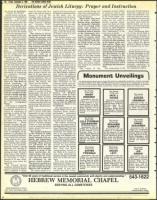
Scanned image of the page. Keyboard directions: use + to zoom in, - to zoom out, arrow keys to pan inside the viewer.
September 09, 1983 - Image 126
- Resource type:
- Text
- Publication:
- The Detroit Jewish News, 1983-09-09
Disclaimer: Computer generated plain text may have errors. Read more about this.