

64 Friday, July 1, 1983
THE DETROIT JEWISH NEWS
New Raphael Patai Book Delves IntoThe Arab Mind'
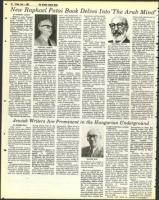
By EZEKIEL LEIKIN
(Editor's note: Ezekiel
Leikin, reviewer of the
new volume by Dr.
Raphael Patai, is the
newly-elected executive
vice president of the De-
troit District of the
Zionist Organization of
America.)
Raphael Patai, the noted
anthropologist, with some
20 books to his credit, has,
in his latest volume ("The
Arab Mind" Revised Edi-
tion from Charles Scribner's
Sons), focused attention
upon the complexities of the
EZEKIEL LEIKIN
Arab personality. The re-
sult is a readable, well- sider themselves as sepa-
researched study of the rate nations or peoples;
Arab psyche, illuminating in their view, the Arabs
the evolving trends, moods constitute one nation, the
and social patterns indig- division into separate
states is but a temporary
enous to the Arab world.
He traces the "psycholog- condition that sooner or
ical transformation" of the later will be overcome.
Arab from a posture char-
In chapters dealing with
acterized by self-criticism, such diverse areas as
despondency and shame, "Group Aspects of the Arab
exacerbated by the Mind," "Child Rearing,"
"humilitating defeats" at "the Role of the Woman,"
the hands of the Israelis, to Bedouin values, sex, reli-
one of renewed self- gion, etc., the author tries to
confidence and redressed zero in on such traits, cus-
honor in consequence of toms and beliefs as are
Egypt's "victory" in the common to the Arabs and
1973 Yom Kippur War.
blend them into a composite
This mood was given an profile of the Arab mind. In
added lift by the dramatic doing so., the author is not
reassertion of Arab power unmindful of the admoni-
and influence flowing from tion propounded by another
the emergence of the Arab anthropologist - psychol-
as the undisputed purveyor ogist team, Kluckhohn and
of much of the world's preci- Murray, to the effect that "a
ous commodity: oil.
group can no more have a
The author states that common character than
most definitions of an . . . a common pair of legs."
"Arab" as one who speaks
The author makes refer-
Arabic, lives in an Arab ence to Ibn Khaldun, a 14th
country and believes in Century Arab historian,
Moslem teachings, fall who portrayed the Arab in a
short of the mark. Only the most unflattering light:
linguistic qualification "Arabs can gain control
holds good for all Arabs.
only over flat territory on
The Arabs do not con- account of their savage na-
ture" and propensity "to statements and discussion.
blame Arab disunity for Is-
plunder and cause damage";
Thus, on the eve of the
rael's triumphs.
and he adds: "the Arab can 1948 war (War of Libera-
The mood of euphoria
obtain authority only by tion), the president of Syria
which had seized the Arab
making use of some reli- assured Mussa Alami, a
world following their "vic-
gious coloration, such as leading Palestinian Arab
tory" in the 1973 war has
prophesy or sainthood . .; leader, that the Syrian
evaporated with the "tragic
because of their savagery, army will have no trouble
collapse of Lebanon, the
the Arabs are least willing taking care of a "few Jews,"
disarray of Arab politics
of nations to subordinate adding "in confidence" that
and the eruption in Iran."
themselves to each other, as Syria "even has the atomic
The gap between the
they are rude, proud, am- • bomb," ostensibly produced
ideal and the real in the
bitious and eager to be the by a "very clever fellow, a
Arab mind is evident in
leader."
tinsmith."
current
inter-Arab rival-
Another Arab historian,
The Saudi - Iraqi - Egyp-
ries and conflicts, which
Maqiizi (1364-1442), of- tian assurances were
RAPHAEL PATAI
the author sees as con-
fered the following por- couched in a similar, hector-
and political forces agitat- trary to the teachings of
trayal of the Egyptian char- ing tone unrelated to
ing the Arab world at this the Koran; these teach-
acter, which, he said, was reality.
time. Obviously, the impact ings rule out wars be-
dominated by. "indecision,
The author believes
of Westernization will af- tween Moslems.
indolence, cowardice, de- that these characteristic
fect, in one degree or an-
Nevertheless, Patai sees
spondency, avarice, impa- expressions of bravado
other, the Arab personality. "considerable progress" in
tience, disdain of duty, are tantamount to the
The author discerns a the "regeneration of the
slander, falsehood, etc."
"typical dream of wish
new form of sobriety in Arab world." The Arabs'
Patai, who generally fulfillment," the strong
the utterances and writ- major challenge in the
treats the Arabs with a yearning that construes a
ings of Arab intellectuals. 1980s — he believes — "is to
detached objectivity, in- desired event as an ac-
Symptomatic of this new digest the overwhelming in-
terjects to say that these complished fact.
awareness is a recent flux of Western things,
historians referred
The Arab belief in pre-
statement by a Kuwaiti techniques and skills and to
primarily to Bedouin destination or fate impacts
minister,
contrasting the integrate them into the con-
Arabs.
profoundly on his personal-
oppressive condition of text of Arab culture."
The leading Arab- ity. The society's ills or his
the Arab masses with the
While the study confirms
American historian, Philip individual mistakes and
democratic freedom of that the Arab "mind" is not
K. Hitti, touches upon an- failures he attributes either
Israel, where people have monolithic, reflecting dis-
other significant aspect of to fate, the devil, or "im-
a "right to criticize their tinctive variations from one
the Arab "mind": "No coun- perialism" which, in turn,
own leader."
country to another, inter-
try in the world has such absolve him from his own
Nasir al Nashashibi gives Arab warfare remains a
enthusiastic adoration of passivity, corruption and
expression to this new trend "constant feature" in Arab
literary expression and is so other failings.
in Arab thinking, em- history and experience to
moved by the word . . .
Another characteristic, phasizing the Arabs' "hu- this very day.
hardly any language seems
capable of exercising over incomprehensible to the man mission," which calls In spite of the massive re-
Western mind, is the Arab's for "the good of all, for social search embodied in the
the minds of its users such
irresistible influence as unpredictable transition justice and for mutual help book, much of the data is not
self-control to uncon- among the classes."
new; nor can this reviewer
Arabic." This rhetoric — to from
trolled outbursts of temper
A major theme of contem- discern new insights into
the Arab — is an achieve-
and emotionalism. Once porary Arab statements and the make-up of the Arab
ment akin to the attain- gripped
by whipped up writings is Israel. In at- personality and the author's
ment of masculinity.
frenzy,
Arab
mobs vent tempting to rationalize prognoses for the future.
A by-product of this in-
their
fury
indiscriminately
their defeats at the hands of These reservations aside,
fatuation and florid lan-
on all "outsiders," a pattern the Israelis, some Arab in- "The Arab Mind" repre-
guage, usually embellished
with folk-proverbs and say- of behavior that is all-too- tellectuals attribute Israel's sents a valuable. contribu-
ings, is the Arabs' penchant familiar to observers of the superiority to the Jewish tion to Mideast scholarship.
for exaggeration and over- contemporary Arab scene. state's advances in science The author's editorial proj-
It would be difficult, the and technology, while the ections, however, may be
emphasis, which finds ex-
study
implies, to predict the Arabs are mired in "scien- validated or refuted by to-
pression even in political
outcome of the economic tific backwardness." Others morrow's headlines.
Jewish Writers Are Prominent i n the Hungarian Underground
Nig
By MOSHE RON
TEL AVIV — Three
Jewish writers who lived at
one time in Israel have re-
turned to Hungary to work
in the underground press
and make sure that the
socialist justice is upheld.
One of the writers was even
born in Jerusalem, but this
did not keep him from going
abroad.
George Kardosh lived in
Israel for two years after the
establishment of the state,
served in the army and was
a member of a kibutz. He
wrote three books about Is-
rael. After leaving the coun-
try he has not visited Israel
again.
He speaks perfect Hebrew
and when he met an Israeli
tourist, he asked him to
bring him a falafel recipe.
Laszlo Nemesh fought
with the Jewish Brigade
during World War II. He
lived in Israel for a time and
then returned to Hungary.
He published a book "The
Disappeared Europe," in
which he argued that after
the Nazi rule the Hunga-
rian Jews should return to
Hungary and build it anew.
He intends to visit Israel
with his wife, who is also a
writer, and see their family
in Ramat Gan.
The central figure in
Hungarian literature
today is Androsz
Mazey (his Jewish name
is Meisel). He lived for
many years in Israel and
was a member of Kibutz
Dvir. He has returned to
Hungary, but preserved
his Jewish identity.
Mazey has visited Israel
three times in recent years,
and he told his friends that
he is suffering from a split
personality. When he is in
Hungary he feels as a Jew
and is connected with Israel
in its fight for its existence.
But when he is in Israel, he
feels like a socialist who has
to criticize several negative
factors.
He was in Israel when the
Lebanon war broke out and
he published several arti-
cles in a Hungarian news-
paper in which his split per-
sonality was expressed. He
praised, for example, the Is-
raeli officer Eli Geva, who
refused to attack Beirut.
But he also stressed that in
MOSHE RON
another country, unlike Is-
rael, such a mutinous officer his forehead. He wanted to
would be executed.
lay tefilin, but he did not
Mazey told in his articles
wish to fool the nice young
how he met a bearded young
bearded soldier.
man who asked him to lay
tefilin. He remembered his
He even published a
grandfather, who studied
poem in which he ex-
the Talmud with tefilin on
pressed the wish that the
day should come when
Israel would mix with its
neighbors and give up its
nationality, which would
be the best historic event.
He was criticized by
many people, among
them several non-Jews,
who argued that the
Jewish people have their
own place in history and
should they vanish the
world would lose a whole
civilization.
One of the interesting
writers among the "Yordim"
in Hungary is the poet Mik-
losz Arasty. He was born in
Jerusalem and became
famous in Hungary because
of his work in a tractor fac-
tory in Hungary for a year
at the request of the Hunga-
rian Writers Association.
His impressions of this work
appear in his book, "The
Wages Per Unit."
When he brought this
book to the official publish-
ing house he was arrested
and sentenced to two years
in prison for instigation
against the regime. He
spent eight months in
prison and became a central
figure of the intellectual op-
position in Hungary after
his liberation. He is now the
editor of an illegal news-
paper which deals with sev-
eral aspects of the Com-
munist regime. He writes
about anti-Semitism, op-
pression of national
minorities, etc.
The head of the illegal
newspaper is Laszlo Reik,
son of a Communist leader
who was murdered in Hun-
gary in 1949.
Arasty was born in
,
Jerusalem in 1945. His
Jewish name was Hof-
man. His parents were
members of the Kibutz
Haogen, but were expel-
led because of their
Communist activities.
They settled in
Jerusalem and his father
opened a small workshop
for repairing watches.
His mother comes from a
Hasidic family in Mun-
kacz.
During the siege of
Jerusalem, the family
moved to Tel Aviv. After the
establishment of the state of
Israel, they asked for a per-
mit to return to Hungary.
In Hungary, the parents
separated. Visitors from Is- .
rael have met the mother in
Budapest. She has "re-
covered" from her former
Communist views and de-
fends her son, who is fight-
ing for a "human" Com-
munism.
Miklosz Arasty is still
very much interested in Is-
rael. He wishes to visit Is-
rael and meet some mem-
bers of his family. His book
was translated into several
languages and he is living
on the royalties. He does
translations and publishes
articles in newspapers.