

7- 7
.1
1518 - - - - -THE'DETROlt JEWISH - NEWS
.
-
2 -frttlAtilieceriber
.
111
Purely Commentary
The Fortieth Anniversary of the United Jewish
Appeal Marks a Glorious Chapter 'in World Jewish
History, With Emphasis on the Unity of an Era
By Philip
Slomovitz
UJA's 40th Anniversary: Sensational Triumph for Jewish Philanthropy in U.S.
Special significance attaches to the annual conference of the United Jewish Appeal to
be held in New York in the coming weekend. It will be an occasion to retrace the steps
that marked unification of American Jewish ranks from a state of divisiveness.
Whatever unity has been achieved is attributable to the interest in Israel. Therefore, it
also has much that stems from the tragedies of the 1930s and 1940s.
In the consideration of fund-raising procedures the Keren Kayemet LeYisrael —
Jewish National Fund — merits consideration as the first fund solicitations which were
conducted on a worldwide scale. It was at the World Zionist Congress in Basle in 1901
that the famous mathematician, Prof. Hermann Schapira of Heidelsberg, proposed the
formation of a fund to be used for the redemption of Palestine and the establishment of
Jewish settlements in the Holy Land. He believed that if every Jew throughout the world
were to donate a penny a day there would be enough money to redeem the land and to
compensate the Arabs adequately. But every Jew did not donate a penny a day and the
task became difficult.
Then came the hard times. Chaim Weizmann and his associates in the World Zionist
Organization, pressed by the anti-Semitic trends and the sufferings that were created for
Eastern European Jewries during World War I, created the Palestine Foundation Fund
— Keren Hayesod. The Balfour Declarqtion imposed new duties for national redemption
upon world Jewry. Still the funds that were raised for the Zionist cause were com-
paratively meager.
Philanthropically, it was the American Jewish Joint Distribution Committee that
emerged as the great movement seeking mercy and help for the impoverished and
oppressed. JDC, too, becaine the chief factor in that sphere after several other relief funds
could not attain the goal of greatness philanthropically, as the achievement of JDC
retains to this day the glorious role of a great, perhaps the greatest, philanthropic agency
serving Jewry and also mankind.
In the early years there were divisions, the Zionist fund-raising tasks, the functions of
the United Israel Appeal which is today part of the total Diaspora task for Israel.
In a sense there was the contrast, the relief efforts of the JDC functioning separately
from the Zionist endeavors.
Then came the years of horror, the Hitlerian threats, the needs both for aid to the
oppressed and that of aiding the immigrants to Israel and the survivors from the
displaced persons camps.
The need for unified labors resulted in the formation of the great agency that became so
.
vital as the rescuing movement for the surviving Jews from the Holocaust and as the fund
that aided in the settlement of hundreds of thousands of Jews, first in Palestine and then
in the reborn state of Israel. The United Jewish Appeal came into being 40 years ago and
today it combines in its scope all the obligations that must be fulfilled, for the emigrants
to Israel, the settlers who must be provided for socially, educationally and economically.
A review of the history that has thus developed into the most important means of
providing for the new generation of Jews serves as a reminder of the leadership of the
people that has gained the appelation of rahamanim bnai rehamanim, the merciful
sons of a merciful people. A long list of notables forms the cast of characters, includi
Rabbi Jonah Wise, son of the founder of the Reform Jewish movement in America,
Isaac M. Wise, a spokesman for the non-Zionists. The latter included many who were I -
anti-Zionists. But the leadership often had in its ranks the philanthropic who avoided
both the Zionist and the anti-non-Zionist titles, such as Felix Warburg, William Rosen-
wald, Edward Warburg and their many associates. There were the Zionist advocates like
Abba Hillel Silver and the many from his Zionist ranks.
Israel united them. They merged into a coordinated identification that makes the
United Jewish Appeal the great source for rescue and rehabilitation, for assistance for
the oppressed and aid to the homeless to build new homes in Israel.
Now there is the unity that makes
the Zionist Leon Dulzin, the new
_head of the World Zionist Organiza-
tion and of the Jewish Agency the
directing head of world Jewish
philanthropy. After 40 years, Israel's
leaders also are the compatriots of
the Diaspora dignitaries, of Vladimir
Jabotinsky in an age when there was
conflict in Zionist as well as world
Jewish ranks, and of Prime Minister
Menahem Begin, the present re-
spected guide of his people.
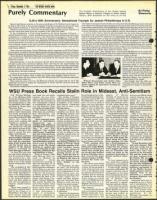
William Rosenwald, left, Rabbi Abba
Any wonder that the 40th an-
Hillel Silver and Rabbi Jonah Wise are niversary of the UJA marks an espe-
shown signing the agreement creating the cially glorious chapter in Jewish his-
UJA in 1939.
tory?
WSU Press Book Recalls Stalin Role in Mideast, Anti-Semitism
Prof. William McCagg,
Jr., of the Michigan State
University Russian history
department, analyzes Sta-
lin's foreign policy in "Sta-
lin Embattled: 1943-1948,"
published by Wayne State
University Press.
For students of Russian
history under Communism
and recent developments
involving Russian diploma-
tic as well as internal USSR
affairs, this volume be-
comes - must reading and
valuable as a textbook.
While the author does not
deal specifically with the
anti-Semitic policies of Sta-
lin, there is enough in this
book to expose the prej-
udices of the dictator.
The Russian position
that was taken at the time
of the partition of Pales-
tine and the establish-
ment of the Jewish state
and the Soviet vote in
support of the Zionist
ideal is evaluated by
Prof. McCagg as follows:
"At about the same time
the anti-blocist decision to
back the partition of Pales-
tine proved to be a two-
edged sword. Russia was the
home of one of the largest
Jewish "'Communities in the
world.
"The revolution of 1917
had eased some of the ten-
sions which surrounded the
Jews under the tsarist re-
gime. In the 1920s Trotsky,
a Jew, was a leading figure
in the Bolshevik govern-
ment, and Jews, insofar as
they were not capitalists or
religious, enjoyed relative
freedom.
"There were projects to
give them a national home-
land in the Crimea or in
Birobidzhan. But after the
great purges destroyed
many of the old Bolsheviks
and made the rest public
enemies, the new elites
began to internalize the no-
tion that the revolution of
1917 represented a victory
of nationalities and Jews
over the Russians. Even
during the war against Hit-
ler, the "bestial" destroyer
of the Jews, one could hear
that Shcherbakov had
"cleaned out the Yids from
the CPSU."
"Jews remained prom-
inent as individuals:
Kaganovich was a
member of the Politburo,
and Molotov's wife was a
Jew, as was Vor-
oshilov's. The Jewish
Anti-Fascist Committee
was one of the most use-
ful propaganda organs of
the regime. But there'was
silent resentment, and
hate-filled jokes could be
heard even in Stalin's
inner circle. The Soviet
decision to support the
Jews in Palestine in 1947
evidently politicized this
anti-Semitism at home.
"Early in January 1948,
when Milovan Djilas ar-
rived in Moscow, - he
encountered Soviet
bureaucrats boasting of
their anti-Semitism. On 12
January, when Stalin and
Beria made their attempt to
recruit Djilas as a spy, they
used anti-Semitism as part
of the bait. On 13 January
at Minsk, political thugs
murdered the head of the
Jewish Anti-Fascist Com-
mittee, Solomon Mikhoels.
This murder heralded the
end of the freedom which
the Jews had enjoyed in the
Soviet Union since 1941;
Stalin evidently connived in
it, thus encouraging a
variety of nationalism
which was antipathetic to
the Party revivalism of the
preceding three years."
The murder of Solomon
Mikhoels and the prejudices
that caused the persecution
of members of the Jewish
Anti-Fascist Committee
thus find an echo in the
McCagg expose.
_ Russia's_ leading per-
sonalities are drawn into
the McCagg analyses. One
wonders what had hap-
pened to Il'ya Ehrenburg.
He had written books and
articles on Jewish subjects
and was viewed as Russia's
chief apologist on Jewish is-
sues. He was unquestiona-
bly the leading Soviet jour-
nalist. McCagg comments
on him in relation to the
attitudes towards Jews by
Stalin and their role in the
era of Stalinism:
"On 21 September Il'ya
Ehrenburg published an
article in Pravda which
raised the question of di-
vided loyalties among
Jews, a clear menace to
the Soviet policy of sup-
porting Israel. In Oc-
tober, when the first Is-
raeli ambassador arrived
in Moscow, the Jews of
the city demonstrated
their delight in the
streets.
"In November, one after
the other, the flourishing
Jewish political and cul-
tural organizations of the
Soviet Union were sys-
tematically abolished, most
of their leaders were ar-
rested, and their member-
ship was terrorized. Even
Molotov's wife, who was
Jewish, was sent to a camp."
Here is how Dr. McCagg
views the Russian role on
the Middle East in relation
to Stalinism:
"Important developments
in another part of the world
confirm the subjection of
Soviet foreign policy to Sta-
lin's domestic political man-
ipulations during 1947. On
s 26 September, four days
after the policy shift in
Seoul and one day after
Zhdanov allowed the "mis-
take" to occur at Szklarska
Poreba, the British an-
nounced that they would
withdraw from their man- .
date in Palestine.
"Earlier in the year, hav-
ing decided against 'going
it alone' with a socialist
economy at home, the
British recognized that in
free market terms they
were almost bankrupt.
Their military empire, it
followed, was too expensive.
In February they an-
nounced their decision to
leave India and abandoned
to the Americans the de-
fense of Greece and Turkey.
"Until autumn they
were undecided as to
which part of the Middle
East they would keep and
which they would give
up, but now they decided
to leave Palestine, where
they were having great
trouble acting as a buffer
between the Arabs and
the Jews.
"The Soviet government
in its turn now had to make
a choice. On the one hand, it
could stand aloof and curry
favor in the Moslem world
by opposing the partition of
Palestine and by insisting",
as before the war, that the
Zionist dream of a Jewish
state in the Middle East was
pure imperialism of a re-
tfograde 19th Century type.
Such a course had disadvan-
tages, however.
"It would place the Soviet
state on the side of religious
Moslem masses who, as ex-
perience had shown, were
almost impervious to the
appeals
of
Marxist
socialism. It would also be
unpopular among Soviet
sympathizers in the Euro-
pean and American politi-
cal left, where there was
great sympathy for the
Jews, and it offered no pos-
sibility for a Soviet intru-
sion into the Middle East.
"On the other hand, if the
Soviet Union opted to sup-
port the partition of Pales-
tine, the emerging anti-
Communist trend in West-
ern public opinion might be
halted, and through the
United Nations Moscow
might step in when the
British stepped out.
"A choice was made by
13 October 1947, the day
before Stalin's reassur-
ing talk with Konni Zil-
liacus about the Comin-
form meeting. On that
day, a Soviet delegate to
the United Nations re-
vealed that his country
would support the parti-
tion of Palestine and
would not insist on the
continued frustration of
Zionist political objec-
fives.
"To have opposed parti-
tion would have implied
isolationism and disregard
of public sentiment abroad
— in other words, adopting
the position of Malenkov. To
support partition meant
participation in the great
world and popularity in lef-
tist circles abroad, the posi-
tion of Zhdanov and
Molotov. The anti-blocists
had recovered, it seemed,
from their setback in Korea.
"In the following months
the advantages of the new
Middle Eastern policy from
the anti-blocist viewpoint
became more evident. At
the United Nations in Oc-
tober and November, it led
to a very real official collab-
oration between the gov-
ernments of the Soviet
Union and the United
States. The result was the.
UNO's Palestinian parti-
tion plan of 29 November,
with its implied recognition
of Soviet involvement in the
Middle East.
"Had it not been for a
coincident escalation of
political tensions in West-
ern Europe and the failure
of a new Council of Foreign
Ministers' Conference on
Germany, the advantages
might have been greater
still. Furthermore, by the
end of the year, the inde
pendence struggle of the
Jews meshed with the
enthusiasm for 'movements
of peoples' which Zhdanov
had tolerated at Szklarska
Poreba.
"In late December 1947
and early January 1948,
civil war broke out in
Palestine between the
Jews, who were sup-
ported by the European
left, and the Arabs, who
got their weapons from
the British. The Jews '
Palestine thus bec
(by Soviet definitions
the day) the enlightened
vanguard of a great revo-
lutionary movement of
all the Middle Eastern
people against a most be-
nighted form of im-
perialism — a coalition
between Whitehall and
the Mullahs."
Embattled Stalin also re-
presented an era of horror
and of anti-Semitism. It is
exposed scholastically by
Prof. McCagg. It has a rela-
tion to the present situa-
tion, thus giving special
significance to Dr.
McCagg's thoroughly re-
searched work.
_-4