

48 Friday, December 30, 1977 THE DETROIT JEWISH NEWS
Innovative Program Helping the Lonely Elderly of Tel Aviv
long 15-hour days. Five
years ago he retired and
moved to Israel with his
wife, Sylvia.
"Retired, I found myself
completely cut off from life.
I had to learn to live with
myself, to cope with being a
nothing. I walked the
streets. The countryside
was beautiful, but I was not
happy with myself."
Energetic and enterpris-
ing, Elkin walks four miles
every morning, "in order to
get a proper start" and an
additional mile every after-
noon with his wife. One year
his partner on his early
morning walks was Avra-
ham Golani, secretary of
the local Labor Council.
"I told Golani how lonely
I was, how much I wanted
to do something. Together,
we devised the idea of turn-
ing an empty building in our
neighborhood into a work-
shop for the elderly.
"Unofficially, and on a
very partisan basis, we de-
veloped this project. Letters
to pensioners living in the
area were sent out, inviting
them to a meeting. Two
years ago we opened our
doors. The first month we
had three workers, growing
rapidly to a dozen.
"Today, we are 16, but we
could accommodate many,
many more if we had better
facilities."
Elkin is grateful for the
encouragement and finan-
cial assistance he has re-
ceived from Golani. "With-
out him, we would not be
where we are today."
Run completely as a vol-
unteer operation, the work-
shop has only one paid
worker, Nahum Kellman,
its control manager who is
"our contact with the manu-
facturers who supply us
with orders."
Kellman, patient and
knowledgeable, also in-
structs the pensioners in
their work which hag varied
from cutting and cleaning
In a large, run-down, one-
story building in Kiron, a
suburb of Tel Aviv, six men
and 10 women—whose aver-
age age is 73—sit working at
long tables.
Some are busy bolting and
packing small bundles of
screws; others are assem-
bling gaily-colored plastic
Purim noise-makers.
The work is unskilled
piece work for which these
elderly receive a minimal
wage according to their
ability and output, accord-
ing to Ruth Seligman of
Israel Digest.
The room is cold and un-
heated, without any decora-
tion or physical expression
of warmth. Yet, within
these four bare walls there
is an atmosphere of con-
tentment. People chat, with
'kiddish- the dominant lan-
guage.
"We're managing to bring
dignity and meaning back
into their lives," says 72-
year-old Ralph Elkin, the
founder and mentor of this
project.
Although still small, it is
filling a vital need and coulc
serve as an example to oth-
er communities—in and out-
side of Israel—on how to
recognize and fulfill their
responsibilities to the el-
derly.
"They are the lost souls
for whom so little is being
done. - says Elkin, who is
iissatisfied with the cold-
ness of professionals and
organizations "which under-
stand so little about the
problems of the elderly,
about their need to feel ap-
preciated and wanted."
Elkin, a pensioner him-
self, understands intimately
and personally the problems
of those who, after years of
fruitful employment, find
themselves alone, outside
the pale of society.
Russian-born, he emi-
grated to the United States
at the age of 8. From his
early teen years, he worked
hi
,
Ov
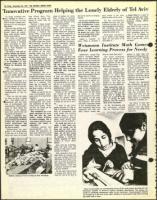
Elderly citizens of Tel Aviv busy in their workshop.
strips of leather for Army
belts, working on grenade
carriers, packing bandages
to trimming threads from
ammunition pouches.
"Our workshop, - notes
Elkin, "could serve as the
nucleus for a valuable ex-
tended home-care program
for the elderly, especially if
it were supplemented by
medical care and other
care-giving personnel such
as occupational therapists,
speech therapists, speech
therapists, social workers
and physiotherapists.
The current trend in re-
habilitation is away from
the hospital environment,
away from hospital care.
"Currently, we have one
elderly handicapped man of
g7 working here. He has
suffered a stroke, cannot
talk and works with diffi-
culty, dropping bolts into
small bags. I have to sit and
work with him, stamping
shut the bags.
"If we had the right kind
of help,. we could accom-
modate many more handi-
capped elderly, but we are
not professionals. It is diffi-
cult for us to accept these
people, to undertake their
rehabilitation without pro-
fessional assistance."
Visitors to the workshop
are excited by the work
done there, by its possi-
bilities for growth. Elkin,
himself, is full of new ways
in which he can be of serv-
ice.
"I want to get more
people involved. I'd like to
take in professional elderly
such as accountants who
could render free services
to their peers, a sort of
elderly-to-elderly project
which would benefit both
the giver and the recipient."
He would also like to in-
stitute a light lunch pro-
gram "so people can sit
down and eat their noon-
meal together. So many live
alone, eat all their meals
alone. And we should also
be running a 'meals-on-
wheels' program for those
unable to leave their
homes."
Busy with the workshop,
Elkin still finds time and
energy to help many others
besides the elderly.
With assistance from the
Bnai Brith, he collects new
and used clothing which he
distributes to the poor, stor-
ing it in a room at a near-by
day center for mentally re-
tarded children. "and, thus
I became involved in help-
ing these children."
He has been instrumental
in buying Bar Mitzva pre-
sents for two of the boys at
the center and for arranging
outings.
He has also arranged con-
certs at Sheba Medical Cen-
terks Rehabilitation Center
for the elderly. "And when I
gave a carnation to every
member of the audience,
the people just cried. They
were so touched that some-
one had thought of them."
Called a "nudintk" by
some, Elkin is actually a
good citizen in the most
positive sense of the word.
He has successfully
prodded the town hall into
collecting garbage on time,
spraying against mosquitoes
and curtailing the early-
morning honking which dis-
turbed the entire area.
As he says, "you have to
sit on heads to get things
done, but you have to be
nice about it."
Ralph Elkin is a man of
unusual warmth and vision,
a one-man force for good,
tirelessly visiting elderly
"shut-ins".
"They just need someone
with whom to talk. I try to
bring them out of their iso-
lation, convince them that I
have something good for
them. I try to implant in
them the conviction that,
even if you're old, you're
not dead."
Weizmann, Institute Math Games
Ease Learning Process for Needy
REHOVOT, Israel—The have to reach their level."
Science Teaching Depart-
The math curriculum
ment at the Weizmann In-
used in 80 percent of Is-
stitute is trying to make the
rael's junior high schools
mathematics curriculum for was prepared by the very
disadvantaged children eas-
same department at the
Weizmann Institute.
ier and more fun, according
to the Jerusalem Post. A
Rina Hershkowitz, who
new project with this aim in
heads the department's
view is under way at two work with disadvantaged
junior high scheols in Kiryat
children in junior high
Malahi and Or Yehuda.
schools and the other four
"We have two reasons for teachers working on the
not creating a special cur-
project, visit the two
riculum for the dis-
schools to see where the
advantaged," explained
pupils are having difficulty.
Prof. Maxim Bruckheimer,
Skill acquisition, such as
head of the institute's sci-
learning to add and subtract
ence teaching department.
negative numbers, is one
"One is that we don't know
trouble area. The good stu-
of anyone in the world
dents find it i boring; the
it
with-
enough
c ev
others are so put off by the
out making all the same
idea of solving 50 math
mistakes that exist in the
problems that the result is
old programs. The second,
chaos in the classroom.
and more important reason
So Ms. Hershkowitz and
is that disadvantaged chil-
her colleagues, working
dren eventually have to be
with the classroom teach-
integrated with other chil-
dren, which means they ers, developed several
_..
-111110M
.
games to help make the
necessary drilling more fun.
In one such game, "The Big
Race," players move
around the board by manip-
ulating algebraic expres-
sions. There are three sets
of cards—positive numbers,
zeros and negative num-
bers—and the pupils can
choose numbers from
whichever deck they like to
substitute for the x's in the
algebraic expressions.
Though the department
has developed six games,
most of the enrichment (or
"fun") material is in the
form of work sheets. Sol-
ving the problems cor-
rectly—and they are the
same Ones as in the text-
books—leads to completing
a sentence, a picture, etc.
One effect of these new
materials is to wean the
teacher from the black-
board into the middle of the
classroom.
These Israeli pupils are concentrating on one of the math games developed by the
Weizmann Institute of Science's science teaching department. The games are
aimed at equalizing mathematic skills in the classroom. Disadvantaged children
are brought up to the level of the other children in math games that make learning
fun rather than a chore.