

56 Friday, November 25, 1977 THE DETROIT JEWISH NEWS
An Historic Visit in a Quest for Peace in Middle East
(Continued from Page 1)
and courageous move by
President Sadat, and believ-
ing in the need to continue
the dialogue prepared and
proposed by both sides dur-
ing their exchange . . . and
in order to enhance the
prospects of fruitful con-
summation of this signifi-
cant visit, the government
of Israel, expressing the will
of the people of Israel, pro-
poses that this hopeful step
be further pursued through
dialogue between the two
parties concerned, thereby
paving the way towards suc-
cessful negotiations leading
to the signing of peace
treaties in Geneva with all
the neighboring Arab
states."
Begin asserted that "con-
tinuation is the key word"
in summing up the success
of the Sadat visit. Neither
he nor Sadat indicated what
modalities would now be
pursued to further the dia-
logue that has been agreed
upon. But both stated, in a
joint interview with ABC
television correspondent
Barbara Walters that they
would instruct their envoys
at the United Nations and
elsewhere to maintain
contacts.
There were two jarring
notes. One was Sadat's fail-
ure to extend an immediate
invitation to Begin to visit
Cairo and address the Egyp-
tian Parliament. The other
was his refusal to state, in
reply to a reporter's ques-
tion, that his assertion that
1973 saw the last Egyptian-
Israeli war "cancelled out"
his many declarations in the
past that Egypt would
resort to the war option if
diplomacy failed.
In his reply to the ques-
tion, the Egyptian leader
said: "I have said after my
visit here and during the
preparations for Geneva .. .
I was deeply touched by the
Israeli children and the
warm welcome they gave
me . . . it is the same in
Egypt. My people are 100
percent behind me. They
don't want any war . . . but
I have said, and I warn this:
withdrawal (by Israel) is
not a subject to be put on
the negotiating table as a
principle, except for details.
Mr. Begin differed with me
on this and saw this as a
pre-condition."
Sadat told the hundreds of
newsmen at the press con-
ference in the Jerusalem
Theater that Begin had "the
full right now to come and
-.address our parliament" as
he had addressed the Knes-
set. But "for certain rea-
sons" they had resolved "to
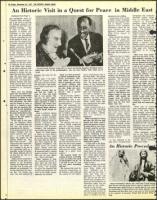
Former Israeli Premier Golda Meir is shown presenting Egyptian President Anwar
Sadat with a gift for his granddaughter, who was born Sunday while Sadat was in
Israel.
tion to a Palestinian state in
Sadat was then presented
postpone this issue for the
the West Bank. "We cannot
an ancient chandelier by the
future."
allow such a state within 10
Begin said, "I do under- Israeli government. Mrs.
miles of our coast," she
stand the reasons why at Nina Katzir gave him a
said. "We cannot solve the
this stage such an invitation book of paintings and songs
misery of the Palestinians
was not issued." But neither by Israeli children and
on account of the security of
he nor Sadat would state the asked him to give this gift to
the state of Israel."
his wife. Begin also gave
reasons.
Golda acknowledged that
Begin stressed that he Sadat his book "The
there was Palestinian mis-
now had the "right" to Revolt" with a special
ery—and it needed to be
come to Cairo and noted inscription.
solved. "And a solution is
"As an old lady, (Sadat's
that it was merely "the
possible," she said, referr-
exercise of that right" description of her) who has
ing to an agreement with
grandchildren may I pre-
which was being postponed.
Jordan, which would take
Sadat indicated, in reply to sent you a gift for your new
into consideration the rights
questions, the Israeli jour- granddaughter," Golda
of the Palestinians.
nalists would be welcome to Meir said concluding her
Golda stressed that as a
accompany Begin whenever speech at a special meeting
with the Labor Alignment
mother she felt everything
he visits Egypt, though not
should be done to spare the
Knesset faction. Sadat reac-
before.
About a half-hour before, ted to Golda's remarks on lives of soldiers, whether
they are Israelis or
leaving Jerusalem, Sadat the old lady with an emba-
Egyptians.
called on Israeli President rassed laugh, explaining to
Sadat responded by noting
Ephriam Katzir at the pres- Shimon Peres, "I - always
that after the 1973 war both
idential residence where an call her that."
himself and Golda contrib-
The meeting was one of
official ceremony was
uted to the process of peace.
attended by Begin, Cabinet several. Sadat conducted
He noted that he was aware
with the various Knesset
members and Knesset
of Israel's need for security,
factions, at his own request.
members. The atmosphere
but differed with the
In fact, when Sadat first
was friendly and informal.
Israelis on the definition of
declared his intention of
Katzir, in a short speech
security. Referring to the
in which he cited Sadat's visit the Knesset, he insisted
speech by Labor chairman
that he would be allowed to
statement that there would
Shimon Peres Sunday night,
meet with the factions.
be no more wars, expressed
Sadat said it was a very
Golda recounted that at
the hope that the barriers
constructive speech.
the time she served as Pre-
that were lowered by the
(A high aide in the Egyp-
mier she had always hoped
Egyptian President's visit
tian delegation said Peres'
would never be raised for the day she would meet
speech could have served as
with an Arab leader, "and
again., Katzir said the
a basis for negotiations.
there your are, a great Arab
efforts to seek peace should
Asked about the same sub-
be promoted until a lasting leader of' a great Arab
ject in the press conference
country."
peace is reached. "Peace be
later, Sadat again stressed
She praised Sadat for
with you on your depar-
coming, because, according the importance of Peres'
ture," Katzir told Sadat.
speech, although, he said,
to her, no matter how good
Sadat, replying in Eng-
he differed with many of the
an intermediary can be, "if
lish, repeated his call for no
things he said.)
I can talk to you, if I can
more wars but said deci-
When meeting with Shelli
see you, that's something
sions will have to be made
Knesseters Meir Payil and
different."
by Israel. He thanked
Liova Eliav, Sadat told
She stressed the need for
everyone and repeated that
Eliav: "Although I am in
he will never forget the wel- territorial compromises on
all frontiers, and explained Cairo and you are here, I
come of the Israeli people,
follow your work, and I
the reasons for her opposi-
especially the children.
appreciate it." Eliav told
him that he felt the with-
drawal from occupied terri-
tories and the recognition of
Palestinian rights, was not
only good for the Arabs—
but also for the Israelis.
Prior to Sadat's meetings
with the Knesset factions he
met with an eight-man dele-
gation of notables from the
administered territories.
Among them were Anwar
al Hatib, former Jordanian
governor of Jerusalem, Hik-
mat al Massri, former
chairman of the Jordanian
Parliament known for his
close contacts with the
Egyptian president and
Elias Freij, mayor of
Bethlehem.
Sadat assured the delega-
tion that he would not
neglect the Palestinian
cause. The members of the
delegation complained over
the burden of the Israeli
occupation and Sadat told
kern he regarded those liv-
I ing under the occupation as
heroes.
During his stay in Israel,
Sadat visited the Yad
Vashem Holocaust Memo-
rial and prayed at the Al
Aqsa Mosque. At Yad
Vashem Sadat appeared to
be visibly moved by the
Holocaust displays. Report-
ers were worried there
would be an embarrasing
incident over donning of the
yarmulka when entering the
memorial (UN Secretary
General Kurt Waldheim
refused to wear one when he
visited Yad Vashem), but
Sadat put one on after Begin
gave him an explanation.
Sadat was greeted with
cheers of 1,500 Moslem wor-
shippers inside Al Aqsa and
another 1,000 outside the
mosque. Some 150 demon-
strators were dispersed by
police near the area after
Sadat had left.
Sadat's visit disrupted the
normal Israeli routine. Sun-
day the streets of every city
and town were nearly
deserted. Shops, offices,
factories were either closed
or manned by skelton crews
as Israelis of all ages and
political and religious per-
suasions remained riveted
to television and radio sets,
watching and listening with
rapt attention to every
move, every nuance, every
word of Egyptian President
Anwar Sadat's historic
journey to Israel.
It was reflected in the
daily press, including those
newspapers that ordinarily
exercised caution, skepti-
cism or militancy with
respect to Egypt's
intentions. Maariv covered
its front page with the
words "Welcome Sadat - in
Arabic. The English-lan-
guage Jerusalem Pos
lished an extraordinar
urday edition
an
Arabic headline welcoming
Sadat which sold out quickly
and seems destined to
become a souvenir item.
'Haaretz carried a welcom-
ing editorial in Arabic on its
front page with Hebrew
translation on an inside
page.
There were many depar-
tures from the norm. In the
ultra-Orthodox township of
Bnei Brak where television
sets are banned from homes
because they are considered
a tool of evil, many of the
ultra-Orthodox joined
throngs outside of TV shops
watching Sadat's arrival.
The Israel Electric Corp.
reported that power con- `
sumption broke all records
for a Saturday night
because everyone was at
home with radios and TV
sets on and using electrical
appliances to heat snacks
and beverages. Sunday
morning, however, when
normally the resumption of
business and industrial
activity would create peak
demands for electricity, the
company reported the
power load was abnormally
low.
There was, of course,
some commercial exploita-
tion of the event. Many -
firms bought advertising
space in newspapers to link
their products with the
Sadat visit. Street vendors
did a brisk business hawk-
ing Egyptian flags and com-
memorative dishes.
imprinted with the Israeli
and Egyptian colors and the
words "Welcome Sadat."
Other businesses didn't
fare as well. Those restau-
rants and coffee houses that
remained open had few cus-
tomers. Movie theaters
were nearly empty.
An Historic Precede'',
Chaim Weizmann is shown, left, with Emir Faisal during
their .historic meeting in the desert north of Aqaba in 1919.
Weizmann later quoted Faisal as saying that he was eager
for negotiations to begin between the Arabs and the Jews.
Weizmann told him there was a vast area for both peoples _
to live together in harmony. Faisal later became King of
Iraq.