

48 Friday, July 22, 1977
THE DETROIT JEWISH NEWS
.
Mendel Grossman's Courage and Martyrdom:
He Portrayed Anguish of Holocaust 'With a Camera in the Ghetto'
Mendel Grossman is a
name that will be recorded
with glory in the history of
resistance to Nazism and of
an heroic photographer who
has contributed immensely
towards recording the ter-
ror that was Nazism.
There were many ways of
resisting the horrors that
were perpetrated by the
Germans during World War
II. Grossman's was not by
means of a gun. He used a
camera. He was a martyr
who was determined to por-
tray the occurrences in the
Lodz Ghetto. His volumi-
nous attainments were de-
stroyed, but enough were re-
tained to perpetuate the
story of the terror as well
as of the life of the Jews in
that ghetto.
"With a Camera in the
Ghetto," the very deeply
moving collection of the
Grossman photographs and
of the Lodz Ghetto suffer-
ers, emerges as one of the
most deeply moving books
about the Holocaust.
In the Lodz Ghetto, the
first set up for Jews of Po-
land by the Nazis, 43,000
died of hunger and thou-
sands more were sent to
the German extermination
camps.
Grossman was the brave
photographer who devoted
the last years of his life to
the dangerous task of tak-
ing pictures of the victims
of the Nazis. He had a hid-
den camera with which he
made his rounds. He risked
his life and he kept photo-
graphing. The 70 rescued
photos in "With a Camera
in the Ghetto" serve as in-
erasable additional evi-
dence of what had tran-
spired during the years of
the agonies that were
caused by the Hitler
hordes.
This Schocken Books vol-
ume was edited by Zvi
Szner and Alexander Sened.
The appended story is addi-
tionally dramatized by the
inclusion of the text of
"The Chronicle of Lodz
Ghetto." This accurate his-
torical account was edited
by Lucjan Dobroszycki and
Danuta Dombrowska.
Fortunately for the histori-
cal record, the facts about
Grossman also are included
in this volume, as an appen-
dix of the life of the heroic
photographer.
Grossman was a respect-
ed Polish artist and photog-
rapher. In 1939, his work re-
ceived critical acclaim and
his career was beginning.
In 1940 he was imprisoned
in the Lodz Ghetto.
Grossman worked in the
ghetto's department of sta-
tistics and there he had
access to photographic
equipment. Most of the
photos he took, however,
were not for the German de-
partment's records. Gross-
man traveled with a cam-
era hidden beneath his coat
and secretly snapped pic-
tures that he then hid in
round tins. He took tre-
mendous risks, often photo-
graphing in view of Ger-
man police, and he sub-
jected himself to physical
dangers; such as walking
over rooftops and climbing
church steeples.
Afflicted by a heart ail-
ment, Grossman persisted
in photographing the ghetto
from its beginning in 1940,
when 160,000 Jews were im-
prisoned within an area----ol-
1.5 square miles, almost to
its end, in 1945, when 887
survivors were liberated.
He was known by many
within the ghetto and be-
loved ior his labors.
Before being evacuated
from Lodz, Grossman hid
in a window sill the 10,000
negatives he had accumu-
lated during his five years
within the ghetto. After the
war, his sister retrieved the
negatives from the window
sill and sent them to Israel
to be stored on a kibutz, but
all of the negatives were de-
stroyed when the k ibutz
fell into Egyptian hands dur-
ing the War of Independ-
ence.
Several days before the
German surrender, Gross-
man collapsed and died dur-
ing a forced march on a
road outside a work camp
in Germany. He was 32
years old; his camera was
still with him.
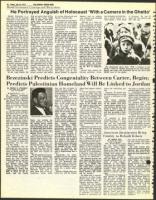
The photograph above, from "With a Camera in the
Ghetto," taken by Mendel Grossman in the Lodz Ghetto,
depicts the agony and frustration felt by the more than
160,000 Jews of the ghetto.
Brzezinski Predicts Congeniality Between Carter, Begin;
Predicts Palestinian Homeland Will Be Linked to Jordan
By TRUDE B. FELDMAN
The Jewish News Special
Israel Correspondent
WASHINGTON, D.C. —
Dr. Zbigniew Brzezinski,
President Carter's national
security adviser, described
new Israeli Prime Minister
Menahem Begin as having
some of the same character-
istics in common with the
President of the United
States.
"I'm personally acquaint-
ed with the prime minister
and know him to be a for-
thright and direct person.
He has certain deeply-held
beliefs. In that sense, he is
much like Jimmy Carter,
who also has deeply-held be-
liefs and who is forthright
and who speaks with can-
dor."
Dr. Brzezinski predicts
that President Carter and
Prime Minister Begin—who
was scheduled to visit Wash-
ington this week will dis-
cuss "things openly and
frankly. They may disagree
on a number of issues, but
personally, the two men
will get along."
Dr. Brzezinski, who vis-
ited Israel last year, is a na-
tive of Warsaw, Poland. He
came to North America at
age 10. During the Presiden-
tial election of 1968, he di-
rected foreign policy task
forces for Vice President
Hubert Humphrey, and was
a member of the foreign
and defense policy task
force for then Presidential
candidate Jimmy Carter.
Reacting to claims that
Begin's victory was due, in
part, to fears by the Is-
raelis, that the United
ZBIGNIEW BRZEZINSKI
States was putting too
much pressure on Israel,
the foreign policy expert
said that from all he has
noted, including Israeli pub-
lic opinion polls, that "domes-
tic issues and factors were
the paramount reasons" for
Shimon Peres' defeat.
Turning to the question of
Begin's insistence on retain-
ing the West Bank as a per-
manent part of Israel, Dr.
Brzezinski said that Prime
Minister Begin has in-
dicated that he is approach-
ing any possible negotia-
tions on the basis of UN
Resolution 242 and that he
has been very explicit on
that.
On the question of a home-
land for the Palestinians,
Dr. Brzezinski stated: "We
want to resolve the issue of
the Palestinians in such a
way that they don't become
a political force dedicated
to increasingly effective ef-
forts to threaten Israel.
Therefore, they have to
have some sort of an ar-
rangement within which
they can feel at home. It
would be more stable, and
more acceptable if such an
arrangement was related in
some fashion to the king-
dom of Jordan."
He added that it is for the
Israelis to negotiate as to
what is more likely to en-
dure, to be stable and to
pose the least security
threat to Israel.
"We feel that any ar-
rangement for the Palesti-
nians will be better if it in-
volves some relationship
with Jordan," he said.
"Also, anything that is con-
trived for the Palestinians
in that context ought to in-
clude extensive demilitariza-
tion, security arrange-
ments, patrolling rights,
transitional defense em-
placements, security lines
beyond mutually recognized
borders, a complex of
arrangements the total ef-
fect of which would be to
provide Israel with the secu-
rity it needs, and to which
it is entitled, and which it
now enjoys on the basis of
the present status which has
the disadvantage of being
not founded on the termi-
nation of hostilities and
which, therefore, runs the
risk of degenerating into a
war."
Explaining
his
inter-
pretation of the two United
Nations resolutions (242 and
338) dealing with the 1967
war, Dr. Brzezinski said
that they make it clear that
a peace settlement will in-
volve the trading of terri-
tories for a peace settle-
ment.
Should a Middle East war
break out, will the United
States lend support militar-
tween the conflicting par- will have to include, as the
ily?
ties.
essential point of departure,
'It's just beyond a shad-
a comprehensive peace
However,
he
denied
that
ow of a doubt that the
treaty including mutual rec-
the
Administration
is
trying
United States stands behind
ognition and comprehensive
to force a settlement in the
Israel," he concluded. "It's
peace treaty including mu-
region.
an h storical commitment,
i
tual recognition and com-
The Carter Adminis- prehensive relationships
which is unalterable."
Dr. Brzezinski said that
tration's recent statements
It's possible and in fact
peace in the Middle East
on the Middle East have
probable th-A. some Arabs
will require more than just
caused alarm signals in Is-
continue to harbor the ex-
the end of belligerency.
rael and have led the Arab pectation that peace would
"Real peace," he said,
world to believe that the
be stage one and that
"has to mean mutual recog-
United States is pushing Is- only
it'll lead to stage two, name-
nition of the permanence of rael into accepting a solu-
ly the liquidation of Israel.
a settlement, mutual recog-
tion favorable to Arab inter-
"That's why we feel that
nition of the existence of est.
any peace arrangement has
the parties to that settle-
In response to these to be a self-enforcing one,
ment, the undertaking of a
mounting fears, Dr. Brze- so that over time the Arab
comprehensive political, dip-
dream for stage two be-
lomatic, commercial and so- zinski concluded: "I hope
comes increasinly an unre-
cial relationships, and so this isn't the impression
forth."
al one and simply fades as
they have gotten. We have
Addressing himself to the
peace. becomes more and
made it clear that any set-
question of what assurances
tlement between the parties more entrenched."
he has from the Arabs that
they are prepared to make
this kind of peace, he sai d
that "in conversations
we've had with Arab lea d-
ers, a willingness on their
BY MOSHE RON
butz and 10 Palmach fight-
part in favor of such an ar-
The Jewish News Special
ers were killed, with many
rangement has been noted.
Israel Correspondent
" d the pur ose of ne o-
TEL AVIV—Three years others wounded and taken
tiations would to test the - ago the Ihud ha butz prisoner.
degree of their willingness. movement rebuilt Kibutz - The Arab Legion plun-
If they are prepared to go Gezer, which was aban- dered and destroyed the set-
down this path, that's all to doned in the 1960s. New im- tlement, but immediately
the good. If, in negotiations, migrants from the U.S. and after the destruction a Pal-
it becomes clear they are Canada first settled there mach unit reoccupied the Id-
not, then it's obvious there and other groups followed.
butz.
would be no settlement."
Kibutz Gezer, founded in
Gezer was built up again
The National Security Ad- 1945 near Rehovot, was an
and prospered. But a social
viser observed that one of isolated settlement in the
crisis broke out amo'
the Carter Administration's midst of Arab villages.
its members, and
goals for a Middle East Members of the -kibutz groups started to leave, _
lowing a general trend
peace settlement is to try came from the Youth Aliya
and make direct negotia- movement and native-born after the establishment of
tions possible by--"reducing Israelis. There were 100 the state. Many kibutz mem-
bers left their homes,
the gaps over fundamental members, and the kibutz
issues between the Arabs started to prosper and de- moved to the cities and
looked • for work.
and the Israelis."
velop.
New pioneers three years
Then the War of Independ-
He added that it was dis-
ago came to Gezer with rev-
agreement on these funda- ence started. On June 10,
olutionary ideas. Some of
mental issues that "in the 1948 the Arab Legion at-
settlers were leftists
past prevented direct dis- tacked Gezer. In isolated the
and were of the opinion
Gezer there were few men
cussions between them."
arms: they could not that women had to do the
Noting that the Israelis and
same jobs as men. A
defend themselves against
have always said they want the strong and well-armed
woman, concentrating on
direct negotiations with the units of tne Jordanian Le-
the building projects in the
Arabs, Dr. Brzezinski, said gion, which shelled the set- kibutz. was appointed as its
the (Carter) Administration tlement. Gezer was occu-
secretary. Other members
is interested in trying to pied by the Arab Legion,
wished to keep up Jewish
promote a settlement be- after 1(3 members of the ki- traditions.
American Immigrants Bring
Vitality to Rebuilt Kibutz