

56 Friday, July 8, 1977
THE DETROIT JEWISH NEWS
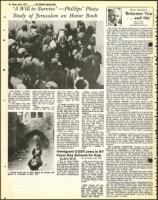
`A Will to Survive' Phillips' Photo
Study of Jerusalem an Honor Book
Boris Smolar's
'Between You
-... and Me'
Editor-in-Chief
Emeritus, JTA
(Copyright 977,'JTA, Inc.)
John Phillips, a former
Life Magazine photogra-
pher in embattled .Jerusa-
lem in 1948, compiled a pho-
tographic record of the trag-
edy that was perpetrated at
that time.
It was when Jews were.
being rounded up, when the
old settlement was being de-
stroyed, when the syna-
gogues were taken over and
Jews were barred from the
Western Wall—which be-
came noteworthy as the
Wailing Wall—and the syna-
gogues were lost to a
people whose links with the
Holy City were of gener-
ations.
Phillips returned to Je-
rusalem in 1976. He corn-
piled the historic photo-
graphs and they are now
part of the history of mod-
em Israel in "A Will to Sur-
vive," a volume thus appro-
priately titled by Dial
Press.
So deeply moving is this
story of Jerusalem the con-
quered by Jordan in 1948,
now the redeemed by Israel
in 1967, fully alive in- 1977,
that the book became the
Honor Book of the World
Jewish Book Fair in Jerusa-
lem in May of this year.
So significant are these
photographs that they have
been placed on display at
the Jewish Museum in New
York and will remain as an
exhibition of merit for the
coming few months.
An American born in Al-
geria, John Phillips began
his dual career as a writer
and photographer in 1936.
One of Life Magazine's orig-
inal team of photographers,
he has been instrumental in
establishing the art of mod-
em photo-journalism:
Phillips covered World
War II as a combat photog-
rapher and took the famous
picture of Roosevelt, Stalin
and Churchill at Teheran.
He went behind German
lines to photograph Tito and
his partisans in Yugoslavia.
After the war he covered
the trial of Mikhailovich,
Kruschev's visit to Tito,
and the Israeli War for Inde-
pendence.
During the 1950's Phillips
spent some time working
on films with Mike Todd
and later with Jacques
Tati. In 1957 he wrote his
first book, "Odd World," a
photo-journalist's story;
and in 1965 he published a
second book, "The Italians-
Face of a Nation."
He has written for Time.
Life, Esquire, Holiday, and
The Reporter and many for-
eign publications including
the London Sunday Tele-
graph, Paris-Match, Eu-
rope, and Stern; and he has
also done photographic illus-
trations for a number of
books.
Immigrant USSR Jews in NY
Favor Day Schools for Kids
BY BEN GALLOB
(Copyright 977, JTA, Inc.)
A young Jewish girl is shown fleeing the burning Old
Quarter of Jerusalem in May, 1948.
Twice as many children
of Russian Jewish immi-
grant families settled in the
new York area are enrolled
in Jewish day schools as in
public schools, according to
a rabbi who served as So-
viet Jewry chairman for
the Board of Jewish Educa-
tion of Greater New York.
Rabbi Israel Grama cited
the figures in connection
with a statement by the
BJE that the "growing ten-
dency" of Russian Jewish
imnugrant parents to place
their children in day
schools was one of the find-
ings of a "Needs Assess-
ment Study of Bilingual
Education Needs for Recent-
ly Arrived Russian Immi-
grants."
Rabbi Graina said the
needs assessment study
showed that some 400 Rus-
sian Jewish emigre chil-
dren . are attendmg New
York City public schools
and that some 800 are at-
tending day schools.
ZOA AT 80: The Zionist Organization of America, which
is now holding its 80th annual convention in Israel is ac-
tually older than 80_years. It derives its origin from the
"Zion Society" which was organized in Chicago in 1895,
and which sent a delegate to the first World Zionist Con-
gress in Basle. The delegate was Leon Zolotkoff, the Chi-
cago Jewish editor.
The Chicago Jewish community was at that time the sec-
ond largest in the United States, next to New York. m. ,w
York had no organized Zionist group in those years. -
ever, Dr. Richard Gottheil, one of the first advocate. of
modern Zionism in this country, happened to visit Europe
in 1897 at the time when the first World Zionist Congress
took place, and he attended. Following his return to New
York, he called a conference which resulted in the estab-
lishment of the "Federation of American Zionists."
Dr. Gottheil, who was professor of Semitic languages at
Columbia University for 49 years, was elected president of
the federation at its first convention. Rabbi Stephen S.
Wise was elected secretary. This was the beginning of the
organized political Zionist movement in the United States.
For many years—till the issuance of the historic Balfour
declaration by Britian promising the establishment of a
Jewish National Home in Palestine—Zionism made little
progress in this country. The immigrant Jewish masses
were followers of the leaders of the Jewish labor move-
ment who were anti-Zionist. The Americanized Jews were
similarly anti-Zionist. The organization of Reform rabbis,
which reflected the mood of Reform Jewry, was rabidly
against Zionism. However,. the Zionist sentiments grew
stronger among immigrant Jews as a result of the in-
spiring speeches by Rev. Zvi Hirsh Masliansky, a fiery Or-
thodox folk-speaker who drew thousands of listeners at pub-,
lie meetings. Its strength grew also due to Dr. Smaryahu
Levin, a world Zionist leader and great orator, who got
stranded in the United States when World War I broke out.
The Zionist movement developed even greater impetus dur-
ing the Louis Lipsky period. Lipsky, who became chair-
man of the ZOA Executive in 1912, later dominated the
ZOA for about 30 years. Jewish labor elements inclined to
Zionism formed their own Labor Zionist groups.
THE STORMY PERIOD: The stormy period in 'the
American Zionist movement was the period when Lotiis D.
Brandeis—who later became a justice of the U.S. Supreme
Court—took over the top leadership of the movement in
1914, and involved himself in sharp differences of opinion
with Dr. Chaim Weizmann.
Brandeis, who enjoyed great popularity as a lawyer—he
was known as "the people's advocate," and served as arbi-
trator in the great garment workers' strike in 1910—was
appointed to the U.S. Supreme Court in 1916. He then gave
up his position as chairman of the Zionist Provisional
Emergency Committee, but retained his deep interest in
the Zionist movement. He was made honorary president of
the Zionist Orgy nization of America and of the World Zion-
ist Organization. However, he resigned from these two hon-
orary posts in 1921 after the Zionist movement decided to
establish the Keren Hayesod as the Zionist fund-raising
arm.
The- Brandeis resignation resulted in a split in the ranks
of the ZOA leadership with Brandeis becoming in-
strumental in the creation of the Palestine Economic
Corp. which played a very important role in the economic
development of the Yishuv. The "Brandeisists" returned
to the ranks of the WA leadership after the Arab riots in
Palestine.
THE LIMITED OBJECTIVES: Strange as this may
sound, but the ZOA began to lose popularity and strength
following the establishment of the state of Israel.
Premier David Ben-Burion greatly contributed to this de-
velopment. Soon after he took leadership of the Jewish
state, he proclaimed that a Zionist can be considered only
a person who settles in Israel. This was a challenge to
American Zionist leadership. Ben-Gurion did. not he .e
to declare publicly that following the establishment 4.0.
rael, every Jew—not only Zionists—is seeking to helipile
fledgling state, and that the practical aid is coming more
and more from Jews who were never interested in the Zi-
onist movement through the United Jewish Appeal, private
investments and in other ways.
The ZOA could, naturally, not benefit from such a state-
ment. Nor were the leaders of the Zionist movement in the
U.S. willing to uproot themselves and settle in Israel. The
functions of the ZOA were thus reduced to seek to stimu-
late Jewish emigration from the U.S. to Israel and to pro-
mote Hebrew culture in the U.S. .
The ZOA rias to its credit two direct achievements in Is-
rael—the establishment of Mar Silver, a settlement named
after the late American Zionist leader Abba Hillel Silver
who was ZOA president for a number of years, and the
maintaining of the "American Zionist House" in Tel Aviv,
which it established as a cultural and social center for
American Jews settled in Israel and for Jews visiting Is-
rael. The "American Zionist House" is one of the finest
Jewish centers in Israel.