

• .1164111WWWfikaRIMW
64 Friday, March 25, 1977
THE DETROIT JEWISH NEWS
Vatican to Give Up Control of Jewish Catacombs
ROME — The carved
inscriptions speak of the
lives of Sabine, Aurelia
Flavia, Pegaianos the
scribe and Maria Maroni.
And the ancient wall
paintings depict the relig-
ion of these people with
menoras, shofars and
scrolls.
They were all Jews who
lived in Rome between
the First and Fourth
Centuries and who were
buried in the black vol-
canic rock beneath Rome.
Tens of thousands of Jews
were buried in catacombs
around the city, but only
two sites remain, accord-
ing to Alvin Shuster of
the New York Times.
Now, for the first time
history, these
in
catacombs are expected
to be turned over to Ita-
ly's Jewish community.
They have long been
under the jurisdiction of
the Vatican, which for-
mally took control under
the 1929 Concordat bet-
ween the church and the
Italian Government.
The Concordat, which
governs the relations bet-
ween the church and state,
is now being revised. And
under the proposed
changes the Vatican would
give up its jurisdiction
over the Jewish graves,
which the church has ex-
cavated and maintained at
substantial expense.
of the graves are now
empty and only a few are
marked by carved inscrip-
tions.
Most of the inscriptions
in the catacombs under
the Villa Torlonia are in
Greek, which the early
Jews of Rome spoke al--
most exclusively. Hebrew
was not generally used to
mark Jewish gravestones
until later, perhaps until
the eighth or ninth cen-
turies.
In addition to the con-
ventional decorations of
menoras and shofars, the
Jews in that early period
also used pagan symbols
such as peacocks and sea
monsters to decorate
tomb walls.
"Here lies Phillip,
known for the love of his
brother, who lived 33
years," reads one inscrip-
tion. "Here lies
Pegaianos, the scribe and
lover of the law," reads
another. "May his sleep
be in peace."
The Jewish community
made its appeal for con-
trol over the catacombs
after the announcement,
of negotiations on revis-
ing the Concordat. Al-
though a commission ag-
reed to the proposal, talks
are still under way on the
precise changes to be
submitted to Parliament
for approval.
"We are making some
tentative plans," said
Pietro Blayer, head of Ita-
ly's Jewish community.
"The catacombs are of his-
torical and cultural impor-
tance to the 40,000 Jews of
Italy and to Jews
everywhere. We feel it is
our duty to take up the job
and take care of the
catacombs ourselves al-
though the Vatican has
performed excellent work
in them."
Blayer said that the
Jewish community here
would like to set up an in-
ternational committee to
survey the catacombs
and make plans for
further research- and ex-
cavations. The committee
would also raise funds to
-
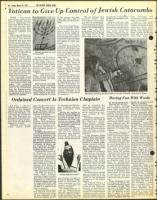
Menora painted on roof
of catacomb.
Unlike the Christian
catacombs of Rome, those
of the Jews have re-
mained closed to the pub-
lic. Visitors need special
permission from the
church's pontifical corn-
mission on sacred ar-•
cheology.
"The catacombs have
been well-preserved,
thanks to the Vatican,"
said Elio Toaff, the chief
Rabbi of Rome.
Other Jewish catacombs
are no longer accessible
because they have been
lost under housing de-
velopments. A few ancient
bones remain in the exca-
vated catacombs, but most
Workman pointing out decorations on wall of Jewish catacomb in Rome.
Ordained Convert Is Technion Chaplain
Having Fun With Words
BY DAVID SCHWARTZ
HAIFA — Rabbi
Aharon Shear-Yashuv, a
convert, is now complet-
ing his first year as chap-
lain of the Technion — Is-
rael Institute of Technol-
ogy. The Technion ap-
pointment is his first rab-
binical post after gradua-
tion from the Jerusalem
Seminary in 1976.
Officially a Jew for only
eight years, Rabbi
the
help _maintain
catacombs and keep them
open to the public.
Those of that early
period were not disco-
vered and explored until
centuries later, after
many had been plun-
dered, even though the
Jews, unlike the Etrus-
cans, did not bury gold
with their dead.
Shear-Yashuv was born a
Christian 37 years ago in
Germany. His conversion
by an Orthodox rabbi in
1969 culminated a 10-year
interest in Judaism.
After completing his
high school education in
1958, Rabbi Shear-
Yashuv (nee' Wolfgang
Schmidt) worked for four
years as a business man-
ager in an iron factory in
the industrial center of
Germany.
In 1962 he decided to re-
turn to school to pursue his
interest in philosophy. He
studied Protestant theol-
ogy and philosophy first at
the Church Academy in
Wuppertal, and later at the
University of Mainz, and
the University of Ham-
burg where he received a
theology degree in 1967.
It was at the University
of Hamburg that his
interests veered towards
more general philosophy
and Jewish philosophy
and history. Here he was
appointed assistant to
the professor of Jewish
history, with whom he
worked for a year-and-a-
half while continuing to
study Christian theology.
By 1968 his desire to
learn about Judaism
could no longer be satis-
fied within the borders of
Germany, as institutions
of Jewish higher learning
no longer exist there, and
he wished to continue his
studies in a Jewish acad-
emy or yeshiva.
He was advised to go to
the Hebrew Union Col-
lege in Cincinnati, where
he was accepted to the
doctoral program. In 1971
he received the PhD de-
gree in Jewish and gen-
eral philosophy from
HUC.
During his studies at
Hebrew Union College the
process towards official
conversion started. At his
insistence the final con-
version in August, 1969
was an Orthodox one with
an Orthodox rabbi from
Montreal presiding.
In summer of 1970 Dr.
Shear-Yashuv visited Is-
rael for five months,
spending two months
learning Hebrew at
Ulpan Akiva and three
months studying Talmud
RABBI SHEAR - YASHUV
and Jewish thought at
Yeshivat Mercaz HaRav
Kook in Jerusalem. He
then returned to Cin-
cinnati to complete his
doctoral studies.
He immigrated to Is-
rael on Independence
Day, 1971 and returned to
Yeshivat Mercaz HaRav
Kook studying full time
until 1973. From 1973 to
1976 he attended the
Jerusalem Seminary for
rabbinic studies (the
Harry Fischel Institute)
while continuing part
time studies at the
yeshiva.
His rabbinic degree was
granted by the head of
the Seminary, Rabbi
Shear-Yashuv Cohen,
who is also the chief rabbi
of Haifa. He married an
Israeli in 1971, six months
after arriving in Israel
and is the father of three
children.
At the Technion, Rabbi
Shear-Yashuv has already
started some innovations.
In addition to the usual
duties of a campus rabbi,
he has started a club for
new immigrants from
Russia, teaching them the
elements of Judaism.
He receives students
daily both in his study
and at the Shine Student
Union Building, for dis-
cussion and help on any
problems they might
have. During the coming
academic year he will
give a course in the gen-
eral studies program on
Jewish thought and phi-
losophy.
He feels he has a special
role as chaplain of the
Technion since, he is the
rabbi of the technical
university of the Jewish
people.
He believes there is a
real ingathering of the
exiles at the Technion,
not only of countries but
of thoughts. His mission,
he feels is to aid Technion
students to study science
and technology from the
point of view of Judaism.
(Copyright 1977, JTA, Inc.)
The other evening,
Mery Griffin on his tele-
vision show, speaking of
his recent visit to Israel,
said he had told an Israeli
that his name Mery Grif-
fin had once been trans-
lated in Yiddish into
"Mavin Gribenes," but
the Israeli didn't know
what gribenes was. He
told the American televi-
sion star that they spoke
Hebrew in Israel, not
Yiddish.
• of
Yet many Israelis
course do know Yiddish —
and it seems some Ameri-
cans, who are' not Jews,
also know some Yiddish.
The other day, the New
York Times carried a lit-
tle story about Tel Aviv.
It said that while Israel
also has its boycott
movement against the
high price of coffee,
"noshing" with coffee and
cake still went on as be-
fore. The word "nosh"
was used as though it was
an English word. It is
easy to understand.
There is no English word
to really express the idea.
To nosh is not simply to
eat. It is a kind of stealthy
eating of delicacies bet-
ween meals. If you want
to reduce, you can con-
tinue eating, but you
have to cut out your nosh-
ing.
Every language is a lit-
tle unique, of course. For
instance, in English, meet-
ing people, we ask, "How
are you?" In Yiddish, one
asks vos makhst du — what
are you making. Every
Jew, it seems, is a man-
ufacturer. You visit a per-
son in a hospital who can
barely sit up and you ask
what he is making.
We get fun out of words.
The other day Earl Wil-
son in his syndicated col-.
umn had a little story
about a romantic affair
between Rina Messinger,
the Tel Aviv beauty who
is Miss Universe and a
young Canadian. Wilson,
questioning her,
apologized — "After all,"
he said, "you are a world
figure." "Yes, she has one
of the world's best fi-
gures," snapped . her
Canadian escort.
Names are words too.
President Carter has said
he prefers to be called by
his first name — Jimmy.
A writer in the Jewish
Daily Forward notes that
all of those in the political
foreground in Israel are
known by their first
names. People in Israel
don't say Mrs. Meir, bnt
Golda, and Rabin is
Rabin, but Yitzhak
Peres in Israel is Shimon.
According to the writer,
one can't get anywhere in
Israel until he is called by .
the first name.
Politically, there is no
question that calling the
President Jimmy is a
gain. The best name for
an American President
seems to be 'a simple
Jewish name. Lincoln for
instance was known as
Abe and Eisenhower was
Ike. Even the man with
the whiskers — Uncle
Sam — imagine him cal-
led Uncle Aloysius or
Uncle Wendell. Such
names wouldn't do at all,
but with a nice short
Jewish name, Sam, how
can he help but be popu-
lar?