

ThrffirriraMrch 18, 1977 '.1714'6171MTIMIlltws
American Gentiles Who Pioneered in Israel
Faced Harsh, Lonely Struggle in the 1800s
JERUSALEM - Great
numbers of people have
streamed into the United
States, from all parts of
the world. But there were
also a few who left the
United States, among
them some devout Chris-
tians who emigrated to
the land of Israel in order
to make it blossom once
again for the people to
whom it had been prom-
- ised by the Almighty.
- They did so because of
their faith that the Jews
would indeed return to
their homeland, writes
Gabriel Zipron.i in the
current Jewish National
Fund Yearbook.
"The first illegal immi-
grant", was the term
applied by Berl Katzenel-
son to Karl Netter, foun-
der of Mikvei Israel. This
description applies as
well to his contemporary
and predecessor,
Klorinda D. Minor, who
• was a zealot in the cause
of the -renaissance of the
Jewish nation in its land.
She and her friends were
motivated by a religious
fervor in striving to
realize the ideal of social
reform in the spirit of
early Christianity.
Inspired and motivated
by their faith and deter-
mined to redeem the
Promised Land for the
Chosen People whom
they believed should,
. sooner or later, return to
their country, and with
absolute faith that she
had been chosen by the
Lord as His messenger,
with her own money she
pwrchasetl a hill,- north of
Jaffa, and established
there an agricultural
farm named Har Hatikva
(Hill of Hope).
Ciergymen from the
United States came to the
Holy Land before and
after her; their descen-
dants built the American
University in Beirut, as
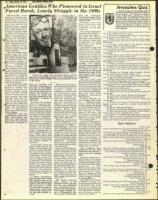
Shown are author John Steinbeck (inset) and the
monument beneath the sycamore tree at Har Hatikva, a
hilltop farm north of Jaffa, where his grandfather lived
in the 1850s.
* *
well as churches and
charitable institutions in
-all parts )f the Middle
East. But Klorinda Minor
was the first who strove to
reform Christianity by
helping the people who
were the ancestors of the
"Redeemer" to return to
their land.
Klorinda, the romantic
wife of a wealthy mer-
chant in Philadelphia,
was fascinated by this
ideal and devoted herself
to it, influenced to a great
extent by Warder Carson,
who was the first Ameri-
can consul in Jerusalem,
and convert to Judaism.
She came for a visit to
Jerusalem in summer
1849, and was shocked by
the poverty in the Jewish
quarter, and the pitiful
situation of its inhabi-
tants, Ashkenazim as
well as Sephardim. In her
first letter home she
wrote: "We have to free
the Jews in the Holy Land
from slavery worse than
the Negro slavery in
America."
In the diary which she
began while crossing the
Straits of Gibraltar, she
wrote: "I spoke with Rab-
bis and various commu-
nity leaders in Jerusalem,
I told them: "You have to
think of the future. You
have to adapt yourselves
to farming. The Jewish
people are a great, chosen
people. You seem weak
but actually you are very
strong. The Lord of Hosts
does not like ghettos,
therefore he took you out
of the Goshen ghetto in
Egypt."
A Swiss missionary,
Ernst Zimpel, later visited
liar Hatikva, and on his
return to Europe issued an
appeal to the Jews to help
the Americans in Jaffa.
The Jews did not come, in-
stead more Americans,
imbued with religious fer-
vor and lofty dreams, ar-
rived.
However, Yehuda Levi,
Rabbi of Jaffa, considered
the father of Jewish cit-
riculture, owned an
orange grove in the vicin-
ity of the farm, trans-
ferred it to the care of the
American settlers. An
American, David Colson,
who came to Eretz Yis-
rael and converted to
Judaism, cultivated the
orchard and even stayed
on after the farm was liq-
uidated. Moses Mon-
tefiore who supported the
farm, finally took over the
orange grove. In 1920
that area was named
"Montefiore Quarter".
Helping re-establish
Jewish settlement in the
land of Israel was com-
manded by the Bible -
KlorindA'S said - and the
holy command must not
be delayed. This activist,
rom-antic Christianity,
which saw the Jewish
people in a different light
from the accepted norm,
was blended with healthy
American optimism,
which prevailed despite
the ridicule and doubts it
was exposed to.
Klorinda died fully con-
vinced that her efforts
would be followed by the
Jews returning to their
plowshares, and the bi-
. blical ideals thus be
realized. What she failed
to achieve during her
short life-span was in-
scribed on her tombstone:
"In memory of Mrs. K. C.
Minor, of Philadelphia,
emissary for the de-
velopment of industry"
and agriculture for the
Jews. Died November 6,
1855, at age 46. She did all
she could."
Her death received
minor notices in the
American press, and the
few that were published
were translated and re-
printed in Jewish publica-
tions. Rabbi Yitzhak Lis-
ser of Philadelphia; who
had a good relationship
Jerusalem Quiz
roL7 v ri l
A quiz testing your knowledge about
Jerusalem has been prepared by Tamar
Grand and Dr. A.P. Gannes in obser-
vance of the 10th anniversary of the
reunification of Jerusalem. This fea-
ture has been prepared for the member
papers of the American Jewish Press
Association by the Department of Edu-
cation and Hebrew Culture of the
American Section of the World Zionist
Organization.
with the "American-
Christian Friends of Zion"
eulogized her with warmth
and gratitude.
However, now that
Eretz Yisrael has been
developed, even her
tombstone has not been
preserved.
The second monument
1. How does Jerusalem rank in population among
erected on Har Hatikva - the three largest cities in Israel?
not preserved either -
2. What is the characteristic shape of the rooftops
was that for Walter of the houses in the Old City?
Steinbeck, who was one of
3. What is the name of the valley which begins
the settlers there (the north of Jerusalem and runs all the way down to the
grandfather of John Dead Sea?
Steinbeck, the Nobel
4. Another valley lies on the western side of
Prize recipient.)
Jerusalem. What is its biblical name?
The Minor farm was
5. Why is this valley- associated with Gehenna -(ar
established in 1852 and place of hellish torment)?
lasted only five years,
6. How are the two major sections of Jerusalem
during which the suffer- identified?
ing and privations en-
7. What other way is there to go from Tel Aviv to
dured by the handful of Jerusalem other than by car or bus?
settlers were as great as
8. There is a quarter of Jerusalem populated by a
their faith and courage.
colorful group of Jews who came from Soviet Central
Upon the death of the Asia. What is its name?
9. There is a suburb of Jerusalem founded in 1880
founder, her twenty-,
year-old son succeeded as by a non-Jewish national group. What is its name?
10. What is the name of the place in Jerusalem
manager of the farm. At
his mother's grave he which houses many birds and animals mentioned in
vowed that he will never the Bible?
abandon this place of his
11. Beside the building which contains David's
own volition "only if my Tomb is the Holocaust Cellar. What is it?
weak body will be unable
12. For how many years was Jerusalem a divided
to defend it".
city - East and West Jerusalem?
But the Arab riots
13. What organization in Jerusalem is concerned
exhausted the strength of with the Hebrew language and its development?
those who remained. The
14. During the War of Independence in 1948, a new
families of Dickson, Bur- road opened the way to Jerusalem. What was it called?
ton, and Colson returned
15. What is the name of the new cultural center
to the United States. One opened recently in Jerusalem?
-
of Dickson's daughters
16. What is Beit Ha'am in Jerusalem?
was married to Steinbeck,
17. What is the name of the famous music school in
they and their three Jerusalem?
daughters remained at
18. What is the Artists' House in Jerusalem?
Har Hatikva.
19. Name four of the gates to the Old City.
Herman Melville, au-
20. Who was the author of the book "Rome and
thor of Moby Dick, while Jerusalem?"
on a Mediterranean
21. What is the name of a Talmudic institute of
cruise, visited the farm, higher learning named for a former chief rabbi of
and was deeply impressed Palestine?
by the devotion and self-
22, What is Mitzpeh Habayit?
sacrifice of the settlers.
23. What is the Russian Compound in Jerusalem?
He referred to them
24. Who was the author of Justice in Jerusalem, a
kindly in his diary, and book written about the Eichmann trial?
his memoirs preserved
25. When is the following traditional prayer re-
the story of the farm, cited? "We pray that You rebuild Jerusalem, the holy
which lost its last inhabi- city, in these very days. Blessed are You Lord, who in
tant in April 1858.
mercy will build Jerusalem anew. Amen"
A band of Bedouins at-
tacked the hill, Walter
Quiz Answers
Steinbeck was murdered,
his wife violated and
(siva al deur:
wounded, but his children aon.1-9) UOZ2?LIII3H 1.133.1.-qg LUO.IJ are spawn. asau •gz;
were rescued. The Presi-
utreuttpla aul le aoln3as
dent of the United States, -oad.s-e pan.zas oum.laSAvei aLll ‘,Taust-repi uoap1.9 •tg
James Buchanan, de-
.1 xem ppom a.tojaq ulssrizi tuo.0 tuaresrmaf of atunD
manded from the Otto- own suu.t2ild atll asnou o4 s2ulpunq pun feapaglea
man government to a2xuT i Llltm puel paumo treIssrva jo iaoxed y •gg
punish the murderers.
.tuaresn.-caf JO math luaTiaDxa
They were hanged in the ur tiwn mAna Jo qui°Z am dole va.re lnoNdol
marketplace of Jaffa, the
•.)loom AelfeH pesoar .Tg
same place where the
•ss.aH sPsoIAI '03
. clocktower now stands.
•untssaw gill
The criminals were Jo 2uuuoo atiq 'pun pasop sl SD.laW jo aveD a4J •poaaH
punished, but the farm `2unci `suolg `(snoseurea) tuaLpiatis 'ejjef `1.10IZ '6T
remained devastated, a
•4 1 e ilae.zsl ..toj !leg uonNITca luau -eumad y •8T
lonely tree left standing
•3!snw jo Stuapeoy ulcinzi
there.
.34a `sieuItuas `saDueLuJoj.Tad
Sometime after the es- realayealp `saanpai 2uldni.ea3 aawa3 iednlinD V .91
- axieau Luaresnaatau •QT
tablishment of the state,
etudng„ ally . t.T
John Steinbeck, grandson
- Stilapepy a2en2uvri maaciaH auy -gT
of Walter Steinbeck, came
lauds' Sci palluna.7
to visit Israel. He made a
uatim `L961 04 8f761 IA-101J `s-realC 61 :Lod '3I
pilgrimage to Har S.RAk
•1sneDoioli
Hatikva and found there
only the sycamore tree, alp jo doaaog ag4 jo aDu -eactuzautaa e axe gaItim
and beneath it a monu- 4snE0010H of JO SWUULL19.I JO uo!palloD y -TT
0 oz p3lIcua 'OT
ment in memory of the
•Suoioo uutuaa0 agI . 6
students of the Shevah
uvaewng
au .8
school, whoell in the War
utetl peolgea .tcg •2,
of Independence.
.5110 MON aul
The author of "Grapes
of Wrath", related to a PuE SID PIO ally to tuainsnaar. lsam pre lsea -9-
•sautp leatlgtg ut aaacp.
small gathering of friends
in Jerusalem, that while paaajjo eau() aaam saoglapes ueuing asnuoag, •g
•(Luouum leo) tuouu!H Jo SaItUA
writing his celebrated
•uo.imi JO Sa 11- e A au .s
book, he often thought of
•padvits-aump are 4auy •g
the "Hill North of Jaffa"
•PdILI1 eJInII Pue
and its history, as told to
puopas s! Alny lay •4s.uj sNuea m011 utatesmar •T
him by his mother.
,
-