

48 Friday, August 27, 1976
-THE DETROIT JEWISH NEWS
For Stronger U.S. Jewish Community
Rabbi Proposes Plan for Synagogue-Federation Alliance
(Editor's note: In his Jewish people and
quest to see America be- designating a significant
come a great center for role in their deliberations to
Jewry, much like its the local religious
European antecedents leadership; the synagogue
destroyed by the by accepting the federation
Holocaust, Rabbi Samuel as the central ad-
H. Dresner has proposed ministrative agency of the
a nine-point program for Jewish community and
federation-synagogue
offering full cooperation.
cooperation to achieve
The federation es-
that end.
tablished a national task
(Spiritual leader of the force to explore synagogue-
North Suburban Synagogue federation relations several
Beth El in Highland Park, years ago. Some of the areas
Ill., Rabbi Dresner voiced they have or intend to dis-
his proposal in a lengthy cuss are: Jewish education,
article, "Agenda for leisure time and recreation,
American Jews: Federation joint programs' between
and Synagogue," a portion federation agencies and the
of which appeared in the synagogue, consultation by
November issue of Moment professionals of both bodies,
magazine.)
prevention of duplication of
programs, family and ch,'d
By RABBI
care, the aged, social action,
SAMUEL DRESNER
The signs of the times funerals and burials.
The possibilities in such
point to the possiblity for
discussions
are immense
the first time in our his-
tory in this land of our be- and long overdue. Each
coming what we must be- community should now es-
come, a holy community. tablish such a liason com-
Only through the cooper- . mittee.
It is time that the
ation of federation and
federations stopped making
synagogue can true
communal unity once surveys and began to ex-
again emerge, and that amine premises. Support
will mark a new dawn for for the so-called non-
denominational and/or
the American Jew..
Accordingly, t he secular agencies as against
the so-called religious agen-
following steps should be
cies, that is, the "com-
taken:
munal" versus the "sub-
Federation and syn-
communal," can no longer
agogue should acknowledge
be defended. The words
each other as partners in
Judaism, God and Torah
the Jewish community: the
should begin to find their
federation by affirming a
way into federation
religious definition of the
pronouncements, not as the
respected position of one
section of the Jewish com-
munity, but as the nor-
mative description of what
we in fact are.
Federation, in other
words, must see the goal of
Jews in America to
become a kehilla kedosha,
a sacred people, and strive
to enable it to fulfill that
goal. Federation's exper-
tise is process; the syn-
agogue's is substance. The
two stand in dire need of
each other.
If the federation un-
derstands the Jewish com-
munity to be a religious
community, then the
religious leader, the rabbi,
must no longer play a
peripheral role in federa-
tion.
Those programs, services
and institutions which con-
tribute to the expression of
Jewish values and needs
should take priority over
those which do not. Were
unlimited funds available,
discussion of priorities
would be academic, but un-
limited funds are not
available. Therefore, a
system of priorities is man-
datory. American Jewry
faces an internal enemy of
ignorance and assimilation,
consequently its priority
must be to strengthen the
Jewish mind and spirit.
Jewish education should
be communally supported,
that is, free to parents, and
decentralized.
RABBI DRESNER
If the reason for our sur-
vival is to sanctify life, and
the Torah is the meaning
of our identity, then the
Jewish community's first
and foremost objective
must be to teach Torah
through the subsidization
of Jewish education in
massive doses from cradle
to grave and from the most
elementary level to the
great academies.
It is time that a united
synagogue demand une-
quivocally that federation's
funds must go to the syn-
agogue schools as well as
others. The goal, must be
free Jewish education from
elementary through high
school ! Jewish education
must eventually be free and
supported from the com-
munity, whatever shifting
in priorities this may call
for.
Furthermore, Jewish
education should not only be
free, but it should be decen-
tralized. By that I mean, the
recognition that education
is not abstract, but exists
within the context of a
specific philosophy and a
way of living. There is no
education uberhaupt, in
general. The federation
must respect the various
points • of view that are
represented in the com-
munity and not try to
homogenize or control them.
I propose that the com-
bined rabbinate of each
community discuss with
their local federations the
possibility that together
they assume full respon-
sibilities for funerals and
burials, with all profits ac-
cruing to Jewish education.
Thus, in one measure, the
community could again
become a "sacred" com-
munity, a kehilla
kedosha. The hevra
kadisha could be re-
established in a dignified
and proper fashion, the
synagogue could work to-
gether with federation
and a frightful scandal
would be halted.
The flight of the Jewish
volunteer, which is
denuding our women's
organizations, and the
shortage of workers with
the aged, the poor or the
sick, has at its source the
absence of "mitzva" as the
guiding motivation. We do
not have an adequate
Jewish social service, that
is, a corps of persons who
take upon themselves as a
mitzva the care and ser-
vice of others.
Why not develop a Jewish
social service for young' —
and old — to serve in the
Jewish community here and
elsewhere?
If the federation accepts a
religious definition of the
Jewish community, then
each of its agencies m;
examine on a regular ba,
the extent to which Judaism
informs, the orientation of
its workers and the work of
the agency itself.
This will require not only
inservice training for staff,
but the credentials of
Jewish learning and com-
mitment, as well as social
work skills, in future hiring.
It will likewise require the
training and appointment of
those experts who can
enable federation agencies
to better achieve Jewish
goals. This should not be
done through the service of
volunteers, but rather with
the same sense of
professionalism as the
hiring of psychiatrists or
building contractors, until a
synthesis is achieved
between Judaism and the
particular agency work. The
synagogue should be seen as
having a particularly impor-
tant role to play and
cooperation between it and
federation agencies en-
couraged.
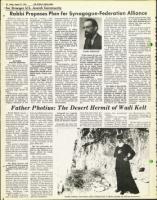
Father Photius: The Desert Hermit of Wadi Kelt
WADI KELT, Israel —
Father Photius, an
Austrian-born hermit
monk no• longer has to
carry pails of water from
the streams that lie 60
meters below his cliff-side
monastery in Israel.
According to the
Jerusalem Post, chance
meeting with Mayor
Teddy Kollek brought
teams of Jerusalem
workers and their electric
pump to fill the monas-
tery's cisterns with fresh
water.
The ancient channels
which had once brought
rain water to the cistern
had long been broken.
Kollek told the Jerusalem
Post that the cost of the
mercy mission, by
Jerusalem workers would
be paid by the Jerusalem
Foundation.
The filled cisterns will
permit Fr. Photius to plant
a vegetable gaiden in
addition to his flower gar-
den.
The monk, who rises
each morning at 2, a.m.,
generally divides his days
between prayer, contem-
plation, the writing of a
history of the monastery
and physical work includ-
ing the tilling of his gar-
den and washing of cloth-
es. ("Without a strict
daily discipline you
couldn't make it.")
His writing, however,
has virtually come to a
halt since Bedouins broke
into the monastery in
April during his absence
and stole his two typew-
riters — one with Greek
letters and one with
Latin letters — along
with cameras and ikons.
Once every two or three
weeks, Fr. Photius walks
six kilometers up the
steep slopes to Anatot
where he takes a bus to
Jerusalem. He returns in
a taxi bearing groceries
and the contents of his
post office box.
The box generally in-
cludes newspapers sent to
him by the Austrian em-
bassy which he reads
while still in town.
Although he regards
himself as a hermit, he
concedes that his shop-
ping trips to town deviate
from the hermit's regime.
Normally, he says, the
church provides a hermit
with food and other pro-
visions but he is not pro-
vided such service. The
monastery is open to
visitors Wednesdays and
Thursdays but is difficult
to reach. A convivial man,
Fr. Photius apparently
enjoys his occasional nal Christianity. (The
visitors. _
monastery, however, is
Despite his .Austrian-
the property of the White
(Linz) origins, Fr. Russians.)
Photius has chosen to be
He has been a monk 16
a member of the Greek
Orthodox Church which years — one of them on
he feels is closest to origi- Mount Athos in Greece.
The small monastery,
which is 1,650 years old, is
probably the oldest in the
country. It was founded
by a Fourth Century
saint, Chariton, whose
tomb, was to make it a
center of pilgrimage.
Colonies of hermits
lived in the caves on the
cliffs surrounding the
spring. Encouraged by
Byzantine rulers anxious
to bu,ild up a Christian
presence in the desert to
counter increasing Arab
pressure, some 7,000
hermits were said to be
living in the Judean Des-
ert when the Persian in-
vasion of 614 led to their
general slaughter.
Father Photius, the hermit monk of Wadi Kelt, is shown outside his hill-top monastery.