

THE JEWISH NEWS
Incorporating The Detroit Jewish Chrmlicle commencing with the issue of July .20, 1951
Member American Association of English-Jewish Newspapers. Michigan Press Association, National Editorial Association.
Published every Friday I The J,wish News Publishing Co., 17515 W. Nine Nlile, Suite 8G•, Southfield, Mich. -18075.
Second-Class Postage Paid at Southfield, Michigan and Additional Mailing Offices. Subscription $10 a year.
PHILIP SLOMOVITZ
CARMI M. SLOMOVITZ
Editor and Publisher
DREW LIEBERWITZ
Business Manager
Advertising Manager
■
Man Ilitsk . Ne'sis Editor . . . Heidi Press. kssistant
Editor
Sabbath Scriptural! Selections
This Sabbath, the 26th day of Ronniuz, 57A, the following script,' oil selections will in' read in our synogotmes:
Pentateuehal portion. Numbers 30:2 36:13. Prop/1(11.ml portion. Arcilliuli
-
Wednesday, Rosh Hodesh A e,
mbers
Candle lighting. Friday. July 23. 8:42 p.m.
NOE. [AIX, No. 20
Page Four
Friday. July 23. 1976
Not 'Supermen' . . . Just Human Duty
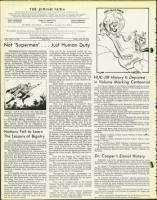
Philadelphia Inquirer Cartoonist Auth por-
trayed Israel in the image of Superman rescuing
hostages from death threats by hijackers. New-
sweek defined the Entebbe heroism as "military
precision, courage and sheer hutzpa." At the
United Nations the head of the American dele-
gation, Ambassador William W. Scranton, told
the Security Council that Israel's action in the
Ugandan airport was a "combination of guts
and brains that has seldom if ever been sur-
passed." In Washington and in London, in most
of the capitals of the world, even in the Quai
d'Orsay whence had come antagonism to Israel,
there is awe and admiration for the "guts,"
`hutzpa," call it what you will, that was re-
hearsed in an Israeli military camp and then en-
acted with great speed at Entebbe.
Was it the work of "supermen?" Of course
it was courage, caring, fearless action, and at
the root of it was a determination that never
again should Jewish life be cheapened and
relegated to ghettoes and camps dominated by
beasts posing as human beings and that Jewish
Nations Fail to Learn
The Lessons of Bigotry
Mexican officials again avow that their
country retains friendliest relations with Israel
and that both Mexico and Israel are compatible.
On the face of it this at once points to a claim to
double standards and invites indignation.
The Western nations acted unanimously at
the United Nations Security Council to demand
some form of international agreement to outlaw
terrorism. But Mexico again saw fit to play the
role of a devil's advocate in behalf of the villain-
ous programs of the Soviet-African-Third World
pro-Arab bloc to condemn Israel for having
dared to rescue her citizens who were held as
hostages and to protect them against the armed
forces of a beastly ruler and the terrorists he
protected.
Is it possible that any nation that has good
relations with the rest of the world, including
Israel and the democracies, has failed to learn
the lesson that once it condones terrorism it
may itself soon become the victim of it?
For the first time in UN history the free na-
tions combined their forces on a basic principle
of human decency against the countries that
choose to retain a backward position in matters
involving Israel and human decencies. Mexico
aligned itself with medievalism. Does that na-
tion on the border of the U.S. again risk a boy-
cott of its tourist needs?
lives are to be protected under all cir-
cumstances, whenever danger is on the horizon
and wherever that circumstance may occur.
So, it was not a matter of being "supermen"
but of being human, not a cause of imitating the
miraculous from the screen and the fable but of
assuring that men are men, that human beings
do not bow to the beasts of the jungle.
Therefore, the reproduced brilliance of Car-
toonist Auth beckons commentary and defini-
tion on behalf of fellow Jews. There has been
entirely too much of this business of
blackmailing, hijacking, harassing, tormenting,
extorting money and cheapening and
dehumanizing the society of man wherever the
location may be.
Israel acted in behalf of Israelis, but her
heroic representatives were acting for mankind.
In Uganda there was a demonstration against
the men of the jungle. It was a declaration that
there must be an end to barbarism and in-
humanity, regardless of who the victims may
be. The barbarians, a new brand of beasts who
have terrorized humanity, must be stopped: that
was Israel's message and it was transmitted by
men to men, by humans to humanity.
Will the message be heard? Not
everywhere. In the Kremlin human values still
are politicized, and the USSR cohorts and the
blind and unrealistic in the so-called Third
World insist upon adhering to the inhumanities
of hijackers and the jungle. But the common
man translates admiration for Israel's courage
into an endorsement of every possible aim to
uproot terrorism. This has become a duty for
mankind, for civilized society, and it is an
ethical code that stems not from "supermen"
but from men and women who value life and
aim to protect it.
In fiction, on the screen soon to be utilized
for portrayal of Israeli achievements in defense
of human values and in historical analyses
Israeli action will be judged as approaching the
superhuman only because there has been so
little of courage globally to match the "guts" and
"hutzpa." Realistically, the story will be of men
who insist upon acting as men, being judged as
men and dedicated to the idea that
men—humane men, women and children—must
be treated as men and protected as humans. The
lessons have been taught. Mankind must learn it
fast.
Vast are the lessons of that historic ex-
perience of July 3, 1976. They tested the at-
titudes of nations and of the press of the world.
The newspapers emerged in human fashion.
The editorial writers were as moved as Jews and
non-Jews who admired the courage of people
aiming at respect for the lives of innocent people
who were at the mercy of barbarians.
Throughout the world, newspapers ex-
pressed respect for and admiration for the acts
of bravery, and more especially for the deter-
mined will to uproot indecencies.
This was in evidence also at the United
Nations Security Council where, on an unusual
occasion, the Western powers acted unitedly
against the terrorists.
That's how a glorious occasion expressed
respect for humane action which challenged
civilized people. Not supermen, MEN, in the im-
age of •God!, acted to defend justice!
HUC-JIR History Is Depicted
in Volume Marking Centennial
The 100-year history of the Reform theological seminary is pre-
sented in a Ktav-published volume, "Hebrew Union College-Jewish In-
stitute of Religion at One Hundred Years."
It is a history of HUC, established in Cincinnati by Rabbi Isaac
Mayer Wise, and JIR, the creation of Rabbi Stephen S. Wise in New
York, which were merged into the one school training Reform rabbis.
Prof. Michael A. Meyer authored the essay describing the history
of the school, including the inner conflicts, the difficulties and the
triumphs, the personality struggles which often marred the unity of
purpose in the school.
As a proper supplement to the discussion, the president-of the
college, Dr. Alfred Gottschalk, gives an account of projected purposes,
of aims and aspirations, of encountered difficulties and the determi-
nation to chart progressive future trends.
History, rabbinics, Bible studies, philosophy, numerous topics re-
lated to the story of a great institution for the training of rabbis, are
interrelated in the contents of this book.
Edited by Rabbi Samuel E. Karff of Houston, the volume includes
a number of historic photographs of personalities and events marking
the HUC-JIR story and the school's developments.
The essays on scholarship comprise a 192-page section of the
book, which is subtitled "A Survey of Scholarly Contributions." The
five authors of this section and their subjects are:
• Lewis M. Barth, dean of the Los Angeles school and associate
professor of Midrash and related literature, Hebrew Union College —
rabbinics.
• Sheldon H. Blank, Nelson Glueck Professor of Bible, Heew
Union College — Bible.
• Martin A. Cohen, professor of Jewish history, Hebrew Union
College — history.
• Lou H. Silverman, Hillel Professor of Jewish Literature and
Thought, Vanderbilt University — theology and philosophy.
• Ezra Spicehandler, dean of the Jerusalem school and professor
of Hebrew literature, Hebrew Union College — Hebrew language and
literature.
Dr. Cooper's Zionist History
Especially noteworthy among the most recent descriptive works
on Zionism is a history by Dr. Elias Cooper, editor of the Americar:
Zionist, monthly publication of the Zionist Organization of America -,
Dr. Cooper's "Portrait of a National Liberation Movement: Brief
History of Zionism," published by and available in bulk or singly from
the ZOA, this 22-page brochure covers every aspect of Zionist origins
and activities. Its very brevity is a major recommendation for this
pamphlet. It serves the important purpose of clearly evaluating the
great Jewish libertarian movement.
Dr. Cooper's "Pre-History of Zionism" and the subsequent his-
toric experiences provide a birds-eye view of the tragedies of the pre-
Hitler as well as the Nazi eras, the motivations that led to the Herzlian
tasks of creating the great national and political movement and the
many events throughout the world that preceded Israeli statehood, the
ultimate result of Zionist efforts.
Describing the effects of the Arab wars on Israel and the threats
from the newly amassed Arab fortunes for mankind, Dr. Cooper con-
cludes with a warning:
"Only a determined, principled stand by the Western powers can
prevent a demoralization of the world by Arab fanatics:7