

2 Friday, July 2, 1976
THE DETROIT JEWISH NEWS
Purely Commentary
An Appropriate Theme for the Bicentennial Issue ;
Separation Principle and Its Many Aspects and
Conflicting Views . . . Catholic-Jewish Ecumenism
By Philip
Slomovitz
Shades of James Madison, Thom as Jefferson in Tackling Separation vis-a-vis Carter
Religion had its impact in politics more often than in
the unsuccessful Alfred E. Smith presidential quest in 1928
and John F. Kennedy's success in 1960. Attempts at inject-
ing prejudices by politicians , have been frequent.
Discussion of a "religious issue," in relation to the lead-
ing Democratic candidate, in the current campaign, may be
one of curiosity rather than prejudicial suspicions. Nev-
ertheless, the question itself is of great interest. The vital
note of interest relates to a great American tradition which
has been labeled the Separation Principle. It relates to the
oft-feared injections of religious practices in public institu-
tions, primarily the schools, and the insistence of the con-
cerned that Church and State be kept separate.
Jimmy Carter, whose nomination for the presidency by
the Democrats now appears a certainty, is a Baptist. Tradi-
tionally the Baptists support the Separation ideal. But Bap-
tists also are religiously dedicated and many are believed to
lean towards a new policy of permitting the reading of
prayers in the schools.
William V. Shannon tackled "The Religious Issue" re-
cently in an Op-Ed page article in the New York Times and
his view of the Separation idea may add rather than detract
from puzzlement. He had this to say:
Secularism is a false and distorting creed with
which to bind the richness and variety of the Ameri-
can experience . . . Not only have Americans been
a religious people, but Christianity and Judaism are
animating forces in the Western civilization of
which America is a part.
Unfortunately, the Supreme Court in recent
decades has gone far toward affirming this see/War-
ist creed as the one, true constitutional gospel. That
poisonous metaphor, "a wall of separation" be-
tween church and state, has given secularist notions
a power in the law that they do not possess in the
plain language of the First Amendment or in the
rich pluralist experience of American life.
To pretend that state and church can be walled
off from one another is to found a constitutional
theory upon a social fiction — never a sound basis
for any law. The social reality is that religion has in
the past and does now play an important part in the
lives of many people as it does in Governor Carter's.
The intertwining of religion and the state can be
seen in everything from inscriptions on our money to
the provision of chaplains in the armed forces to the
granting of tax exemption to church-owned prop-
erty.
Rather than simply obeying the constitutional
command to be neutral toward all churches, the
Court in trying to construct its imaginary wall has
been led into much grave nonsense. Thus, what be-
gan as a niggling fear that some child might be psy-
chologically damaged by hearing the Lord's Prayer
in the classroom has forced public schools to ban the
singing of Christmas carols and the observance of
Hanuka.
Similarly, the Supreme Court strives to distin-
guish why if it is constitutional to pay for a bus to
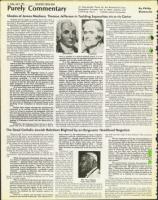
JEFFERSON
MADISON
drive a student to a church-related school, it is un-
constitutional to pay for teaching him physics or ge-
ography once he gets inside the school.
It is this aggressive secularism that finds Mr.
Carter's religion worrisome. Ironically, the Baptist
Church of which he is a member is a strong sup-
porter of the wall-of-separation theory. There is no
reason to suppose that he will try to overturn the
Supreme Court's decisions banning prayer in the
schools and severely restricting financial aid to
church-related schools.
His religious faith probably accounts, in part at
least, for his empathy with poor people and with
blacks, an empathy that leads him to espouse pro-
grams which many secular liberals approve. But
since he admits that he likes to pray and to read his
Bible and to teach Sunday school, Mr. Carter is a
standing contradiction to the outlook and the legal
fictions of those who believe that God is dead and
should not be mentioned in polite society.
Would James Madison, Thomas Jefferson, John Adams
and other of the earliest proponents of the Separation idea
and the formulators of that principle have become so tan-
gentially involved in the Separation dispute? There is such a
thing as calling a spade a spade, and the basic idea is at
hand. A clever theoretician could easily frame a prayer that
might sound like a common denominator for all faiths, in-
cluding even the Muslim. But even praying together is ana-
thema to many differing faiths, and that is not ignorable.
Just a bit of heresy: The fact is that there is more secu-
larism than religiosity, but it is a sort of "sanctimonious
secularism." Viewing the White House occupants realisti-
cally there is evidence that Abe Lincoln was an ethical man
who turned to preachments after he had been elected Presi-
dent. Traditionally, there was . no sense • questioning his
faith. That was not part of statesmanship or diplomacy.
This was true of Eisenhower and Truman. Kennedy's
church-going could have been a private affair if the noto-
riety seeking newsmen hadn't watched his every step. John-
son found himself as much at home in any church as he did ,
in any political bailiwick. Only Nixon found it necessary to
turn the White House into a church on Sunday mornings
(once or twice into a synagogue) and we called his bluff then
on turning the nation's capital into a church.
Therefore, the added necessity not to go overboard with
private religious affairs when the sanctity of the state's se-
paratism from religion and dogma is so vital to the nation's
traditions.
From what has been learned, it is doubtful wh,
Jimmy Carter would deviate from the Separation tradit.
or whether he would risk antagonizing anyone on the score
of religious preferences or freedoms. Yet, the issue has been
raised and needs to be settled quickly before it becomes an
unnecessary issue in 1976.
The Baptists are devout Christians who believe in Pro-
phecy. They are dedicated to the proposition that, as e
ciated by the Prophets, in the Old Testament that is so
to them, Israel's rebirth as a soveriegn state is an historic
inevitability. Will the Baptists, as some suggest, negate
this view because of modernity dominating the Israeli
scene, because of freedoms on the beaches, non-restrictions
on dress which is often scanty, the secularization that is not
outlawed in a state in which the religious group is part of
a coalition government?
The suspicion of Baptist inconsistency in supporting Is-
rael is unquestionably unjustified. Yet, an earlier experi-
ence by a noted Jewish scholar is worth recording.
Perhaps 40 years ago the eminent French-Jewish poet,
essayist and historian Edmond Fleg went to Palestine to
retrace the steps of Jesus and to write a biography of
Christ. Instead, he found his people and became enamored
with the Halutzim, the pioneers who were building a new
life in the Jewish National Home which was eventually to
become the autonomous state of Israel. He met with people
of all faiths and he found a prejudice among some Catho-
lics. One Bishop expressed his horror over his experiences
with the pioneers in the Holy City and he said to Fleg, in his
outrage of what the Jewish youth were doing: "They are
dancing on the streets of Jerusalem."
This was related by Fleg in his book "The Promised
Land" which became the substitute of what he had planned
as a biography of Jesus.
Jews had come to the ancient homeland to build a So-
ciety of Free Men. That's why they danced and continue to
dance in the streets of the Holy Land, while building a
great spiritual-cultural center linked with economic-indus-
trial-scientific progress for the benefit of all mankind.
Could a devout Christian who believes in Prophecy ob-
ject to the social amenities that predominate in the Jewish
Homeland? Could a religious Baptist emulate the horror of
a devout Catholic, ignoring the realities of the new age and
the freedom of a self-liberated people? This now becomes
inconceivable even in more extreme religious ranks.
None of the religious issues seems to have a place in the
political disputes of the present time. They have been tac-
kled and demolished. The nation will be all the better with-
out injecting them in the great contest for White House oc-
cupancy.
The Good Catholic-Jewish Relations Blighted by an Enigmatic Headlined Negation
Whoever said "Let me write the headlines,. and I don't
dence shows it, the impressions of many Catholics
care what's in the story," as an indication of how popular
indicate it, and not a small number of Jews will ac-
interest can be affected by mere sensation, must have influ-
knowledge it — though usually off the record. Cath-
enced the heading over an article on the New York Times
olics have acknowledged the existence of anti-Jew-
Op-Ed Page (June 19) by Rev. Andrew M. Greeley, director
ish feelings in the latest years since the Vatican
of the Center for the Study of American Pluralism.
Council and have worked against them — though
The heading over his article read: "Anti-Catholic Feel-
perhaps not effectively enough. As far as I can see,
ing Among Jews." Let the shock wear off while the issue is
there has been no reciprocity at all from the Jewish
given some consideration, with due respect to whatever
side.
studies the Reverend made in the area of Pluralism.
Whichever way
Whichever way we judge the article, it emerges as a the issue is judged,
contradiction. The Reverend commenced his essay :by stat- the Greeley view must
ing:
be rejected. It just
While the general relationship between Ameri- isn't true. We have
can Roman Catholicism and American Judaism is come a long way in
excellent — perhaps better than that between the the relations with the
two historic offshoots of the Sinai religious tradition Catholics. From the
anywhere else in the world — there are still some Vatican stemmed the
moderately critical flashpoints that may flare up worst of prejudices,
when some Jewish intellectuals — probably a small and the present Pope
minority — 'engage in behavior that many Jewish is not only under sus-
nonintellectuals also engage in.
picion but he is
But then came the verdict, to match the heading, the unquestionably
shock, the negation, the suspicion-inspiring view in which among the most prej-
the Rev. Greeley stated:
udiced of men in rela-
The Very Liberal
Why is it-that all of our issues are relatively less tion to Israel. He is
Pope John XXIII
important and seem to make no major claim at all on the opposite, the refu-
moral concern? Justice for the people of Israel is su- tation of Pope John XXIII who had offered hoPe for a broth-
premely important, but justice for the Catholics in erhood of men and a kinship with the Jews. But the Pope is
the nasty little colonial regime in the north of Ire- not all of Catholicism. Among Israel's friends are some of
land is not. Freedom for Soviet Jews is of capital the most eloquent defenders of the cause of justice for Je-
concern, but freedom for the Catholic captive na- wry and for Israel.
tions is not.
Just before the Greeley article appeared, the Syn-
There is a strong and powerful anti-Catholic agogue Council of America issued a most heartening mes-
feeling in the Jewish community. The empirical evi- sage affirming the Catholic-Jewish friendship and the prog-
ress that has been made in that direction. That statement
affirmed:
We are impressed with the acknowledgment of
the pastoral message (of the U.S. Catholic Bishops
last November) that at the heart of the old hostilities
toward the Jewish people was an anti-Judaic theol-
ogy. In dealing with the old notion that the Jews
were guilty of deicide, the pastoral letter makes a
point of observing that the "Jewish people neygr
were, nor are they now, guilty of the deati
Christ." The pastoral letter reaffirms the pos
enunciated in the Vatican Guidelines of 1975
call on Christians to see "post-Biblical Judaism s
rich in religious values and worthy of our respect
and esteem."
We particularly welcome the pastoral n
sage's emphasis of the importance of Israel in Jew-
ish thought and life. The pastoral letter declares
that, "Christians should strive to understand the
link between land and people which Jews have ex-
pressed in their writing and worship throughout the
two millenia as a longing for the homeland, holy
Zion."
Whose views are to dominate, those of the liberal and
justice loving Catholics and of the Synagogue Council or of
the Pluralism student, the Rev. Greeley, whose conclusions
create suspicions of Jews that are charges of hatreds that
are groundless?
The Vatican attitude is anathema to us, and when a
Catholic spews hatred we relegate him to the Middle Ages.
But Catholics have been humanly allied with Jews in many
good causes and in the abandonment of ancient prejudices
through most recent Vatican II ecumenism. Why disrupt
such a friendship?
.'