

56 April 16, 1976
THE DETROIT JEWISH NEWS
America's Indians and the 10 Lost Tribes:
A Debate That Lctsied Several Centuries
(Editor's note: The following article first apeared in
The Jewish News of March 5, 1943, and was re-printed
from Lee M. Friedman's "Jewish Pioneers and Pa-
triots" by special permission of the Jewish Publication
Society of America.)
What became of the lost Ten Tribes of Israel? Today
we believe that when Sargon II (719 BCE) deported the peo-
ple of the Northern Kingdom en masse, these Hebrews ei-
ther were completely assimilated and incorporated into the
general population of Assyria and Babylonia, or of the na-
tions which later conquered those lands, or identified them-
selves with their Judean fellow Hebrews.
This was not always the general belief. When the read-
ings of the Bible was a daily requirement for serious Chris-
tians, the assurance of the words of prophecy was accepted
literally. It was then the unquestioned belief that at the
appointed time the Jews would be called from the ends of
the earth to be converted.
It was inherrent, therefore, in the logic of the situation
that these 10 lost tribes must somehow have escaped from
Assyria and, in the meantime, be hidden away somewhere
awaiting this calling of the Lord. But where?
Favorite Mystery Story Told
Among Christendom
Savages Recite Shema
As an adjunct to his work, Reverend Thorowgood added
"An Epistolicall Discourse of Mr. John Dury to Tho-
rowgood. Concerning his conjectures that the Americans
are descended from the Israelites. With the History of a
Portugal Jew Antonie Monterinos, attested by Manasseh
Ben Israel, to the same effect."
There was appended a translation of an affidavit from
which it appeared that this Mr. Monterinos or more cor-
rectly Antonio de Montezinos, is just plain Aron Levi. He
has a long and complicated story to tell. Boiled down, what
Aron Levi says is that, while traveling in South America, he
met a race of savages who recited the Shema, practiced
Jewish ceremonies and claimed to be of the tribe of Reuben.
He had appeared before the authorities of the Am-
sterdam synagogue; and the author submitted the at-
testation of Rabbi Menasseh ben Israel that "the au-
thor Monterinos is a vertous man, and deparate from
all manner of worldly interests & that he swore in my
presence that all that which he declared was the truth."
is
•
•••
.-e•AP
This puzzle was long the favorite mystery story of
Christendom. Fascinationg solutions had a surefire
popular appeal. To find the answer, the public eagerly
swallowed many a traveller's tale or even waded
through ponderous theologians' discourses to have
their imaginations stirred by the discovery of the lost
tribes in distant lands amongst strange peoples.
cr•
Appeal to Puritan Hopes
"I declare how that our Israelites were the first find-
ers out of America; not regarding the opinions of other
men, which I thought good to rufute i few words onely;
and I thinke that the ten Tribes live not onely there, but
also in other lands scattered every where; these never
did come backe to the second Temple, & they keep till
this day still the Jewish Religion, seeing all the
cies which speak of their bringing backe unto thy.
soile must be fulfilled; So then at their appointed
time, all the Tribes shall meet from all the parts of thp
world into two provinces, namely Assyria and Egypt, nor
shall their kingdom be any more divided, but they shall
have one Prince the Messiah the Sonne of David.
I do also set forth the Inquisition of Sparne, and
rehearsediuers of our Nation, & also of Christians, Mar-
tyrs, who in our times have suffered seurall sorts of tor-
ments, & then having shewed with what great 11071010'S
our Jews have been graced also by several Princes who
profess Christianity, I proue at large, that the day of the
promised Messiah unto us cloth draw nee•, upon which
occasion I explaine many Prophecies."
Of-course no party in a controversial religious field has
it all to itself. So, no sooner was Thowowgood's book well
launched on its way to popularity, than the opposition made
itself heard. Sir Harmon L 'Estrange, a well-known theolo-
gian, was the first of the opposition to join issue. In 1652 he
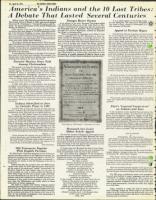
published Americans No Jewes, or Improbabilities that -the
Americans are of that Race. With many Latin quotations,
and on the authority of many and various authors and by
showing a chapter and verse from Holy Script, he demon-
strates, to his own entire satisfaction, that the Americans
are just simple Indians and never Jews at all.
It was evident that they were more interested in these
missing Jews than in Jews close at hand.
In 1650, John Eliot, a young minister, was preaching
the gospel to the Indians in a small settlement south of Bos-
ton, Mass., known as Roxbury. In order to get the English
public interested in providing funds for the support of these
missionary labors, the Reverend Thomas Thorowgood of
Norfolk, England, in that year published a book entitled,
`Jews in America., or Probabilities that the Americans are
of that Race. With the removal of some contrary reasoning,
and earnest desires for effectual endeavors to make them
Christians.'
This proved a good start; and _the heat of' the contro-
versy only confirmed all contestants in their preconceived
opinions.
Indians Identified as Jews
by Catholic Priest in 1585
It proved that, at long last, the lost 10 tribes had been
found in America. By sure proof the Indian redskins were
identified as Jews. This was not an original discovery.
As early as 1585, Father Duran, in a history of New
Spain, basing his conclusions upon - a fancied ressemblance
between the religious rites of Jews and American Indians,
wrote: "My opinion and supposition is confirmed that these
natives are of the Ten Tribes of Israel that Salmanasser,
King of Assyrians, made prisoners and carried to Assyria
in the time of Hoshea, King of Israel." (Quoted from The
Lost Tribes a Myth, A. H. Godbey, Durham, 1930, p. 2) The
Thorowgood book, however, as if disclosing a new discovery,
won the formal approval and license of the official censor.
It is a subtle appeal to the Puritan hopes
for the Millenium. The letter from Menasseh
ben Israel to Dury, quoted in Thorowgood, is a %‘
fair summary of the tract:
Eliot's 'Learned Conjectures'
on Indians and Jews
L.,.,44006AmVP
Title Page of L'Estrange's "Americans No Jews"
Menasseh ben Israel
Makes Subtle Appeal
Sep tem. 4, 1649
The interest aroused in England by Thorowgood's book
I have perused this learned and pious discourse con- evidently
suggested the idea to Rabbi Menasseh ben Israel
cerning Americans, and thinking that it will much con- that this theory
of the Indians being Jews could be made
duce to that most Christian worke of their conversion to use of for the benefit
of the real Jews. For some time the
the faith of the Lord Jesus Christ, I doe approve it as Amsterdam Jewish merchants
had hoped to be able to bring
very worthy to be printed and published.
- about the repeal of the ban against the admission of Jews
John Downame. to England which had existed since 1290.
To further that end, Menasseh ben Israel wrote a Span-
Old Testament Popular
ish pamphlet which, in the same year, was translated into
With English Puritans
Latin and published under the title of Spes Israelis.
By 1650 Charles I had been beheaded and the Puritan hi-
The Latin edition was addressed "To the Parliament,
erarchy had taken control of the English government. En- the Supreme Court of England." Then it was translated into
glishmen's thoughts had turned back again to the Old Tes- English and became that landmark of Anglo-Jewish history
tament and their interest in Jews had been re-awakened — published in London, in 1650, entitled:
The Hope of Israel:
an interest not merely in the Old Testament Jews but in
living Jews.
Written By Menasseh Ben Israel,
an Hebrew Divine, and Philospher.
Taking literally the promise that the Millennium
Newly extant, and Printed in
would come when the Jews shall have been dispersed to
all the ends of the earth and "called" (converted), the
Amsterdam, and Dedicated by the
Author to the High Court, the
Puritans looked for that happy time as very near at
Parliament of England, and to the
hand, possibly an event to occur within the lifetime of
those then living. So this was a timely topic, this find-
Councell of State.
Translated into English, and
ing and identification of the 10 lost tribes of Israel in
published by Authority.
another end of the world! It was a further strange con-
In this treatise is shewed the place where the ten
firmation of the truth of the prophecy, and an assur-
Tribes at this present are, proved; partly by
ance that the Millennium was really closer at hand
the strange relation of one Antony Monte-
than had ever before appeared.
The book is a typical 17th Century religious polemic
zinus, a Jew, of what befell him as he tra-
velled over the Mountaines Cordillaere, with
seeking to prove its contentions by citations and interpreta-
divers other particulars about the restoration of
tions of holy text. That was considered stronger proof than
the Jews, and the time when.
any presentation of actual personal observations indentify-
Printed in London by R. I. for Hannah Allen,
ing the customs and traits of the Indians with those of the
at the Crown in Popeshead
Jews. To the scientific investigation, this presentation is
Alley, 1650.
naturally wholly unconvincing.
-
In the meantime events marched forward and by the
year 1660 the Stuart dynasty was restored to the English
throne and His Majesty, Charles II, reigned. In that year,
Thorowgood decided to publish a new edition of his book.
Instead of merely republishing, he entirely rewrote it. He
even changed the dedication. This time it was addressed "To
the King's Most Excellent Majesty" and a certificate from
witnesses appended to show that the 1650 edition was origi-
nally to have been so dedicated, had not_God at that time
permitted violence to prosper. This new tract was -entitled
Jews in America,
or
Probabilities, that those Indians
were Judaical, made more probable by some addition, to
the former Conjectures. An accurate DISCOURSE is
premised of Mr. John Eliot (who first preached the Gos-
pel to the Natives in their own language) touching their
origination and his Vindication' of the Planters.
• Omitted are Dury's discourse and Mr. Aron Levi Mon-
terinos' affidavit. Instead we have the "learned conjectures
of Reverend Mr. John Elliott" himself'.
With actual contact with Indians and long accr
ances with them, one might well have expected-from
a recital of personal observations and experiences; but, true
to tradition, he only repeated the same old arguments
Bible texts in the same old Ivay.
Thus was launched another chapter in this age-old puz-
zle and a new element introduced into the controversy prov-
ing that the poor American Indians were the ten lost tribes.
For 200 years numberless books and pamphlets.
learned and foolish, in many languages, pro and con.
continued to appear perpetuating this controversy.
now only to find their resting place on the dusty and
neglected shelves of libraries and to testify to the pas-
sion of past generations, excited over what they regard
as a vital issue.
Today, satisfied to accept the word of science that,
while ethnology assigns an Asiatic origin to the American
Indian, he is far removed from anything Jewish, the world
turns to problems more vital to the Jews, to the Indians, to
America, and to humanity.