

72 April 2, 1976
THE DETROIT JEWISH NEWS
Bnai Mitzva at Western Wall
Three Detroiters Attain Religious Identification
By GREER CASHMAN
Special to The Jewish News
There is nothing unusual
these days about American
families selecting Jerusalem
as the site for 'a Bar Mitzva
celebration, but it is un-
usual when the celebration
of a Bar Mitzva becomes a
spontaneous decision on the
part of three men partici-
pattng in a United, Jewish
Appeal Study Mission.
Dr. Wilton H. Goidrath,
Dr. Jack Jackson and Steven
Tronstein missed out on the
traditional Bar Mitzva cele-
bration when they were 13
years old. They made up for
lost time in Jerusalem in
March, while participating
in the Detroit Campaign
Mission to Israel. .
Not one of them had
boarded the El Al plane to
Israel thinking that he
would be a different man on
his return. Tronstein, a sev-
enth generation American,
whose great-grandfather
was the only Jewish officer
in the Union Cavalry, could
not recall any Bar Mitzva ce-
lebrations in His family. Dr.
Goidrath confessed that a
Bar Mitzva "was always
something that I secretly
missed."
The happiest people
about the decision of the
three men were mission
leaders Dr. Murray and
Diane Shekter. The Shek-
ters, who are frequent vis-
itors to Israel, wanted the
Detroiters in their charge
to see and enjoy Israel in
the same light as they have
done over the years.
While they were anxious
for mission participants to
understand the problems
which Israel is facing, • they
were equally keen for them
to explore the Israeli life-
style in order to get a better
feel for the country.
The Mission got off to a
good start from the very
beginning. Jane Weiner,
whose heart condition had
caused her to doubt that she
would ever see Israel, had
made the trip after under-
going open heart surgery.
After landing in Israel, she
literally danced in the
street. A woman driving
past in a car stopped to ask
her why she was dancing.
She replied, "It's because
I'm so happy to be here."
"We're happy to have
you," said the driver with a
smile before she continued
on her way.
The Shekters took their
group from the airport to
Tel Aviv's colorful Carmel
Market, where everybody
bought food and went on to
picnic at Megiddo.
Before reaching Jerusa-
lem, the group explored the
ancient prison in Acco, the
religious sites and the art-
ists' quarter in Safed and
the strategic military posi-
tions in the Golan Heights.
In the Golan, they met
Vardi Ben-Yaacov, hand-
some, dark-eyed, unmarried
officer, obviously aware of
his good looks. When ques-
tioned as to why he was sta-
tioned in the Golan, Vardi
joked that he was "ap-
pointed by the Ministry of
Casting."
,
The group also visited Ki-
butz Lavie, a religious ki-
butz which specialized in
making furniture for local
consumption and for export.
They saw how the kibutz
members live and how
their industry operates.
They found the people on
'the kibutz to be charming
and were reluctant to
leave.
Study missions such as
the one led by the Shekters
also include inspections of
the humanitarian programs
at the entrance to the city at
nightfall. Leaving the bus,
they recited the Site'lie-
•hiyanu blessing, and like
the pilgrims of old, walked
into the city.
Few visitors to Jerusalem
get to see the Western Wall
at night, but there is a mys-
tic appeal about the Wall,
standing in floodlight splen-
dor against the dark back-
drop of the sky, and the
Shekters were determined
that their people were not
going to miss this awe-in-
spiring sight.
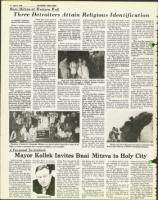
Jack and Julie Jackson, at left, and Jane and Sey-
mour Weiner walk through a Middle Eastern market
during their Campaign Mission to Israel.
financed by the United Jew-
ish Appeal through its bene-
ficiaries such as the Joint
Distribution Committee and
Malben, which help people
from infancy throughout
life.
The Shekters, who have a
special love for Jerusalem,
arranged for their group to
spend more time in and ar-
ound Israel's capital than
anywhere else. They arrived
Members of Detroit's Campaign Mission are shown before take-off on their El Al
flight to Israel to examine that country's problems and strengths.
They gave everyone just
enough time to eat at the
hotel, and then took them to
the Wall.
It was the first of three
visits. On the second occa-
sion, they went in day-
light. The men put on tefi-
lin to mark the occasion.
Some had never done so
before. Murray talked
about the significance of
the Wall and of Jersulam
in Jewish life, and it was
then that the three Bar
Mitzva celebrants made
their decision.
By this time, everyone in
the group had begun to feel
like family, and each and ev-
ery single member of the
mission began to take an ac-
tive interest in the Bar
Mitzva. Trees were planted
in honor of the Bar Mitzva
"boys". The traditional
fountain pens were pur-
chased.
A talit was presented to
each of the three, and on the
Sabbath of. the Bar Mitzva,
which naturally took place
at the Wall, the women
pelted the three celebrants
with nuts and candy. In the
evening, they held a ban-
quet, with all the pomp and
ceremony of an American-
style Bar Mitzva.
But the Bar Mitzva was
not the only aspect of the
Mission which made it dif-
ferent. The Shekters wanted
their group to get out into
the streets of Israel, into the
restaurants which are fre-
quented by IsraeliS, into the
shops which do not specifi-
cally cater to tourists and
into the back alleys and
courtyards of the Orthodox
Mea Shearim district, which
is to Jerusalem what Wil-
liamsburg is to New York.
In Mea Shearim they
met a kabalistic mystic
who amazed members of
the group by what he could
tell them about them s elves
with the help of kabaliitic
'divination.
In Jerusalem's busy King
George St., Murray Shekter
entered a small restaurant
and asked for tables to be
set up for 20 people.
When the group returned
for their meal in festive
mood, there were vases of
flowers decorating the ta-
bles. When Shekter asked
the proprietress of the res-
taurant where the flowers
had come from, she replied:
"I bought them. I was so
happy to see your happi-
ness, that I wanted a share
in it."
The happiness of all Mis-
sion participants was re-
flected in a recommitment
to Israel. All of them had
made their pledges to the
Allied Jewish Campaign-Is-
rael Emergency Fund be-
fore leaving Detroit. In ev-
ery instance, these pledges
had shown an increase over
gifts made the previous
year. When the group sat
down to talk about their
feelings in Israel, the contri-
butions went up another 25
percent.
This was the second , oc-
casion on which the S'
ters led a group to Is.
The first time was labs
October. "We're amazed,"
said Diane, "at how the
people from that mission
have become Campaign
workers."
She conceded that per-
, haps the love which she and
Murray have for Israel is
contagious. "If people love
Israel, they can't help but to
do everything they can for
Israel through the UJA and
the Allied Jewish Cam-
paign-Israel Emergency
Fund."
Dr. Goldrath is chairman
of the Professional Divison
of the 1976 Allied Jewish
Campaign-Israel Emer-
gency Fund. Dr. Shekter
leads the Dentists Section of
that Divison.
Also on the Detroit Cam-
paign Mission were Mrs.
Goidrath, Mr. and Mrs. Jer-
ome Halperin, Mrs. Jack-
son, Irwin Kahn, Dr. and
Mrs. James E. Labes, Mrs.
Kristine Magidsohn, Dr.
and Mrs. Jerry B. Morof,
Dr. and Mrs. Saul Rosner,
Dr. Seymour S. Weiner and
Robert C. Zack.
Margo and Jerry Halperin met this new friend in the
Holy Land while on a Detroit Campaign Mission.
A Personal Invitation
Mayor Kollek Invites Bnai Mitzva to Holy City
JERUSALEM — Mayor Western Wall, in Jerusa-
Teddy Kollek of Jerusalem lem, the Holy City towards
has issued a personal invita-
tion to all Bnai Mitzva to
take advantage of the Israel
Ministry of Tourism's Bar
Mitzva programs.
Combined with the serv-
ice and warmth of El Al Is-
rael Airlines ; Mayor Kollek
stated that a trip to Israel
for Bar Mitzva can be one of
the most important events
in a young man's life.
"A boy's Bar Mitzva day is
a stepping stone in his life,"
Mayor Kollek writes, "one
of the days which will al-
ways remain in his thoughts
and feelings. To celebrate
one's Bar Mitzva at the
MAYOR KOLLEK
which Jews throughout the
world pray three times
daily, makes the occasion
even more meaningful.
"As King Solomon said
when he built the Temple:
`That thine eyes may be
open toward this house
night and day, even toward
the place of which thou hast
said, My name shall be
there: that thou mayest
hearken unto the prayer
which thy servant shall
make toward this place.'
"The historical signifi-
cance of Jerusalem, the
beauty of the city and its
ancient monuments, help
make a special day that
much more special, for the
Bar Mitzva boy, his family
and friends, a day never to
be forgotten.
"It is my honor and plea-
sure, in the name of the City
of Jerusalem and my fellow
Jerusalemites, to invite you
to celebrate here and to
wish you a warm Mazel
Tov."
The Ministry of Tourism
has established a special
Bar Mitzva program which
is available to the young
man and his family in Is-
rael.
The program includes:
• The Bar Mitzva service
at the Western Wall or syn-
agogue in Jerusalem or Tel
Aviv.
• A kidush and/or lunch-
eon reception at a hotel or
banquet hall in Jerusalem
or Tel Aviv.
• The presentation of a
special Bar Mitzva medal-
lion, a silk talit and a certif-
icate on behalf of the presi-
dent of the state of Israel.
• The planting of a tree
in the name of the Bar
Mitzva boy at the Bnai
Mitzva Forest.
• A visit to the home of
an Israeli family with a son
of Bar Mitzva age.
• Travel arrangements
via El Al Israel Airlines at
the lowest applicable group
airfares.
• The selection of and
reservations in the f
hotels throughout Israel.
• Fully escorted, custom-
tailored sightseeing tours
throughout biblical and
modern Israel by private air
conditioned car or motor-
coach with chauffeur/guide.
• The services of El Al
and the Ministry of Tourism
from the minute .you land at
Ben-Gurion Airport until
you depart from Israel.
Persons wishing more in-
formation on the program
can contact El Al's South-
field office, 557-5737, or
write Youth and Students
Division, Ministry of Tour-
ism, PO Box 1018, Jerusa-
lem 91000, Israel.