

4$ Friday, February 13, 1976
THE DETROIT JEWISH NEWS
U.S. Jewry Honors Dr. Jacob R. Marcus on 80th Birthday
Dr. Jacob R. Marcus' 80th
birthday, occurring on
March 5, will not be a pri-
vate celebration. American
Jewry will act as a unit in
acclaiming the services ren-
dered by this distinguished
scholar, author and lecturer
who is among the major in-
terpreters of Jewish histori-
cal values.
As historian, Dr. Marcus
has to his credit one of the
largest collections of books
which he has authored in a
lifetime of gathering facts
about American Jewry. In
that role and as director of
the American Jewish Ar-
chives at Hebrew Union Col-
lege and the Union of Amer- Jewish Publication Society
ican Hebrew Congregations, of America and a charter
he is rightfully acclaimed as member of the board of the
the best informed man on Training Bureau for Jewish
the history of the American Communal Service.
In 1955 Dr. Marcus was
Colonial, Revolutionary and
honored by the National
subsequent periods.
Dr. Marcus is a past Jewish Welfare Board for
president of the Central his contribution to Ameri-
Conference of American can Jewish culture.
An 18-page pamphlet,
Rabbis, and of the Ameri-
can Jewish Historical So- containing excerpts from
ciety. He has been honor- Dr. Marcus' "The Jew and
ary president of the the American Revolution —
Society since 1959, and A Bicentennial Documen-
was awarded its Friedman tary" will soon be distrib-
Medal for "distinguished uted through the 10 largest
service to history" in 1961. synagogues in the Metropol-
He is a trustee and for- itan Detroit area to their
mer vice president of the memberships.
A Bicentennial Feature
Dr. Marcus' major
works include: Israel Ja-
cobson; A Brief Introduc-
tion to Modern Jewish
History; Jewish Festsch-
riften; The Rise and Des-
tiny of the German Jew;
The Jew in the Medieval
World; Communal Sick
Care in the German
Ghetto; and a nuiber of
important studies on
American Jewry.
Excerpts from Dr. Mar-
cus' work have been appear-
ing regularly in The Jewish
News in honor of America's
Bicentennial celebration,
and another in that series
appears below.
DR. JACOB R. MARCUS
•
major Jewish Task in 1776 Was Undisrupted Commerce
lished by the Americans.
Phillips did not expatiate on
the revolt, merely remark-
The fact that 100 or more
ing laconically that the
American Jews may have
Americans had 100,000 sol-
served in the armed forces is
diers, the British 25,000 and
of no great historic signifi-
a fleet.
cance. Jewish commercial
What was going to hap-
activities were far more
pen? Only God knew, but
important in an agrarian
before the war was over
economy where industry
England would be bank-
and manufacturing were
rupt.
minimal and the coasts
In an appendix to the let-
were blockaded by the pow-
ter, Phillips got down to
erful British fleet.
business, asking for cloth,
The farmers and town-
apparel, notions, and medi-
speople had to have yard
cines.
goods and tea; it was imper-
The letter was written in
ative that the soldiers be
Yiddish, no doubt with the
supplied with uniforms,
expectation that if the Bri-
blankets, and shoes. One
tish intercepted, it, they
way to relieve the shortage
would let it go by because
was to arm merchant ships
they could not read it.
and send them out as priva-
That was a vain hope,
teers to prey on enemy com-
for the ship, which sailed
merce.
from St. Eustatius, was
This Jews did, arming
taken, the letter was im-
small ships heavily and
pounded, and just because
packing them with large,
the English could not read
tough crews who scoured
it, they concluded that it
the seas for valuable British
was in code. It rests today
cargoes.
in the English Public Rec-
Many an American who
ords Office in Chancery
joined or financed a priva-
Lane.
teer dreamt of striking it
Since the quartermaster
rich. Impoverished Morde-
department of the Revolu-
cai Sheftall decided to try
tionary armed forces was
his luck. After his impris-
primitive and inadequate,
onment and exile from Bri-
the government turned to ci-
tish-occupied Georgia, he
vilian purveyors for badly
determined on a bold
needed supplies. Many, if
stroke to recoup his losses.
not most, Jewish merchants
of that day were purveyors
on a large or small scale,
offering the government
clothing, gunpowder, and
lead.
Harassed for lack of
funds, the authorities took
their time before settling
accounts; some trusting
suppliers were never paid at
all. One of the merchants
who was never reimbursed
for his advances was Levy
Solomons, of Canada, a
brother-in-law of the ebul-
lient David Salisbury
Franks.
Solomons, a Whig, served
the American troops in Can-
ada in 1775 and 1776, help-
ing them establish hospitals
and lending them money.
When the Americans
were forced to retreat, this
zealous patriot provided
the sick and the wounded
with transportation on
their way to the border.
The
British, knowing
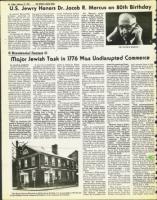
The Moses Meyers Mansion is still in use in Norfolk, Va. It was built in 1791 by one
where his loyalties lay,
of the leading Jewish commercial backers of the American Revolution.
By JACOB R. MARCUS
American Jewish Archives
In one way or another he
managed to secure hold of a
20-ton sloop, the Hetty, sold
shares in her to secure
working capital, loaded her
with 30 men including a
Negro slave, and armed her
with eight guns, toma-
hawks, blunderbusses, and
boarding pikes.
Then he set sail on what
was to be a most inglorious
adventure. The English cap-
tured the Hetty and scuttled
her, but the persistent Shef-
tall raised and reoutfitted
the vessel.
He tried his luck once
more, but never struck it
rich; indeed, it is questiona-
ble whether any of the Jew-
ish merchants of that day
made any "big money" lying
in wait for British mer-
chantmen.
After a fashion, priva-
teering was a form of
blockade-running. Many
American ships got
through the English naval
barrier, for the enemy
could not guard every cove
and inlet of the long coast.
Certainly one of the most
daring of the blockade-run-
ners wad the firm of Isaac
Moses & Co. Its three part-
ners, Isaac Moses, Samuel
Myers, and Moses Myers,
had an Amsterdam buying
office which shipped their
goods to Dutch St. Eusta-
tius in the Caribbean. From
there the company's ships
made the run to an Ameri-
can port, trusting to fate
that they could slip past the
cordon set up by the English
cruisers.
Isaac Moses and his asso-
ciates were great Whigs.
Shortly after the War broke
out in 1775, when the Amer-
icans set out to conquer
Canada, the three partners
voluntarily offered the Con-
gress $20,000 in hard cur-
rency in exchange for Conti-
nental paper which — as
they might have foreseen —
ultimately proved worth-
less.
If it was any consolation,
they received the grateful
thanks of John Hancock for
their generous gift.
Isaac Moses & Company
operated on a large scale;
Jonas Phillips, of Phila-
delphia, was not so ambi-
tious. One of Phillips'
blockade-running letters,
written in July, 1776, has
been preserved. It was dis-
patched via St. Eustatius
to an Amsterdam kins-
man, a prominent Jewish
merchant in that city.
Enclosed in the letter was
a broadside copy of the Dec-
laration of Independence
which had just been pub-
seized his goods and furni-
ture on July 4, 1776, and
threw them into the street;
his neighbors shunned him
and refused him shelter.
The Jewish businessmen
of the period were nothing if
not ingenious; there was no
supply job that they would
not undertake. Exiled to
Philadelphia, the New York
fur trader Hayman Levy
became a garment manufac-
turer producing breeches
and shirts in the local poor-
house.
The tailor Levy Marks
petitioned Congress — un-
successfully — to give him
the job of superintending
the manufacture of army
uniforms.
Levy's cousins, Barnard
and Michael Gratz, turned
to anything that offered a
profit. They exported to-
bacco from Virginia, outfit-
ted troops, and shipped sup-
plies to George Rogers
Clark, who was dedicated to
the task of driving the Bri-
tish out of the western fron-
tier.
Michael Gratz's father-
in-law, Joseph Simon, a
Pennsylvania pioneer,
manufactured rifles in
Lancaster with his guns-
mith partner, William
Henry. Out on the Ohio
frontier, one of Simon's
companies, Simon &
Campbell, provided the
Indian commissioners
with goods for pacifying
the natives. The Gratzes
performed the same serv-
ice in New York State,
where the Iroquois had to
be held in check.
The Americans could not
afford to fight on two
fronts: against Indians in
the back country as well as
the English in the East. In
short, the Jewish importers,
wholesalers, and blockade-
runners managed — no one
really knows how — to fer-
ret out goods even in the
darkest of days.
The shopkeepers distrib-
uted them. This relatively
successful job of keeping
commodities flowing was
the real Jewish contribution
to the war effort.
When the war was over,
the Jewish Whigs were very
proud of their party's
achievements. Those New
Yorkers who had gone into
exile returned home in late
1783 and sat down to write •
Governor George Clinton a
letter:
"Though the [religious]
society we belong to is but
small when compared with
other religious societies, yet
we flatter ourselves that
none has manifested a more
zealous attachment to the
sacred cause of America in
the late war with Great
Britain."
They were happy that
they now enjoyed full politi-
cal equality, for they were
fully conscious of the fact
that theirs was the only
state of the 13 where Jews
were privileged to hold of-
fice.
Still unemancipated,
Jews in all the other states
waited for the fulfillment
of the Great Promise made
in the Declaration of Inde-
pendence: "All men are
created equal."
Finally, in 1786, Virginia
began to move when it
passed Jefferson's Bill for
Establishing Religious
Freedom. A year later Con-
gress adopted the North-
west Ordinance which guar-
anteed religious and
political freedom in the new
states to be formed in the
future north of the Ohio and
west of the Alleghenies.
When the federal consti-
tution was approved by a
majority of the states in
1788, the Jews were satis-
fied: Article VI declared cat-
egorically that no religious
test would ever be required
for any office under the fed-
eral government.
The adoption e' the
United States ConE ion
was one of the most iiiipor-
tant events in the entire his-
tory of Diaspora Jewry.
There had been nothing like
it since 212 C.E., when the
Emperor Caracalla granted
citizenship to all free men in
the Roman empire.
American Jewry was
the modern world's first
free Jewry. One can well
understand why the Jews
of Philadelphia joined so
gladly in the Federal Par-
ade of July 4, 1788.
In this, the greatest spec-
tacle that America had yet
witnessed, the Christian
clergy walked arm in arm
with "Rabbi" Jacob Cohen.