

THE DETROIT JEWISH NEWS
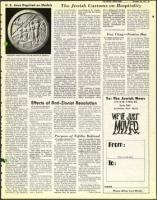
U. S. Jews Depicted on Medals
Medallion depicts first Jewish settlers in America.
The "Arrival of the 23" is
the subject of the first
medal of a series, of 120
medals of The Medallic His-
tory of the Jews_ of America
now being produced by The
Judaic Heritage Society.
Particularly timely for
the nation's Bicentennial,
the first medal of the group
shows the first Jewish set-
tlers in America — .23 refu
gees from Brazil — arriving
in New Amsterdam . in Sep-
tember 1654. AlthOugh a
sprinkling of individual
Jewish settlers had reached
the continent earlier, this
marked the beginning of
organized Jewish life in Co-
lonial America.
In the years to follow,
American Jewry was to con-
tribute a great deal to the
growth of the nation, far be-
yond the significance of its
modest numbers.
The' Medallic History of
the Jews of America marks
the milestone of the first
synagogue designed and
built in Continental North
America which was conse-
crated on April 8, 1730.
Eighteenth Century Jew-
ish life, as portrayed in sev-
eral medals, shows the
Jews' prominence in the
commercial world. Medals
depicting Francis Salvador
(the first Jew to die' in the
Revolution), Aaron Lopez (a
successful merchant and
important Revolutionary
leader), and Haym Salomon
(the "broker of the Revolu-
tion") honor the important
contributions made by Jew-
ish Americans to the fight
for independence.
Many outstanding Jewish
citizens in America after
the U.S. became a nation
are also commemorated
with medals. These include;
• ong others, Ernestine
•se (1810-1892), an early
fighter for women's rights;
photographer
Solomon
Nunes Carvalho (1815-1897),
perhaps the second Jew to
cross the Rockies; Joseph
Seligman (1819-1880), lead-
ing international banker;
Emma Lazarus (1849-1887),
author of the famous sonnet
inscribed on the Statue of
Liberty; and Louis Dembitz
Brandeis (1856-1941), the
first Jew to be appoirited to
the U.S. Supreme Court.
The list of memorable
persons, places and events
featured in The Medallic
History of the Jews of
America totals 120. The se-
ries is scheduled for comple-
tion on America's 200th
birthday.
The originator of the his-
tory and its design concepts
was Robert Weber, presi-
dent of The Judaic Heritage
Society. Sculptor for the
entire series is Karen
Worth. The literature ac-
companying each medal of
the series was written by
Fred Bertram.
For information about
the complete Medallic His-
tory of the Jews of America,
write: The Judaic Heritage
Society, Suite 4011, 866
United Nations Plaza, New
York, N.Y. 10017.
The Jewish Customs on Hospitalit
In ancient Israel hospital-
ity was not merely a ques-
tion of good manners, but, a
moral institution which
grew out of the harsh desert
and nomadic existence - led
by the people of Israel. The
biblical customs of welcom-
ing the weary traveler and
of receiving the stranger in
one's midst was the matrix
out of which hospitality and
all its tributary aspects de-
veloped into a highly es-
teemed virtue in Jewish
tradition.
Biblical law specifically
, sanctified hospitality to-
ward the stranger who was
- to be made particularly wel-
come "for you were stran-
gers in a strange land" (Lev.
19:34 and Ex. 12:49)
According to the Encyclo-
paedia Judaica, -the Bible is
replete with examples of
`pious hospitality. The ex-
treme to which hospitality
was taken is shown by the
stories of Lot and the old
man of Gibeah who were
prepared to sacrifice the
-honor of- their daughters in
order to protect their
guests, who were to them
complete strangers (Gen:
19:4-8 and Judg. 19:23-24).
according to R. Judah,
than receiving the divine
presence.
The Midrash relates' that
even at the height of Nebu-
chadnezzar's siege of Jeru-
salem, mothers would d e-
prive their childr en of the
last crust i order to grant
hospi ality-to a mourner.
Children were taught to be'
hospitable by instructing
them to invite guests to dine
whjh they answered the
door.
On the other hand, the
rabbis denounced the paras-
itical guest, especially if he
were a scholar. Two ex-
tremes were avoided
through a- clear definition of
the duties of host and of
guest. The host was forbid-
den to make his guest un-
comfortable-either by ap-
pearing miserable or by
watching his guest too at-
tentively, or by neglecting to
serve his guest himself.
• The guest was instructed
to show gratitude to recite a
special blessing for his host,
to leave some food on the
plate, and to comply with
his host's wishes. Some six
centuries earlier, Ben Sira
(First Century CE) had al-
ready defined the table
manners which were to be
practiced by the guest, and
had condemned the parasite
who took advantage of hos-
pitality.
Rabbinic literature wid-
ened the scope of the virtue
of hospitality, which it
called "bring-in of
guests." One of the virtues
for which one enjoys the
fruits in this world and ob-
The tradition of hospi-
tains the principal reward tality was particularly
in the world to come, hos- apparent among Jewish
pitality is, according to R. communities in the Middle
Johanan, even more im- Ages and a separate char-
portant than prayer or, - ibable association called
Hevra Hakhnasat Orehim
was established for that
purpose. MedieVal Euro-
pean Jewish c6mmunities
instituted a system of plet-
ten or "meal tickets" for
travelers and itinerant
scholars, and in the 15th
Century, established stu-
dent hostels.
Nor was individual hospi-
Isru Chag
By RABBI SAMUEL FOX
(Copyright 1975, JTA, Inc.)
The day after a festival is
still regarded as a festive
day. It is usually called
"Isru Chag," which is taken
from the Psalms (118:27)
where we are told to "bind
the festive sacrifice with
cords."
The term "Isru Chag"
would mean to bind the day
of the festival to the day
after so -that it would not be
quickly forgotten. In the
Jerusalem Talmud this day
is also called "Breh
D'inoeda," which means
"The son of the festival."
This means that the day
after the festival still bears--
fruit of the joy of the festi-
val.
It -is claimed by some that
the reason for this extra day
of rejoicing stems from the
fact that in Israel the festi-
val of Shavuot lasts only one
day. In the days of the Tem-
ple, when sacrifices were
offered, some of the sacrif-
r
(Copyright 1975, JTA, Inc.)
It is interesting to note
some of the effects of the
anti-Zionist resolution
passed by the United Na-
tions. "Oil" of 'them are not
exactly what the Arabs con-
templated.
First, there is the reaction
in Israel. David Flinker, an
Israeli newspaperman,
notes that in the past, there
has been something of a
strange coldness to the
Zionist movement itself.
There has even been a dis-
position there to'rnock at
the term Zionism.
All of this, Flinker states,
is now gone. Zionism, once
-an unpopular term has be-
come the favorite of the
—Jewish state.
But what about - the ef-
fects outside of Israel? A
suggestion by Robert
Moses throws a good deal
of light here.
Few New Yorkers are bet-
ter known both in the nation
as a whole and in New York
State itself than Robert
Moses. He was one of those
most closely associated with
Al Smith, the first Catholic
to be nominated for the
Presidency.
Moses was the Republican
nominee for Governor of
New York when Franklin D.
Roosevelt was the Demo-
cratic candidate. Moses'
chief claim to distinction is
in the domain of parks. He
has probably done more to
establish parks than any
man in America.
Robert Moses w.as born a
Jew, but I. cannot recall ever
having read of him identi-
fied with any Jewish cause.
Moses has now come for-
ward with the statement
that with the passage of
the anti-Zionist resolution
by the UN it should get out
of New York-and maybe
move to Geneva. , He says
the site of the UN could be
turned into a nice park.
It costs New York City
millions of dollars every
(Copyright 1975, JTA, Inc.)
."Tefilin," which are worn
by Jews during weekday
morning service prayers ar-
ound the head and the arm,
have a definite purpose.
Technically, this is the'
The tefilin serve as a re-
fulfillment of the biblical
comNiandment which' says minder to man not to allow
"And you shall bind them the stray ideas of his mind
for a sign. up.pn your hand to gain control and to misdi-
. . . And they shall be for rect his intentions. This is
frontlets between your eyes accomplished by. the tefilin
on the head.
(Deuteronomy 6:8).
The tefilin an the arm
Various commentaries_
have introduced a number teach man to control his ac-
of reasons for this com- tions so as not to do the re-
mandment. Abrabanel and grettable things that would
others claim that wearing bring him into conflict with
the tefilin on the head is a his Creator.
The tefilin try to direct
symbol of the requirement
that our thoughts and intel- him into the affirmlative and
lectual activity be dedicated constructive activities.
to God. Wearing the tefilin
on the arm is a symbol of • The knowledge of Hebrew
the requirement that our is the golden hinge upon
deeds be dedicated to God. which our national and reli-
The Sefer Ha-Chinuch gious existence turns.
—Sabato Morais
explains that, by nature,
ices were eveidently offered
also on the day after Sha-
vuot. Consequently, this day
was also regarded as a fes-
tive one and this practice
was also extended to other
holidays.
Furthermore, on other
holidays the meat of cer-
tain sacrifices could be
eaten for two, days. This
meant that the meat of a
sacrifice that was-offered
on the last day of a festival
could still be eaten on the
day after the festival.
Thus, the day after the fes-
tival still has some festive
connotation.
Generally speaking, in
Hebrew tradition, festivals
are not supposed to be
merely isolated experiences.
The spirit of the festival
should have some influence
on the other days of the
year. Observing, an addi-
tional day - in a festive mood
would indicate the carry-
over from the holy days to
the secular days of the year.
Suite 865
year to guard the UN and its
personnel. This not only
means a loss of money to
the city but has its effects in
increasing crime.
The suggestibn of Moses
that the UN be moved to Ge-
neva seems .logical..Geneva
was the headquarters oi the
old League of Nations. The
trouble with the League of
Nations was that it wasn't
really a League of Nations
— it was a League of some
of the nations.
man is composed of mate-
rial flesh and bloods This
leads him into many emo-
tions of passion andidesite.
On the other hand, man
has a heavenly soul which
seeks to deter him from
fulfilling those passions.
Festive Day
17515 W. 9 Mile Rd.
Southfield, Mich. 48075
WEI AST
9Y
Purpose of Tefilin Defined
BY RABBI SAMUEL FOX
tality neglected; among Pol
ish communities, it was also
the custom to billet students
with members of the com-
munity for - their daily
meals. This custom, known
as essen-teg, later spread to
Germany. In modern times,
charitable institutions have
assumed most of the re-
sponsibility of communal
hospitality..
ToI The Jewish News
Effects of Anti-Zionist Resolution
BY DAVID SCHWARTZ
December 26, 1975 43
From
Paste in old label
NAME
Please Allow Two Weeks
1
0